>>
Technology>>
Artificial intelligence>>
What Are AI Agents and How Do ...What Are AI Agents and How Do They Work? The Silicon Review's Complete 2026 Guide
The Silicon Review
14 August, 2026
Author:
Sashindra Suresh
Why Everyone Is Talking About AI Agents in 2026?
If you've been following AI trends, you've noticed a shift. The conversation has moved from chatbots and content generation to something more ambitious: AI agents. Unlike earlier AI tools that relied heavily on human prompts and oversight, AI agents are designed to pursue goals, make decisions, and act on behalf of users. This shift is reshaping how we think about automation, and in 2026, it's dominating conversations across every industry from cloud infrastructure and business operations to education and workforce development.
So, what exactly are AI agents? How do they work? And why does every business leader need to understand them? This is The Silicon Review's complete 2026 guide to answering those questions.
What is AI Agent?
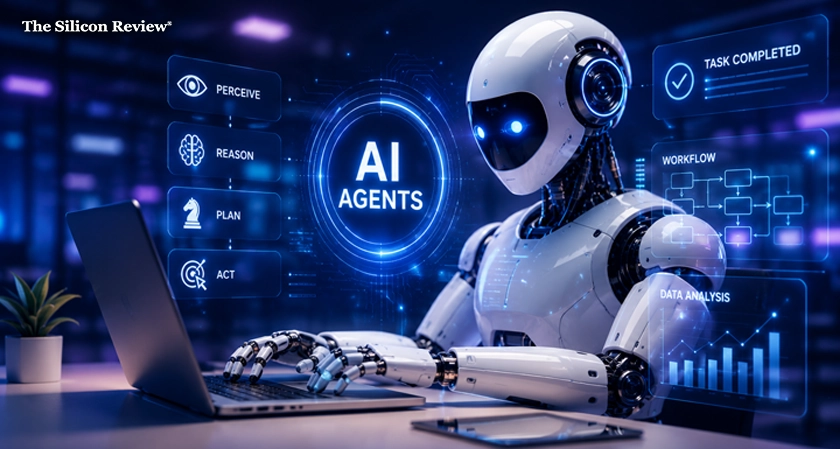
An AI agent is an autonomous software system that can observe its environment, reason about what it sees, plan next steps, and act to achieve defined goals with minimal human intervention. Think of it as a digital teammate that thinks, learns, and acts independently.
Unlike traditional software that follows rigid scripts, AI agents operate based on trained models and can adapt their approach to reach goals without needing explicit, step-by-step programming for every scenario. The key distinction is action agentic AI takes actions in the world, whether physical actions like robotic manipulation or digital actions like booking a flight or updating a customer record.
The core components of an AI agent include:
- Observation: Gathering information from the environment, such as user requests or system logs
- Reasoning: Using a Large Language Model (LLM) to analyze data and determine appropriate actions
- Planning: Mapping out sequences of actions to achieve a defined goal
- Action: Executing tasks using tools, APIs, and workflows
- Memory: Maintaining context over time and learning from past interactions
This ability to reason, plan, and act is what separates agents from traditional AI models and makes them especially powerful in real-world environments.
How Do AI Agents Work? The Architecture Explained
Building an AI agent comes down to five key decisions: define the goal, pick a framework, set up tool access, add memory, and put guardrails in place before deployment. Every agent starts with a fundamental generative AI system at its core. Companies then put different wrappers around that foundation model for their specific product or application. Those wrappers might include:
- Tools: The agent's ability to use calculators, APIs, databases, or operating systems
- Memory: Persistent storage of information across sessions, enabling the agent to maintain context and improve over time
- Guardrails: Safety measures and approval gates that prevent agents from taking irreversible actions without human oversight
According to a November 2025 report by MIT Sloan School of Management and Boston Consulting Group, 35 percent of surveyed businesses had already deployed AI agents, while another 44 percent planned to implement agentic AI soon. This rapid adoption is driven by the fact that agents can continuously observe, reason, and refine their actions, enabling advanced use cases such as workflow automation, analytics, and intelligent assistance across applications.
What are the Types of AI Agents? A Comprehensive Overview
AI agents vary widely in complexity, and understanding the different types is key to knowing when and how to use them. Here are the main types, from simplest to most advanced.
Simple Reflex Agents respond to current input using fixed if-this-then-that rules without storing memory or reasoning about past interactions. They're fast, predictable, and well-suited for high-volume, repeatable tasks where the right response is always the same—like a lead qualifier that instantly sorts high-priority prospects.
Model-Based Reflex Agents maintain an internal "picture" of their environment to handle partial observations and understand how actions affect the world. Unlike simple reflex agents, they factor in relevant context and recent history before acting. An email monitor that automatically reassigns contacts to a re-engagement list based on past open rates is one example.
Goal-Based Agents work backward from a specific, predefined goal, using planning and reasoning to map out a sequence of actions to get there. Think of them like a GPS: give it a destination, and it figures out the route. These agents are ideal for multi-step tasks with a clear objective, such as a scheduler that accounts for time zones and conflicts before sending meeting invitations.
Utility-Based Agents go further by assigning a real-valued score to possible outcomes and selecting the action with the highest expected utility. Where a goal-based agent asks "Did I reach the goal?", a utility-based agent asks "How well did I reach it, and at what cost?" These agents excel at dynamic decision-making with competing priorities, such as a lead generation agent that scores prospects based on likelihood to convert or revenue potential.
Learning Agents are the most advanced type. They continuously refine their internal models and decision-making by adapting their behavior through real-world experience and feedback. Autonomous vehicles that learn from traffic patterns to improve safety are one example. These agents improve over time, making them increasingly valuable for complex, ongoing tasks.
Multi-Agent Systems decompose complex tasks across specialized agents that operate in parallel, with an orchestration layer coordinating them. Instead of one agent doing everything, multiple agents each handle specific roles one querying a warehouse for data, another checking log, and a third investigating schema changes while a lead agent synthesizes findings into a root cause hypothesis. This approach is powerful for cross-functional work that requires parallelism and specialization.
AI Agents vs. Chatbots vs. Copilots: What's the Difference?
Understanding where AI agents fit in the broader AI landscape is essential. Here's how they compare to other AI tools:
|
Dimension |
Chatbot (L1) |
Copilot (L2) |
AI Agent (L3) |
|
Definition |
Answers questions in text |
Suggests actions for human approval |
Executes multi-step tasks independently |
|
Actions |
None text output only |
Proposes actions (human decides) |
Executes actions via tools and APIs |
|
Tool access |
None |
Limited (IDE, document editor) |
Broad (APIs, databases, web, files) |
|
Memory |
Session only (resets each chat) |
Session + limited project context |
Persistent across sessions |
|
Autonomy |
Zero, purely reactive |
Low, human approves every action |
High, executes within defined guardrails |
|
Best for |
FAQ, simple Q&A, information lookup |
Code completion, writing assistance |
Workflow automation, lead qualification, research |
The right question is not "which level is best?" but "which level does this specific task require?" A task like answering customer questions about business hours needs a chatbot. Drafting code needs a copilot. Researching 200 companies and scoring them by 15 criteria needs an agent. For building a complete application from a requirements document, an autonomous system is the right fit.
Real-World Examples of AI Agents in Action
AI agents are already being deployed across industries with measurable results. Here are a few examples:
- Intercom Finn resolves approximately 70% of support tickets autonomously, running about 25 subsystems with an actor-critic hallucination layer to close tickets end-to-end
- Taskade AI Agents execute workflows with 34 tools and persistent memory, autonomously completing multi-step tasks within guardrails
- Devin (Cognition) writes, tests, and debugs code autonomously, planning and executing full coding tasks without step-by-step approval
- AI SDR platforms (like 11x and Artisan) qualify leads, draft outreach emails, and schedule meetings without requiring per-action approval
In practical business applications, AI agents are automating complex workflows, improving decision-making, and reducing manual work all while scaling easily to enterprise levels.
Challenges and Risks of AI Agents
While AI agents offer tremendous potential, they also introduce real operational risks. The most common challenges include:
- Reliability and Hallucination: An agent can act confidently on a wrong conclusion, and because it's executing rather than just suggesting, a bad decision can propagate quickly
- Data and System Integration: Agents need clean, structured access to the systems they act on; legacy tools with inconsistent data often don't connect without significant rework
- Security and Identity Risk: An agent with broad system access becomes a new identity to secure, and a compromised agent can move across connected tools faster than a human attacker would
- Accountability Gaps: When an agent makes a decision with real consequences, it's not always clear who's responsible if something goes wrong
- Cost Creep at Scale: A pilot handling 100 requests a day behaves very differently at 10,000; token costs, error rates, and edge cases all grow with volume
Gartner predicts over 40% of agentic AI projects will be canceled by the end of 2027 due to escalating costs, unclear business value, or inadequate risk controls. The key to success is giving agents the right scope: an agent given too broad a goal tends to create more problems than it solves.
The Future of AI Agents
AI agents represent the next major interface between humans, data, and systems. As the technology matures, we can expect:
- Greater autonomy with stronger governance: Agents will become more capable of making decisions independently, while organizations increase human oversight and approval controls
- Multi-agent collaboration: Networks of specialized AI agents coordinating with one another to complete complex, cross-functional workflows
- More natural interactions: Advances in natural language understanding and memory will enable agents to maintain context across conversations and deliver more personalized interactions
- Hybrid architectures: Combining autonomous reasoning with predefined workflows, business rules, and human approvals to balance flexibility and reliability
For businesses, the implication is clear. The architecture surrounding the model may now matter as much as the intelligence of the model itself. Organizations that embrace AI agents strategically will transform how work is done, how customers experience service, and how business strategies are executed.
Conclusion
AI agents represent the most significant evolution in artificial intelligence since the launch of generative AI. They transform AI from a reactive tool into an autonomous partner that can observe, reason, plan, and act independently. Understanding what AI agents are and how they work is no longer optional for business leaders. As Gartner predicts, 40% of enterprise applications will include task-specific AI agents by 2026. The question isn't whether your organization will adopt them it's when and how you'll implement them strategically.
The Silicon Review ranked the world's No.1 digital magazine of the year 2026 will continue to track and analyze these transformative technologies. Whether you're a business leader, a developer, or simply curious about the future of AI, this is your essential guide. Stop waiting. Start understanding. Because AI agents aren't coming. They're already here.
Frequently Asked Questions (FAQs)
- What are AI agents and how do they work?
A. AI agents are autonomous software systems that observe their environment, reason about what they see, plan next steps, and act to achieve defined goals with minimal human intervention. - How are AI agents different from chatbots?
A. Chatbots answer questions with text output only, while AI agents execute tasks independently using tools, APIs, and workflows with persistent memory and high autonomy. - What are the types of AI agents?
A. Simple reflex agents (if-then rules), model-based reflex agents (internal environment mapping), goal-based agents (planning toward objectives), utility-based agents (optimizing outcomes), learning agents (improving over time), and multi-agent systems (coordinated specialization). - What is agentic AI in simple terms?
A. Agentic AI is AI that takes actions in the world whether physical actions like robotic manipulation or digital actions like booking a flight or updating a record. - What companies are building AI agents?
A. OpenAI (Assistants API, Operator), Microsoft (Azure AI Agent Service, Copilot Studio), Anthropic (Claude Code), Taskade (AI Agents), and Devin by Cognition are key players. - What is the difference between a copilot and an AI agent?
A. A copilot suggests actions for human approval, while an AI agent executes multi-step tasks independently without requiring step-by-step human approval. - Are AI agents safe?
A. AI agents introduce risks including reliability, security, accountability, and cost creep. Organizations mitigate these through guardrails, human approval gates, and governance frameworks.




















Comments