>>
Industry>>
Startups>>
What It Costs to Start a Laser...What It Costs to Start a Laser Engraving Business
The Silicon Review
17 August, 2026
Author:
The Silicon Review Team
Laser engraving has become one of the more accessible routes into small-scale manufacturing. The equipment has fallen in price, the software has matured, and demand for personalized and custom-marked goods has grown steadily. That combination has drawn a large number of entrants, from side-hustle makers to established firms adding production capability in-house.
It has also produced a great deal of unreliable guidance. Most published cost estimates come from equipment vendors, and they tend to emphasize the low end of the range while treating recurring costs as an afterthought. For anyone evaluating this as a business rather than a hobby, the useful analysis separates one-time capital outlay from ongoing operating cost, and then examines where margin is actually made and lost.
The Capital Costs
Startup investment falls into several distinct buckets, and the machine is only the largest of them, not the only one that matters.
The Machine
Equipment is the dominant line item, and the range is wide because the category spans very different classes of tool. Entry-level diode units sit at the bottom and are best understood as hobby equipment: limited power, limited material range, and throughput too low for commercial volume.
Desktop CO2 systems occupy the middle and handle wood, acrylic, leather, and similar non-metals at a workable speed. Larger commercial laser engraving machines with bigger beds, higher wattage, and RF-excited tubes cost considerably more but deliver the speed and duty cycle that production work requires. Fiber systems, which mark bare metal, are a separate category again. Pricing shifts frequently, so current figures should be confirmed directly with suppliers rather than taken from secondhand articles.
The relevant question is not which machine is cheapest but which produces sellable output fast enough to cover its own cost. A unit that takes four times as long per piece has effectively quadrupled the labor content of every order.
Ventilation and Extraction
This is the most commonly underestimated cost. Laser processing produces smoke and fumes that must be exhausted outdoors or passed through a filtration unit. Filtered extraction systems are not cheap, and replacement filters are a recurring expense. Skipping this is not an option in a commercial setting, both for operator safety and for compliance with workplace and landlord requirements.
Software, Computing, and Workspace
Control software is a modest cost, often a one-time license. Design software may be a subscription or a free open-source alternative, depending on the workflow. Beyond that, budget for a suitable computer, adequate electrical supply, a ventilated and appropriately sized workspace, and basic fire safety equipment. None of these are large individually, but together they routinely add a meaningful amount to an initial estimate built around the machine alone.
Business Setup and Initial Inventory
Entity registration, liability insurance, a website, branding, and an opening stock of materials complete the picture. Insurance in particular is often omitted from published estimates despite being a practical necessity for any operation taking commercial orders.
The Recurring Costs That Determine Viability
Capital outlay is a one-time hurdle. Operating cost is what decides whether the business sustains itself.
Consumables and maintenance are ongoing: lenses and mirrors degrade and require cleaning and periodic replacement, and laser tubes have a finite service life measured in operating hours. Glass CO2 tubes are inexpensive to replace but wear out faster; RF-excited metal tubes cost more upfront and last considerably longer. Either way, tube replacement is a scheduled cost, not an unexpected one, and should be amortized into pricing from the start.
Add to that electricity, extraction filters, packaging and shipping, payment processing fees, and marketplace commissions if selling through third-party platforms. Marketplace fees in particular can consume a significant share of the gross margin on low-priced personalized items.
Where the Margin Actually Comes From
The appeal of this business is that raw material cost is genuinely low relative to selling price. A blank tumbler, a sheet of plywood, or a piece of acrylic costs a fraction of what the finished, personalized item sells for. On paper, that produces attractive gross margins.
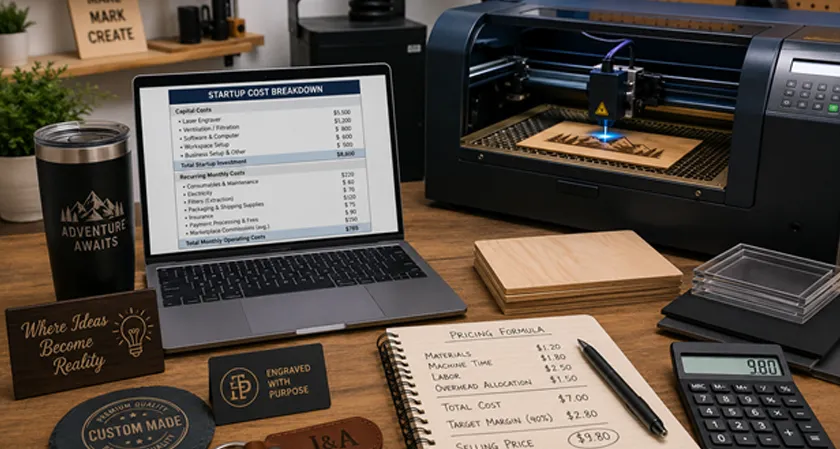
The complication is that material is rarely the binding constraint. Time is. Every order carries setup, file preparation, machine run time, finishing, packaging, and customer communication. Businesses that fail in this category almost always do so by pricing against material cost while ignoring labor and machine time. A defensible price accounts for materials, machine time, labor, overhead allocation, and target margin, in that order.
This is why throughput has an outsized effect on profitability. Machine speed does not change the price a customer will pay, but it changes how many units can be produced per hour, which changes the labor cost embedded in each one. Faster equipment is often the difference between a viable margin and an unprofitable one at the same selling price.
Choosing a Revenue Model
Three broad models dominate, and they have materially different economics.
Direct-to-consumer personalized goods offer the highest per-unit margin but the highest customer acquisition cost, significant seasonality weighted toward the fourth quarter, and heavy competition on established marketplaces. Business-to-business and corporate work, including branded merchandise, awards, and signage, carries lower per-unit prices but larger order volumes, predictable repeat business, and far lower acquisition cost per dollar of revenue. Industrial marking and subcontract work, such as part identification and traceability marking, is the most stable of the three and the least seasonal, though it requires meeting client specifications and often demands fiber capability.
Most operators who scale successfully migrate from the first model toward the second or third, because repeat commercial orders solve the volume problem that consumer sales rarely do on their own.
The Realistic Assessment
Laser engraving is a legitimate small-manufacturing business with genuinely low material costs and real demand. It is not the near-passive, high-margin venture that vendor marketing frequently implies. Profitability depends on three decisions made early: buying equipment with sufficient throughput for the intended volume, pricing against total cost rather than material cost, and choosing a customer segment whose acquisition economics work.
Anyone building a plan should model recurring costs alongside the initial outlay, calculate a break-even volume against fixed monthly costs, and validate demand in a chosen niche before committing to capital. The businesses that endure in this sector are those that treated it as a manufacturing operation from the outset rather than a creative hobby with an invoice attached.




















Comments