>>
Other>>
Politics>>
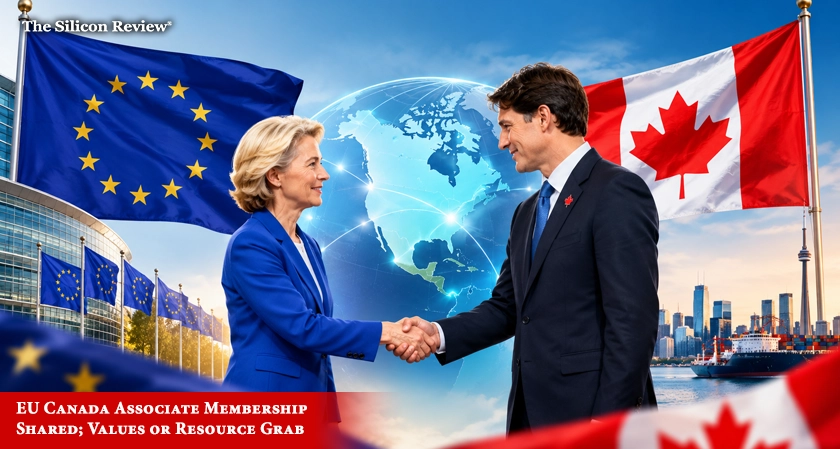
Why the EU has offered Canada ...Why the EU has offered Canada to be an Associate Member? Is it just "shared democratic values" or "using" Canada to secure its geopolitical and economic future?
The Silicon Review
17 September, 2026
Author:
Sashindra Suresh
When European Commission President Ursula von der Leyen officially invited Canada to become the European Union's first-ever associate member, what was the first question that came to your mind? Why now? And why Canada? They spoke warmly of a "community of values" and "shared democratic values." The diplomatic rhetoric was flawless, as always. But behind the polite smiles in Strasbourg, a much colder reality might be unfolding beneath the surface, because it’s a basic universal thought in politics,”There is always a layer hidden beneath the surface in political decisions”. The historic offer arrived exactly as Canada's trade talks with the U.S. completely collapsed under President Donald Trump provoking a North American trade war that is very active right now.
Think about it from The Silicon Review's perspective.
Europe is facing an existential bottleneck, which means it is dependent on rivals;
- Europe has the advanced factories but almost none of the raw materials. Europe is extremely reliant on critical minerals where china has used export controls on this using this situation.
- Europe's defense is highly complex because Out of the 29 nations that make up the Schengen Area, 27 countries maintain their own independent militaries and establish their own defense rules, so lack of unity makes it almost impossible to manufacture mass weapons quickly, considering the current war and the situation, Europe’s physical security is under threat from very long time but now might get even more worse.
- As the whole world is aware that the U.S. has imposed heavy tariffs on international imports and at the same time, Chinese deflation has caused an influx of cheap, subsidized goods to flood the European market, It is squeezed between an unpredictable, tariff-heavy United States on one side and a resource-dominating China on the other.
To survive, Brussels desperately needs protection from supply chain collapse and military exhaustion. But this isn't just defensive panic. It's an aggressive chess move in the EU's long-term play to establish itself as a dominant global superpower.
Canada's geographical location is one main reason. And currently Canada is running to find shelter under any roof it can escape from Washington's brutal tariffs. Meanwhile, Europe may have seen an opportunity. It officially invited Canada to be an associate member. Canada thinks in this current situation it is getting an escape route,
Why this escape route is very important to Canada right now?
If it didn’t find an escape route its whole economy will shut down,
- Canada for decades has sold everything to America, now with the trumps 50% tariff on all the billion dollar worth goods it is currently trapped in 60-70% of its total exports because Canada cannot find buyers overnight.
- If America keeps a permanent 50% tariff wall on Canadian products, Canadian businesses become too expensive to buy. Factories will shut down, mass layoffs will happen across the provinces, and consumer prices inside Canada will skyrocket.
- To survive the tariffs, Canadian manufacturers and tech companies will pack up and move to America, that’s the ultimate plan of president trump, there is a direct connection for President Trump repeatedly calling Canada the "51st state" and mocking the prime minister of Canada as a “Governor” of an American territory.
- Canada sits on a goldmine: vast, untapped reserves of critical minerals (lithium, cobalt, nickel) and massive Arctic trade routes. Without an international shield, Canada will eventually be bullied by the U.S. into handing over exclusive control of these resources for pennies on the dollar.
So Calculating all these European Union has come up with this MASTER PLAN. It isn't a charity invitation. It's a survival swap.
Now we understood the context, so the real question is: Is this new EU-Canada associate membership a mutual rescue mission, or is the EU calculatingly using Canada to safeguard its own slipping geopolitical and economic future?
To find the truth, we have to look past the talking points and follow the resources researched by The Silicon Review.
- The Resource Grab: Securing the Critical Minerals Pipeline
The European Union's ambitious green and digital transitions are hitting a massive wall: Europe doesn't have the raw materials it needs. For decades, the continent has been dependent on China for critical minerals, which are required to build electric vehicles, microchips, and AI infrastructure. By offering Canada an economic partnership, Brussels isn't being generous. It's locking down a VIP pipeline to Canada's vast, untapped mineral wealth.
Why Canada Is the Ultimate Prize
- The Chinese Alternative: Canada offers a politically stable, highly regulated alternative to Chinese supply chains.
- Regulatory Alignment: Under a deep associate status, the EU can integrate its strict environmental rules directly with Canadian mining sites ensuring a seamless flow of "clean" minerals straight into European factories, without hassle.
- Outsourcing the Military-Industrial Complex
With the continuous threat of Russia on its eastern side, Europe’s domestic arms manufacturing capabilities are stretched to their absolute breaking point. Building new military factories on European soil takes years and invites direct security vulnerabilities, because of their lack of unity among these 27 Schengen nations mentioned above.
Enter the broader EU Canada partnership. Canada recently became the first non-European country to join the EU’s €150-billion SAFE defense program. Through this defense integration, the EU effectively outsources its manufacturing burdens. It gets to leverage Canadian engineering, aerospace infrastructure, and industrial capacity to build European defense tech completely insulated from the immediate reach of European conflict zones.
- The Comparison: Why Canada Fits the Blueprint
To understand why the EU is custom-building this "associate" tier specifically for Canada, it is crucial to analyze how Canada European Union relations compare to the EU’s strategy with other global middle powers.
|
Global Middle Power |
Current Trade Strategy |
Why They Don't Fit the "Associate" Blueprint |
|
Canada |
Actively seeking an economic divorce from Washington. |
The Perfect Proxy: Gives the EU massive resource access and an Atlantic footprint without diluting EU voting sovereignty. |
|
United Kingdom |
Managing complex post-Brexit trade friction through piecemeal, case-by-case bilateral agreements. |
Too Heavy politically: Offering London a special "associate" tier would spark a furious domestic political nightmare over rewriting Brexit rules. |
|
Japan |
Balancing delicate trade frictions while anchoring its security within the Indo-Pacific framework. |
The Security Bind: Japan is entirely dependent on the U.S. nuclear umbrella; it cannot pivot heavily to Europe without compromising its core defense. |
|
Australia |
Hedging via alliances like AUKUS while actively managing severe, long-term trade disputes with China. |
Too Far Gone: Australia is already locked into intelligence and AUKUS hardware networks that prioritize U.S. and UK industrial alignment over continental Europe. |
- The news is between Europe and Canada; Why the U.S. Is Intervening
The United States is not watching this transatlantic courtship from the sidelines. Washington has viewed Canada's pivot toward Brussels as an existential threat to its continental hegemony, with political rhetoric from the White House escalating to aggressive threats of absorbing Canada as a "51st state." But why does the U.S. care so much when it is already fighting separate trade wars with Japan, China, and the EU itself?
- Stripping Trump's Leverage: Donald Trump’s "America First" agenda depends heavily on using Canada's 70% export reliance as economic leverage. By building a structural backdoor to the EU market, Canada effectively disarms Washington's sharpest negotiating weapon.
- A Superpower on the Border: A standard market-access trade war with a distant country is one thing. But by pulling Canada into its regulatory orbit, the EU is effectively planting its flag right on America's northern border. The U.S. views this not as a mere trade dispute, but as a structural betrayal of the North American economic block.
What if Canada accepts to be the associate member of the European Union?
If Prime Minister Mark Carney and Canadian officials sign the deal, their internal calculation would be a cold, calculated survival play.
- The Resource Leverage Play: Under the surface, Canada’s leadership knows they sit on a global goldmine of critical minerals and Arctic territory. Accepting the offer is a move to use these assets as a massive bargaining chip. By locking them into European defense and tech frameworks, Canada creates an international line of defense that Washington cannot easily cross.
- Escaping Subordination: The primary thought in Canada is that negotiating one-on-one with a dominant neighbor like Donald Trump leads to submission. By gaining a footprint inside the world's largest regulatory superpower the EU, Canada instantly gains structural leverage. It transforms Canada from an isolated neighbor into the Western hemisphere's anchor for a global superpower bloc.
- The Calculated Risk: They are fully aware they won't have a vote in Brussels. But the internal consensus is clear: being a "voiceless partner" to a cooperative European Union is infinitely better than being an economically colonized "51st state" under Washington.
What if Canada rejects to be the associate member of the European Union?
If Canada steps back and says "we are not there yet," it is not because they suddenly love Washington's tariffs. It is because the immediate, structural risks of walking away from North America are terrifying.
- Fear of Immediate Retaliation: The dominant thought behind a rejection is the fear of pushing Trump too far. If Canada formally ties its economy to Europe, Washington will view it as an act of open defiance right on its border. The U.S. could respond by completely tearing up remaining free-trade frameworks, creating a total economic blockade that would bankrupt Canadian provinces before European supply chains could even open. It might be safe to open the supply chain to Canada immediately after accepting the offer.
- Protecting National Autonomy: Under the surface, Canadian lawmakers are deeply protective of their own regulatory independence. Becoming an associate member means aligning with strict, heavy-handed EU laws and environmental mandates. Canada is deeply hesitant to trade Washington's erratic bullying for Brussels' rigid, bureaucratic handcuffs.
- Holding Out for a Better Deal: The final hidden layer is strategy. By hesitating, Canada signals to both Washington and Brussels that it will not be easily bought or used as a proxy shield. It gives Canada time to negotiate a custom, piecemeal alliance that protects its assets without surrendering its political identity to a distant European parliament.
Conclusion: A Voiceless Shield or True Sovereignty?
As detailed negotiations gear up for the upcoming Canada-EU summit in Montreal in late October, the true nature of this alliance will finally be hammered out. "Shared democratic values" make for excellent press releases, but geopolitics is driven by cold utility. The European Union has offered Canada a seat at the table because it desperately needs Canada’s minerals, defense infrastructure, and Arctic access to survive an increasingly hostile global landscape. The ultimate question remains for Prime Minister Mark Carney and Canadian lawmakers: Is navigating this new relationship a brilliant way to escape Washington’s heavy tariff, or is Canada simply trading an aggressive neighbor to become a voiceless, resource-rich shield for the European Union? Or Does Canada have any MASTER PLAN?
Frequently Asked Questions
- Will Canada become a member of the European Union?
- No, Canada is only negotiating a unique "associate member" status, meaning it will gain economic ties but will not have voting rights in Europe.
- Why did the EU offer Canada associate membership?
- The EU is facing an existential bottleneck and wants to secure Canada’s vast critical minerals and defense capacity to shield itself from China and a volatile U.S...
- Is Canada in a trade war with the United States?
- Yes, Canada and the U.S. are locked in an active trade war sparked by heavy U.S. tariffs and collapsed trade negotiations under Donald Trump.
- Why is Canada trying to escape U.S. tariffs?
- Canada relies on the U.S. for nearly 70% to 80% of its exports, making Washington’s brutal tariffs a total threat to the Canadian economy.
- What happens if Canada accepts the EU invitation?
- Canada gains a powerful transatlantic economic shield, but it risks intense retaliation from a Washington administration that views the move as defiance.




















Comments