>>
Industry>>
Supply chain management>>
How Smart Port Infrastructure ...How Smart Port Infrastructure Is Reshaping Demand for Specialized Lifting Equipment
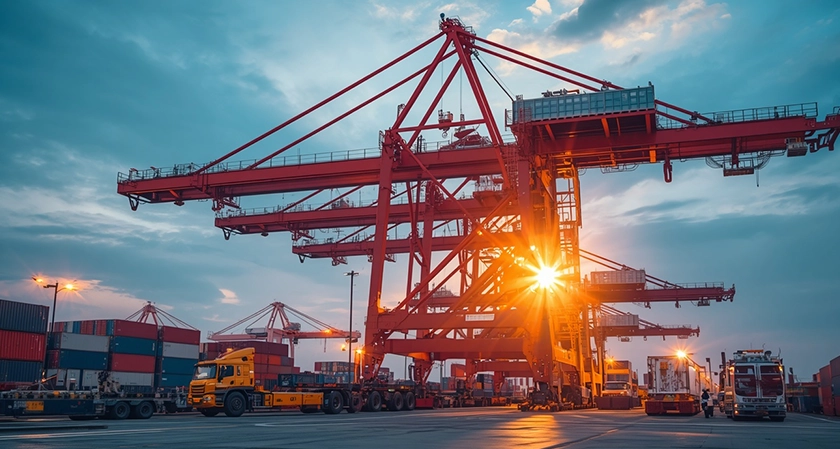
The global push toward port automation has moved far beyond pilot projects. In 2026, terminal operators across Southeast Asia, the Middle East, Europe, and Latin America are actively investing in intelligent cargo handling systems — and the crane equipment specification lists that accompany those investments look markedly different from what buyers were requesting five years ago.
At the center of this shift is a growing recognition that generic lifting equipment is no longer sufficient. Ports operating under pressure to maximize throughput, reduce dwell time, and meet international safety standards are seeking purpose-built systems engineered for the specific demands of container handling, marine operations, and bulk cargo movement.
The Automation Gap in Port Lifting Equipment
Port automation often captures attention at the software and logistics management level — automated gate systems, AI-powered yard planning, vessel scheduling platforms. Less visible but equally critical is the hardware layer: the cranes, hoists, and material handling systems that physically move cargo around the clock.
The transition to semi-automated and fully automated terminals places fundamentally different demands on lifting equipment. Anti-sway systems must be integrated at the hardware level, not retrofitted. Positioning accuracy requirements tighten considerably when human operators are removed from close proximity to containers. Load monitoring, remote diagnostics, and predictive maintenance compatibility are no longer optional features — they are procurement requirements at major terminal RFQ stages.
This creates a clear bifurcation in the market. General-purpose cranes built to broad specifications are increasingly displaced at major port and maritime projects by equipment designed from the ground up for specific applications: container stacking, ship-to-shore transfer, marine deck operations, and inland intermodal handling.
RTG and RMG Cranes: The Backbone of Containerized Port Yards
Rubber Tyred Gantry (RTG) and Rail Mounted Gantry (RMG) cranes represent the operational core of most modern container terminals. Their selection, configuration, and automation capability have an outsized influence on overall terminal throughput.
RTG cranes offer the flexibility advantage: they can be repositioned across yard lanes without fixed rail infrastructure, which suits terminals that need to reconfigure operations as trade patterns shift. Modern RTG specifications for automated terminals typically call for lifting capacities in the 40–65 ton range, stacking heights of five to seven containers, integrated anti-sway control, and compatibility with remote operating stations.
RMG cranes, running on fixed rail, offer higher precision and better energy recovery characteristics — advantages that matter when a terminal is handling thousands of container moves per day. Their fixed path also simplifies automation integration.
Haitai Crane, a Henan-based manufacturer exporting to over 170 countries, produces both RTG and RMG container gantry cranes certified under CCS, ABS, BV, and RINA classification standards — the certifications that matter when equipment is being procured for international port projects and requires approval from maritime classification bodies.
Ship-to-Shore and Marine Deck Equipment: A Distinct Engineering Challenge
Container terminal cranes get most of the attention in port automation discussions, but the marine side of port operations involves an equally demanding set of equipment requirements — ones that are frequently underestimated by procurement teams working from general crane supplier lists.
Ship deck cranes, marine arm cranes, and floating crane systems operate in corrosive saltwater environments, must meet classification society requirements, and are subject to vessel stability constraints that don't apply to land-based equipment. A crane specified for a commercial vessel or offshore platform must be designed to handle dynamic loading conditions, account for vessel motion, and maintain operability in conditions that would halt land-based operations.
The certification landscape reflects this complexity. Marine lifting equipment for commercial vessels and port installations typically requires class approval from bodies such as ABS (American Bureau of Shipping), BV (Bureau Veritas), RINA, or the China Classification Society (CCS). Procurement teams sourcing this equipment from manufacturers without verified marine certification experience carry significant delivery and compliance risk.
Specialized manufacturers in this space — those with documented histories of delivering certified marine deck cranes, ship-to-shore systems, and floating cranes to commercial and offshore clients — represent a distinct tier from general industrial crane producers.
Straddle Carriers and Intermodal Handling: The Last Yard Mile
Beyond the quayside and stacking yard, intermodal terminals face a distinct set of lifting and handling challenges. Straddle carriers — self-propelled, straddle-type vehicles capable of lifting and transporting containers — occupy a critical role in ports that need flexible, lane-independent container movement.
The case for hydraulic straddle carriers in port and intermodal settings is particularly strong at terminals handling varied cargo types, irregular vessel calls, or multi-modal connections between ship, rail, and road. Unlike fixed crane systems, straddle carriers can adapt to changing yard layouts and absorb volume variability without infrastructure reconfiguration.
Recent export projects — including straddle carrier deliveries to Valparaíso Port in Chile and RTG crane installations across the Middle East and Central Asia — illustrate the growing international reach of Chinese maritime equipment manufacturers serving port modernization programs in emerging markets.
What Terminal Operators Should Look for in 2026
The experience of ports that have navigated automation upgrades successfully points to several consistent lessons for equipment procurement:
Certification first, price second. Maritime and port lifting equipment without verifiable classification society certification creates downstream liability that typically costs far more than the savings from uncertified alternatives. For marine applications specifically, ABS, BV, RINA, or CCS certification is non-negotiable.
Application-specific selection. RTG cranes, RMG cranes, ship deck cranes, and straddle carriers are distinct product categories with distinct engineering requirements. Suppliers with genuine depth in specific application segments outperform generalists on both delivery quality and post-commissioning support.
After-sales capability at distance. Port operations run 24/7. Equipment downtime has a direct, calculable cost. Manufacturers with multilingual technical support teams, global spare parts logistics, and documented histories of supporting exported equipment in-country are a meaningfully lower operational risk than those without.
Automation readiness. Even terminals not yet planning full automation should specify equipment with integration-ready control architectures. Retrofitting automation capability onto cranes not designed for it is significantly more expensive than procuring automation-ready hardware from the outset.
The Broader Supply Chain Implication
Port lifting equipment sits at the intersection of global trade infrastructure and industrial automation — two of the most significant capital investment themes of the current decade. As terminal operators balance throughput pressure, labor cost dynamics, and the requirements of increasingly large vessel classes, the lifting equipment layer of port infrastructure will continue to receive sustained procurement attention.
For buyers navigating that market, the practical takeaway is straightforward: the manufacturers most worth evaluating are those that combine genuine application engineering depth, verified international certifications, and a documented track record of delivering to port and maritime clients across multiple markets.












Comments