>>
Industry>>
Construction>>
Supreme Court Allows Trump to ...Supreme Court Allows Trump to Move Forward with $400 Million White House Ballroom Construction
The Silicon Review
01 September, 2026
Author:
Guest
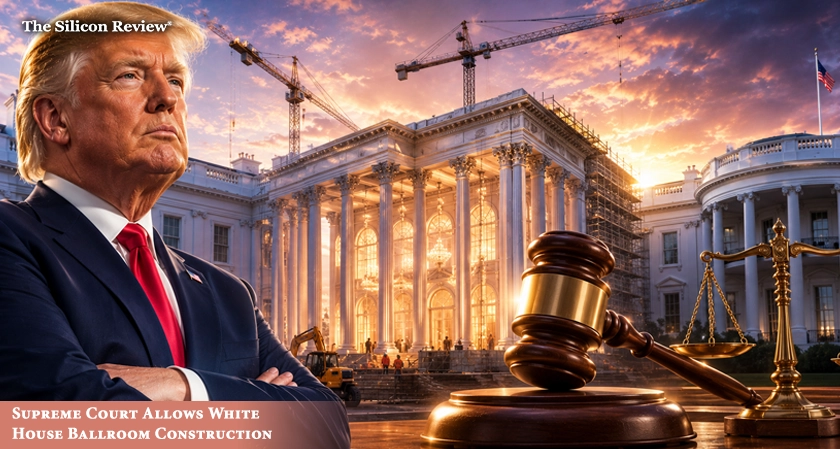
The Supreme Court has ruled 5-4 to allow the Trump administration to continue construction of a $400 million ballroom at the White House, overturning lower court orders that had halted above-ground work.
The Supreme Court has cleared the way for the Trump administration to proceed with the construction of a $400 million ballroom at the White House, ruling 5-4 to overturn lower court orders that had halted above-ground work on the project. The majority found that the preservation group challenging the project likely lacked legal standing to sue.
"The preservation group challenging the project likely lacks legal standing to sue," the majority opinion stated.
Chief Justice John Roberts dissented, calling the project "likely unlawful" without congressional approval.
The Project and Legal Challenge
The $400 million ballroom project has been a contentious issue, with opponents arguing that the administration bypassed required congressional approval and historical preservation reviews. Lower courts had previously halted above-ground construction, but the Supreme Court's ruling now allows the administration to proceed.
"The project is likely unlawful without congressional approval," Roberts wrote in his dissent.
The ruling is a significant victory for the Trump administration, which has made the ballroom project a priority as part of its broader efforts to renovate and expand the White House complex.
Here is the question this ruling raises. The Supreme Court has allowed the Trump administration to proceed with a $400 million White House ballroom project, despite the Chief Justice's dissent that it is "likely unlawful" without congressional approval. When the highest court in the land splits 5-4 on a project's legality, does this ruling settle the matter or simply set the stage for further legal challenges?
FAQ:
Q: What did the Supreme Court rule on the White House ballroom project?
A: The Supreme Court ruled 5-4 to allow the Trump administration to continue construction of the $400 million ballroom, overturning lower court orders that had halted above-ground work.
Q: Why did the Supreme Court allow the White House ballroom project to proceed?
A: The majority found that the preservation group challenging the project likely lacked legal standing to sue.
Q: What was Chief Justice John Roberts' position on the White House ballroom project?
A: Chief Justice Roberts dissented, calling the project "likely unlawful" without congressional approval.
Q: Who challenged the White House ballroom project?
A: A preservation group challenged the project, arguing that the administration bypassed required congressional approval and historical preservation reviews.
Q: What is the cost of the White House ballroom project?
A: The project is estimated to cost $400 million.




















Comments