>>
Industry>>
Healthcare>>
The Role of Technology in Mode...The Role of Technology in Modern Hospital Diagnostics
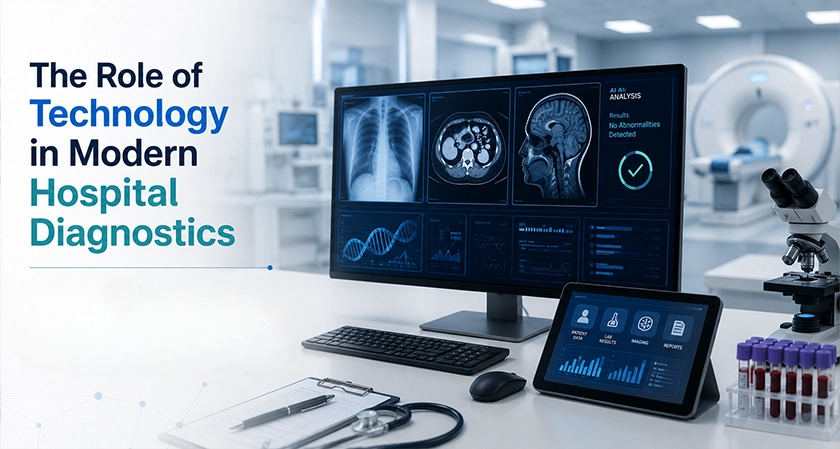
Many hospitals have come to rely on slow, outdated technologies, systems, and processes, often due to financial constraints, resistance to change, or fear of workflow disruption.
Yet, rapid advancements in healthcare technologies are encouraging many hospitals to embrace forward-thinking software and equipment.
Fortunately, various solutions can support modern hospital diagnostics, leading to simplified workflows, greater clinical accuracy, and early disease detection. Learn more about the role of technology in modern hospital diagnostics right here.
Advanced Medical Imaging
Advanced medical imaging is making it easier for healthcare professionals to detect medical issues and diseases early. This is leading to speedier results and better patient outcomes.
High-Resolution Scans
Many hospitals are investing in smarter high-resolution scanners, such as MRI and CT scanners, to help physicians analyze the body without surgery. This is leading to accelerated scan times, earlier detection, and improved productivity. It is becoming crucial technology in critical, trauma, or pediatric care, as it helps medical teams make fast, informed decisions as soon as possible.
Digital radiography is also simplifying image sharing in hospitals, as various departments and other clinical settings can quickly share and receive images to make informed medical decisions in an instant.
Radiomics
Radiomics supports medical imaging by providing quantitative data from scans, helping medical professionals forecast a disease’s progression and predict outcomes. In addition to helping clinicians identify a tumor, radiomics effectively analyzes variations in a tumor’s shape characteristics and spatial patterns. This helps medical teams determine a disease’s aggressiveness and choose the appropriate procedures.
Healthcare Information Technology
Every hospital department must ensure the secure storage, management, and tracking of various data, from sensitive patient information to specimen tracking. Fortunately, various software solutions can make data security and management stronger, helping to take some of the pressure off a healthcare team’s shoulders.
Laboratory Information Systems
Laboratory Information Systems (LIS) have become a critical part of most modern hospital pathology and clinical laboratories. They automate specimen tracking at every step, from collection to final reporting. The right hospital LIS systems also connect various departments, streamlines processes, reduces turnaround times, supports regulatory compliance, prevents manual errors, and increases ROI.
Point-of-Care Testing
Point-of-care testing (POCT) is transforming patient care in hospitals, clinics, and emergency rooms worldwide. Healthcare professionals are no longer restricted to an on-site laboratory, as testing and analysis are now available at a patient’s bedside.
Bedside Imaging
Bedside imaging is becoming commonplace in many hospitals, as medical professionals can use portable ultrasound devices at a patient’s bedside or inside an ambulance. The diagnostic imaging provides an instant assessment for cardiac screening, obstetric assessments, and trauma.
Infectious Disease Control
Every hospital has a responsibility to prevent the transmission of infectious diseases. To keep patients, staff, and visitors safe, many hospitals and emergency departments are using multiplex panels to streamline testing and make swift treatment decisions.
An emergency department can run speedy molecular tests to quickly identify a panel of more than 20 respiratory pathogens within an hour or less, rather than a traditional time length of two or three days. This allows a medical team to introduce the appropriate antimicrobial therapies, supports effective patient isolation procedures, and prevents antibiotic resistance.
Artificial Intelligence and Machine Learning
While artificial intelligence (AI) and machine learning will never replace the knowledge and care of medical professionals, they are helping to improve medical processes, workflows, and triage.
Workflow Optimization
AI is becoming deeply embedded in various innovative healthcare systems, such as LIS, and advanced medical imaging tools. The evolving technology is helping improve workflow optimization, as it can automatically prioritize urgent medical cases, highlight medical abnormalities, and instantly draft accurate reports.
Hospitals can also integrate AI into various existing systems, such as electronic health records, to improve workflow optimization. It can send a scan to a radiologist to ensure they act swiftly following a medical emergency, such as a heart attack or stroke.
Pattern Recognition
AI algorithms have the power to detect and analyze complex scans to catch the tiniest of anomalies that the human eye would struggle to see, such as early-stage lung nodules or microscopic cellular changes. Pattern recognition can also spot minuscule deviations in tissue texture or changes to cellular density, helping to improve patient diagnosis and outcomes.
Predictive Analysis
Introducing predictive analysis in EHRs could save many lives in a hospital. Predictive engines can sift through patient histories to identify those who are at high risk of cardiac issues or sepsis, alerting a medical team to act swiftly.
As predictive algorithms analyze a patient’s entire medical history, including current medications, allergies, and previous conditions, they can provide more accurate recommendations for a patient’s specific needs and background.
Operational Triage
As mentioned, AI has the power to prioritize emergency medical cases during triage, ensuring patients in need of critical care receive immediate care and treatment.
Remote Monitoring
Medical diagnostics are no longer restricted to hospitals, as various remote monitoring tools make it easy to gather patient medical data while they are recovering at home, at work, or on the go.
Wearable Devices
More patients are wearing wearable devices or taking home remote monitoring tools to monitor their health around the clock. This allows healthcare professionals to easily track and review physiological data for various patients in real time, as patients might wear ECG patches every day or regularly use glucose monitors at home. It provides doctors with access to extensive data they can analyze to identify specific health patterns, which could shape a patient’s diagnosis and treatment.
Some hospitals are even using smart cardiovascular and orthopedic implants, as the innovative technology delivers real-time data straight to a hospital to inform a care team about a patient’s structural strain or localized inflammation.
Multiplexed Wearable Patches
A handful of hospitals are now providing high-risk patients with multiplexed smart patches that can monitor lactate and fluid glucose levels and track sweat biomarkers.
Telemedicine
Telemedicine is providing patients in underserved or rural areas with immediate access to modern diagnostics and, in turn, better healthcare. A live video tool means that patients can receive care from a qualified specialist hundreds of miles away, who can instantly review lab results and imaging in real time.













Comments