>>
Technology>>
Cyber security>>
Why Digital Trust Starts With ...Why Digital Trust Starts With Knowing Where Your Business Software Comes From
The Silicon Review
01 September, 2026
Author:
Guest
Software-source verification is no longer a narrow IT task. For distributed and multilingual teams, it is becoming part of everyday operational trust.
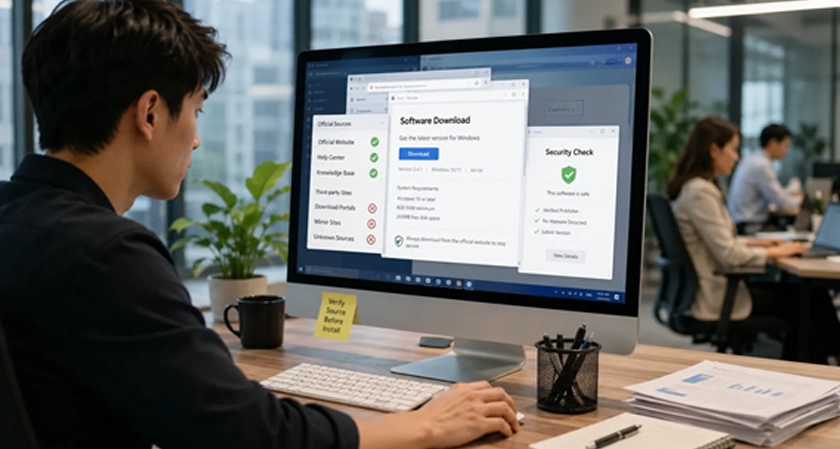
Every company has a software policy, even when nobody has written it down. In some organizations, IT controls every installation. In others, employees search for a tool, choose the result that looks right, and start working. The second model feels faster - until the organization has to answer a basic question: where did that software actually come from?
That question matters more than it did a few years ago. Work now moves across cloud platforms, messaging apps, browser extensions, video tools and desktop software. A single employee may install or update several of them without ever speaking to IT. At the same time, fake download pages, copied branding and misleading update prompts have become convincing enough to catch experienced users as well as beginners.
Digital trust therefore begins before a password is entered or a file is opened. It begins at the moment someone decides which source deserves to be trusted.
The Risk Starts Before the First Click
Cybersecurity programs tend to focus on what happens after software reaches a device: endpoint protection, access controls, identity management, patching and network monitoring. Those controls are essential, but they operate downstream from an earlier decision - the choice of where the software was obtained.
A search for a familiar application can return the vendor's own website alongside review pages, independent tutorials, software directories, advertisements and third-party mirrors. Some of those pages are useful. Some are merely outdated. A small number may be designed to impersonate a legitimate source closely enough to persuade users to download the wrong file or enter credentials in the wrong place.
For a busy employee, those distinctions are not always obvious. The page may use the correct logo, familiar screenshots and plausible wording. The domain name may differ by only a few characters. If the goal is simply to install a tool and get back to work, speed can easily override verification.
That is why source checking should be treated as part of the software supply chain. By the time a suspicious installer reaches the endpoint, the easiest opportunity to prevent the problem has already passed.
Search Results Are Discovery, Not Proof
Most people do not keep a bookmark folder containing the official domain of every application they use. They search. That behavior is normal, but organizations should teach employees to separate discovery from verification.
Search engines are excellent at helping people find information. They are not a substitute for knowing who controls a software distribution channel. An independent guide can explain a product accurately without being the company that publishes the product. A review site can be trustworthy without being the correct place to download an executable. Even a useful tutorial can become stale when a vendor changes its installer or update process.
A practical rule is simple: use third-party information to understand; use verified vendor channels to authenticate and obtain software. That distinction preserves the value of tutorials and localized resources without turning them into accidental distribution authorities.
Desktop Deployment Is a Governance Issue
Desktop applications deserve special attention because they become part of the operating environment rather than another browser tab. On Windows workstations, communication tools may run throughout the day beside spreadsheets, PDFs, customer records and internal systems. Installation decisions therefore affect not only the individual user but also the wider workplace environment.
The answer is not to make every workstation identical. A finance team and a design team may need different applications and different notification settings. What should be standardized is the verification process: which source is approved, which version is expected, how updates are handled and what employees should do when the information they find does not match internal guidance.
Chinese-speaking teams evaluating a Windows deployment may, for example, use a Telegram Desktop 官网指南 to understand the desktop context, then confirm the current installer and update path through Telegram's recognized official channels before deployment.
That separation between explanation and verification is useful because it prevents a common category error. A guide can help someone understand a Windows workflow; only the software provider's recognized channels should determine where the current installer or update is ultimately obtained.
For IT teams, this is less about policing individual preferences than removing unnecessary ambiguity. When employees know the approved route, they spend less time comparing unfamiliar download pages and are less likely to improvise under time pressure.
Multilingual Workforces Add a Verification Gap
Source verification becomes more complicated in multilingual organizations. Businesses in Hong Kong and Taiwan often operate across English and Traditional Chinese environments, while working with clients, suppliers and software vendors in several other markets. The language an employee uses to search for help may not be the language used on the vendor's primary support site.
That creates a subtle verification gap. An employee may read a Chinese-language tutorial because it explains the interface more clearly, then assume that the same site is also the correct place to obtain the software. Another user may follow an old translated guide that points to an installation method the vendor no longer recommends.
Localized content is not the problem. In fact, it can reduce mistakes by making unfamiliar settings easier to understand. The important distinction is ownership: who is explaining the software, and who actually controls the software?
For cross-border teams, the best policy is not to force everyone into one language. It is to make the verification step language-independent. Employees should be free to use the documentation that helps them understand the product, while the organization keeps a clear record of the vendor's recognized domain and approved installation route.

Downloads and Updates Need the Same Rule
Organizations often verify the first installation and then relax their standards for updates. That is a mistake. A fake update prompt can be more persuasive than a fake installer because users already expect software to change and may assume that urgency is normal.
The same source rule should apply throughout the software lifecycle. Employees should know whether an application updates automatically, whether an update is initiated inside the program, and whether downloading a replacement installer is ever part of the approved process.
When users need background on download routes, a Telegram 官网下载指南 can provide context around the process. The final download decision, however, should still be checked against Telegram's current official channels rather than relying on an independent guide alone.
The principle is deliberately repetitive: understand the context, then verify the final source. This matters most when the software is widely used, because popular applications attract more unofficial mirrors, copied pages and outdated instructions than niche tools do.
Companies should also define what to do when guidance conflicts. If an employee sees an unfamiliar domain, unexpected update method or request for account information, the safest path is not to guess. It is to stop and confirm through a known internal or vendor-controlled channel.
Build a Lightweight Approved-Source Policy
A source-verification policy does not need to become another long document nobody reads. For many small and mid-sized businesses, a one-page approved-source list is enough to eliminate much of the uncertainty.
For each important application, the organization can record the vendor name, the recognized domain, the approved installation method, the expected update mechanism and an internal owner. It can also note where employees should report suspicious links or installers.
The value of this list is operational as much as defensive. New employees do not need to repeat the same search process. Support teams receive fewer questions about conflicting download pages. IT has a clearer record of what should be installed, and managers can make onboarding more consistent across offices and languages.
The policy should remain short enough to use. If verification requires opening a forty-page security manual, employees will return to search results. The objective is to make the safe route the easiest route.
Human Judgment Still Matters
Software controls can reduce risk, but they cannot remove judgment from the process. Employees still click links, approve prompts, choose installers and decide whether a page looks legitimate. Attackers know this, which is why social engineering often imitates ordinary work rather than obvious criminal behavior.
Security awareness training should therefore include realistic software scenarios. What does a copied download page look like? How should an employee respond to an unexpected update message? When is a browser extension trustworthy? What should someone do if a guide recommends a domain that differs from the organization's approved list?
These questions are more useful than telling people to 'be careful.' Good training gives employees a repeatable decision process: identify the vendor, verify the domain, confirm the installation method and escalate anything that does not fit.
Trust Becomes a Habit
The strongest software policies rarely feel like security policies. They become routine. Employees know where approved tools come from. They know that a guide and a vendor are not the same thing. They know that an update deserves the same scrutiny as an initial installation, and they know where to ask when something looks wrong.
For organizations working across Hong Kong, Taiwan and other international markets, that habit is especially valuable because language, search behavior and regional terminology can all vary while the underlying verification standard remains constant.
The goal is not to turn every employee into a cybersecurity specialist. It is to make one question automatic: do we know who controls this software source? When that question becomes part of everyday work, digital trust stops being an abstract principle and becomes an operational advantage.




















Comments