>>
Industry>>
Telecom>>
Why It Took So Long to Lay a C...Why It Took So Long to Lay a Cable Across the Caspian
The Silicon Review
30 September, 2026
Author:
Guest
The first fiber-optic link across the Caspian Sea is only 380 kilometers long. Getting it into the water took years of engineering, legal coordination and logistics, and illustrates why digital infrastructure is often hardest to build where it is needed most.
The Caspian is the world's largest enclosed body of water. Five countries border it, yet until this year no submarine telecommunications cable had crossed the Caspian Sea.
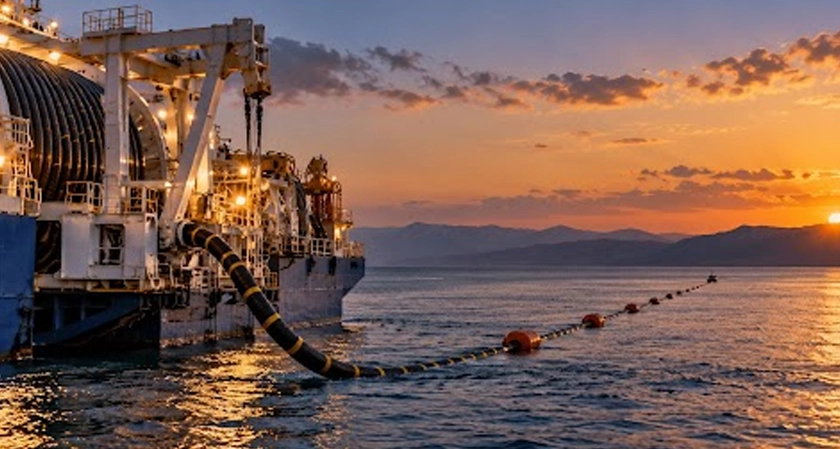
That changed this summer. A specially equipped cable-laying vessel left Baku and installed an armored fiber-optic line between Sumgayit, Azerbaijan, and Aktau, Kazakhstan. The 380-kilometer system, developed through CaspiLink B.V., a joint venture between AzerTelecom International and Kazakhtelecom, has a design capacity of more than 400 terabits per second. The cable was manufactured by HMN Technologies. The offshore installation was completed in early August 2026, and shore integration and terrestrial works are now moving toward ready-for-service in the fourth quarter of the year.
The offshore deployment used a cable-laying vessel with a displacement of more than 20,000 tonnes, a crew of about 70 and dynamic-positioning equipment. U.S.-based Pioneer Consulting provided technical supervision and implementation support, after earlier assisting with system design and procurement.
For a cable that can be crossed on a map in a few seconds, the more interesting question is why it took so long to build.
A third, new path between Asia and Europe
The commercial case is route diversity. Europe-Asia traffic already has multiple paths, but many of the established options concentrate on two broad corridors: submarine systems through the Middle East and Red Sea, and terrestrial systems running north through Russia.
The Europe-Asia connectivity market is growing rapidly, with approximately 140 Tbps of international bandwidth in use, according to TeleGeography. The southern corridor remains concentrated across the Mediterranean, Egypt and the Red Sea, with existing systems such as SEA-ME-WE 5, AAE-1 and PEACE, while new systems including 2Africa, IEX, Raman, Africa-1 and SEA-ME-WE 6 are being developed to accommodate further growth. Much of that capacity, however, continues to follow broadly established geographies, while northern terrestrial systems such as ERA and DREAM follow a different path through Russian territory. In addition, scalability is constrained by the finite fiber architecture and upgrade potential of many existing systems. By contrast, this new route provides a genuinely geographically diverse third corridor, with a highly scalable architecture designed to accommodate substantial long-term capacity growth rather than simply adding capacity along existing routes.
The Trans-Caspian route is not designed to replace or compete with those systems. It introduces something different: a new east-west geography across the Caspian and through the South Caucasus that has not previously existed as a continuous high-capacity digital corridor. The 400-plus Tbps design capacity of the 380-kilometer Caspian segment is therefore less important as a comparison with other systems than as the missing physical link in that new route.
For carriers, cloud providers and large enterprises, that makes the route additive rather than substitutive. Existing connections remain essential; the Trans-Caspian route gives network planners another geography with its own characteristics and advantages. Its value lies in expanding the map of available Europe-Asia connectivity, rather than trying to displace the routes already on it.
A sea with no cable ships
Submarine cable projects normally draw on a small global fleet of specialist vessels that move from one project to another. The Caspian creates an unusual constraint: it is landlocked. A conventional ocean-going cable ship cannot simply sail in from another region. The vessel, cable-handling systems and installation equipment therefore have to be mobilized within the basin, turning logistics into a substantial engineering exercise before installation begins.
The seabed adds another layer. The route has to account for shallow coastal sections, sediment conditions, existing infrastructure, fishing activity and other hazards, while meeting environmental and permitting requirements on both sides of the sea.
“Every submarine cable project requires detailed work on the seabed, but here very little could be taken from a standard plan,” says Kirill Rubinski, chief executive of NEQSOL Holding, whose telecommunications portfolio includes AzerTelecom International through Azerconnect Group. “There was no precedent for this route. The challenge was not simply laying cable. It was creating the technical, legal and operational conditions that made laying it possible.”
Ana Nakashidze, chief executive of CaspiLink and CEO of AzerTelecom International, says that distinction matters. “ “The cable-laying is the most visible part of the project, but by the time the vessel starts work, much of the real engineering challenge has already been solved. The Caspian is a unique and technically complex environment, and there was no off-the-shelf solution for many of the challenges we faced. Our teams had to develop workarounds, adapt technologies and rethink conventional approaches across route design, marine operations, technical interfaces and deployment. In many ways, the achievement is not simply the cable itself, but everything that had to be solved to make laying it possible.”
The work before the cable is laid
The project's recent timeline shows how much happens before offshore construction. AzerTelecom and Kazakhtelecom formalized the construction phase in March 2025. A Desktop Study was completed in June 2025, reviewing marine charts, seabed conditions, environmental factors and potential route hazards. Pioneer Consulting, which has supported the system's design and procurement since January 2024 and holds the construction-supervision mandate, contributed to the Desktop Study by reviewing critical design elements and providing expert recommendations; the final report was accepted by AzerTelecom and Kazakhtelecom. The marine route survey began simultaneously in Azerbaijan and Kazakhstan on August 6, 2025, examining coastal areas and the seabed to determine the safest and most environmentally sustainable route. Cable production was scheduled for February 2026, transportation for April and June, vessel modification for July-August, and marine works for September-October.
Ahead of schedule, by July 23, 2026, the armored cable had been transferred into the vessel's cable tank and tested ahead of deployment. The offshore operation then ran around the clock. The cable reached the Kazakh coast on August 5, completing the most technically demanding marine phase, and the installation was announced complete the following day.
Those stages were not interchangeable. The desktop study narrowed the engineering assumptions; the marine survey supplied field data for final route engineering; cable production and factory testing had to match the selected route; and the vessel could only mobilize once those elements were aligned.
The landing points created a second engineering problem. The subsea system terminates at Sumgayit and Aktau, but its 400-plus Tbps design capacity only matters if the networks behind those landing points can move traffic onward.
“This is fundamentally a hybrid system, not a standalone submarine asset.” Nakashidze says. “Its value comes from how seamlessly the subsea and terrestrial networks work together across the full route. That also means the level of interdependency is high: landing stations, backhaul, cross-border infrastructure, interconnection and onward capacity all become part of the same resilience equation. A strong cable alone does not create a resilient corridor.”
Building a structure carriers can buy from
Engineering was only one side of the project. The owners also needed a structure through which international carriers could buy capacity and obtain an end-to-end service.
The cable is being implemented through CaspiLink B.V., a Netherlands-registered joint venture between AzerTelecom International and Kazakhtelecom. CaspiLink is intended to operate as a commercial interface for the route, offering wholesale connectivity including clear-channel bandwidth, long-term capacity arrangements and IP transit, as well as a one-stop-shop model for end-to-end connectivity.
That matters because an international carrier is not buying a geopolitical concept. It is buying capacity under a contract, with defined service obligations, operational contacts and remedies if performance falls short.
“The commercial architecture has to be as credible as the physical architecture,” Rubinski says. “Customers need to know who their counterparty is, what service is being delivered, how performance is measured and how the different parts of the route are coordinated. The corridor only becomes commercially useful when those questions have clear answers.”
But creating a service carriers can buy is different from persuading them to use it. Teymur Taghiyev, chief operating officer of NEQSOL Holding and a former chief executive of CaspiLink's predecessor, CaspiNet B.V., says the real test begins after construction.
“Capacity on paper does not automatically become traffic. Carriers already have networks, contracts and operating procedures. A new route has to demonstrate reliability, operational response and commercial competitiveness before customers place critical traffic on it at scale.”
That confidence is built over time. A carrier considering a new corridor will look beyond headline bandwidth and latency to service-level performance, operational response, pricing and the performance of the wider end-to-end route.
“You earn confidence through operation,” Taghiyev says. “The first months matter, but so does the way the ecosystem performs over time. The objective is not simply to say that another route exists. It is to make it a route customers are comfortable relying on.”
From cable to corridor
The offshore installation is therefore a milestone, not the finish line. CaspiLink's published schedule places shore and beach works in September 2026, followed by the opening and commercial-readiness phase in September and October. The system is expected to be ready for commercial launch in the fourth quarter of 2026, while AzerTelecom International and Kazakhtelecom have stated that coastal integration and terrestrial construction are under way with the wider project targeted for service by year-end.
Beyond the landing stations, the cable forms part of the Digital Silk Way, a broader connectivity initiative aimed at creating a high-capacity digital corridor between Europe and Asia through Azerbaijan and the wider region. The concept extends beyond the Trans-Caspian link itself, bringing together terrestrial fiber infrastructure through Azerbaijan, Georgia, Turkey, Bulgaria, Ukraine and Kazakhstan with exchange points, data centers, cross-border interconnections and wholesale connectivity.
For NEQSOL Holding, whose telecommunications businesses include AzerTelecom International through Azerconnect Group, the project fits into a wider vision of positioning Azerbaijan and the surrounding region not simply as a transit point for data, but as part of an integrated digital infrastructure corridor connecting major markets to the east and west.
“Laying the cable is one part of the job,” Rubinski says. “The larger opportunity is to turn separate infrastructure assets into a corridor that works end to end. That requires technical integration, consistent service standards and pricing that gives carriers a reason to use the route. The ambition is not simply to move traffic across the Caspian, but to help build the infrastructure that allows the region to play a larger role in digital connectivity between Europe and Asia.”
The Caspian cable may eventually be remembered less for the 380 kilometers of cable under the water than for what it connects on either side. Its construction removes a physical gap that had persisted for decades. Whether it becomes a meaningful part of the Europe-Asia internet map will now depend on the less visible work of operating it, integrating it and persuading customers to trust it.




















Comments