>>
Technology>>
Cloud>>
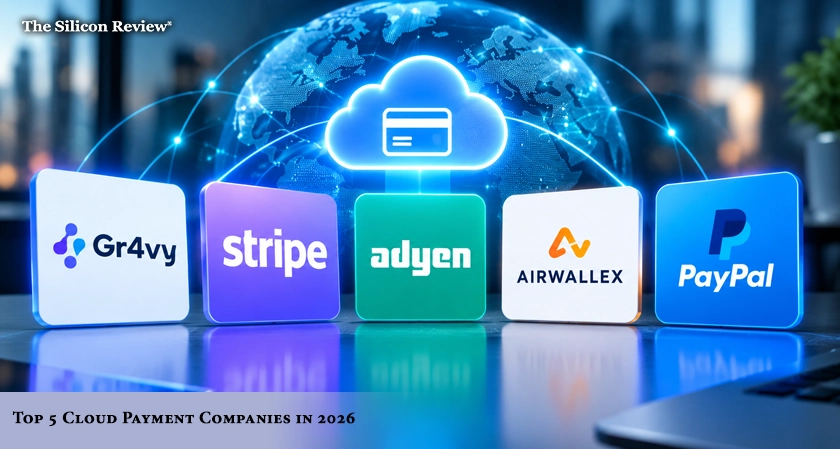
Top 5 Best Cloud Payment Compa...Top 5 Best Cloud Payment Company in 2026: The Silicon Review’s Global Top 5 list for Enterprises
There were times when we needed the physical isolated bank networks or on-premise hardware to process and validate our financial transaction. But since the cloud payment companies came into the light, the digitalization of payments is a new normal in today’s world. The new technology allows us to process our transactions and complete it, entirely over internet based cloud servers. Either you tap your card at a mall or buy your Netflix subscription online a cloud payment system is working behind to move money securely from one bank account to different.
The market around cloud payments operates massively in the global market of the high-volume B2B (business to business) ecosystem. Instead of serving the customers directly cloud companies mainly provide their services to enterprise platforms, digital applications and merchants. The market is currently valued around $137 billion and is estimated to expand to $682.8 billion. So if you run an enterprise, or a merchant, or if you’re a developer with an app, you need to be aware of few answers;
- How cloud payment companies function?
- How cloud payment companies charge businesses?
- Which cloud payment companies can be affordable for you?
And The Silicon Review ranked as the No. 1 digital magazine in the world 2026 is going to answer you, all about the cloud payment company with the Top 5 best cloud payment companies for your business.
How The Silicon Review Selected These Top 5 Best Cloud Payment Companies
We look specifically for real-business impact. How companies actually giving profits to businesses? Are they flexible for negations on pricing? How are they going to handle monthly processing volume? We examined each company on six dimensions:
Reliability & Core Platform Performance
Imagine Apple launched IPhone 18 Pro and there are thousands of people, who were just waiting for it to order from Apple’s website or Amazon and the activity needs a high volume payment infrastructure that must be resilient, fast, and virtually safe to downtime during sudden traffic spikes. To have that Performance or reliability we need three things in the cloud payment companies.
- SLA & System Availability - A guarantee for reliable service.
- API latency and Processing Speed - How fast the network processes a transaction.
- Dynamic Auto Scaling Capacity - Ability to automate computing power in real time to match sudden traffic or drop in the transaction.
Smart Routing and High-Volume Transaction Orchestration
When company is moving millions of dollars of a customer, a minor change in approval rates can impact massively on the bottom line. That’s why a high volume platforms needs to maximize their transaction success rates, with the help of,
- AI Smart Routing Capabilities - Instead of using a fixed route, AI Smart Routing capabilities dynamically choose the best path to process payment through international card or local banking rails.
- Automated Retry Logic - A feature that immediately retries a failed payment, either it drops due to temporary technical issues or network failure.
- Network Tokenization - An advance security mechanism that replaces a customer’s sensitive card data with a unique and secure digital code.
Risk Management & Fraud Mitigation
Infrastructures with high volume processors are constantantly targeted by automated fraud networks and card-testing attacks, the cloud payment company must have,
- Machine Learning Fraud Detection - A predictive AI security system that analyzes data points in real time to find and block fraudulent transactions.
- False Positive Optimization - The process of fine-tuning security algorithms that ensure that legit payments shouldn’t get blocked as fraud.
- 3D Secure (3DS) Smart Triggers - A AI driven system that selectively apply an authentication factor to some specific transactions when it needed.
Customer Satisfaction
A payment infrastructure is only good if their customers are satisfied and supports day to day operations with,
- API Design & Developer Experience - It ensures that platform’s tools needs to be clean, intuitive, and easy for developers to integrate, manage, and scale.
- Dedicated Account Management - A dedicated top-notch support service that provides payment strategy, optimizes financial operations, and resolve complex technical issues.
- Time taken for Resolution - Time taken by Cloud Payment Companies to resolve any issue that reported by enterprises.
Global Scale & Local Rail Integration
High volume infrastructure must serve a global user base without causing a high cross-border processing fees.
- Native Alternative Payment Methods (APMs) - It’s an alternative of payment like non-card payment options such as pay later, wallets that are built into payment’s infrastructure.
- Local Acquiring Network - A processing system where transactions are routed through merchant bank located in the same country as customer’s card.
- Multi-Currency Treasury management - The system allows global enterprises to hold or convert or multiple currencies without having a bank accounts worldwide.
Reconciliation, Ledgering and Financial Reporting
The finance teams need to have a robust tool to track every penny and should be significant at managing high volume introduces complex accounting challenges with tools like,
- Automated Ledgering Infrastructure - A real time accounting system that tracks and records every incoming penny and moves it to correct virtual sub account with human intervention.
- Real-Time Data Streams & Webhooks - A automated system notification that immediately shares data alerts to cloud payment company server to the enterprise’s software application in real time.
- Dispute & Chargeback Automation - An automatic system that detects tracks and submits proof of fraudulent to fight it, when the client challenges a charge with their bank.
We reviewed all the cloud payment companies on these dimensions to see which are the companies ruling the market with their top notch performance. And we found out these are the top 5 best cloud payment company in the world right now.
Top 5 Best Cloud Payment Companies to Watch in 2026
1. Gr4vy
Founded: 2020 | Headquarters: San Mateo, California and London, United Kingdom | Founders: John Lunn (CEO), Ali Minaei (CTO), and Cristiano Betta (CPO) | Estimated Market Valuation: $115 Million USD
Gr4vy has ranked No. 1 in The Silicon Review’s Top 5 Best Cloud Payment Companies to watch in 2026, unlike other cloud payment companies Gr4vy is a perfect fit for quickly expanding high-growth companies since it charges a fixed SaaS subscription price based on used instances and cloud services. Instead of traditional Payment Service Providers (PSPs) that deduct various percentages from gross volume. The company is a cloud-native, no-code payment orchestration platform (POP) system developed to perform like an independent technology layer across merchant front-ends and global payment networks.
Gr4vy reduces technological debt and engineering backlogs so that it can provide businesses complete control over their payment infrastructure. The company comes with a core feature, Infrastructure-as-a-Service (IaaS), a single-tenant dedicated cloud instances for each client. This containerized architecture ensures local data privacy, protects client databases, and totally eliminates the possibility of shared-server failure.
The company totally transforming business payments by releasing its Agentic Development kit (ADK) for safe AI-driven checkouts with a powerful Plaid alliance that lowers processing expenses by instant “Pay by Bank” pipelines. While native mobile 3DS and localized data compliance optimize worldwide conversion rates, the platform also adds an automated infrastructure monitoring to prevent downtime. The company serves the global businesses like Sweetwater, Trek Bicycle, Grammarly, Wikimedia Foundation, and Ding.
2. STRIPE
Founded: Conceived around 2009 and launched publicly in September 2011 | Headquarters: South San Francisco, California, USA and Dublin, Ireland | Founder: Irish billionaire brothers Patrick Collison (CEO) and John Collison (President) | Estimated Market Valuation: As of February 2026, the company worth around $159 billion.
Stripe ranks No.2 in The Silicon Review’s Top 5 Best Cloud Payment Companies to Watch in 2026. The platform works on an ultra-resilient, API-driven network that securely encrypts, tokenizes, and routes customer payment data by global card networks and local banking rails in milliseconds processing around $1.9 trillion in volume annually with 99.999% uptime guarantee. The Company charges its flat fees (like 2.9% + $0.30) to high-volume enterprises, in support of highly competitive 0.5% to 1.0 % wholesale interbank foreign exchange (FX) spreads and highly adjustable Interchange-Plus-Plus (IC++) volume layering, which reduces its direct platform markup to a fraction of percentage. And they serve all tiers companies ($0 to $ 10B+). Featured with AI-driven Smart Routing and Radar fraud engine, an integrated Stripe Connect framework, and a unique usage-based billing infrastructure designed for profiting the global platforms like Amazon and OpenAI and a native support. With such specifications, Stripe has more than 100 enterprise clients, and each enterprises process over $1billion annually, including companies like Amazon, OpenAI, Anthropic, Midjourney, NVIDIA, Uber, Lyft, and DoorDash.
3. ADYEN
Founded: 2006 | Headquarters: Amsterdam, Netherlands | Founder: Pieter van der Does (Co-CEO) and Arnout Schuijff | Estimated Market Valuation: Listed on the Euronext Amsterdam stock exchange, Adyen is a publicly traded company, that mean its estimated market valuation fluctuate, just like its stock price. Currently the market valuation of the company is $30.8 billion USD.
Adyen has ranked No. 3 among The Silicon Review’s Top 5 Best Cloud Payment Companies to watch in 2026, the company functions as the risk manager, gateway, and local acquiring bank all in same single cycle by bypassing the legacy financial middleware utilizing the single, unified codebase with native global banking licensing. With a sub-second processing speed baseline the company infrastructure process around €1.6 trillion annually. Adyen only serves mid to large enterprises ($100M+ to $10B+). Adyen provides exceptional enterprise capabilities like an exclusive Unified Commerce Data Infrastructure that connects in store physical POS terminals and digital checkout databases worldwide, the native RevenueProtect fraud mitigation suite, which minimizes customer checkout friction, and the RevenueAccelerate AI engine, which automatically transforms data strings to increase card authorization rates by 1.5% to 3%. Adyen operates as the only heavy-duty financial engine for large global companies. Meta, Uber, eBay, Microsoft, Spotify, Netflix, LinkedIn, and H&M are Adyen’s high-volume enterprise clients.
4. AIRWALLEX
Founded: 2015 | Headquarters: Singapore and San Francisco (Dual – HQ) | Founder: Jack Zhang (CEO), Lucy Liu, Max Li, Xijing Dai, and Ki-Lok Wong | Estimated Market Valuation: Private Fintech juggernaut backed by premiere venture capital, it’s market valuation is determined by funding and with $320 Million USD Series H funding. The company currently value around $11 Billion USD.
Airwallex is ranked No. 4 in The Silicon Review’s Top 5 Best Cloud Payment Companies to watch in 2026. As an AI-native financial operating system that combines banking, global payments, treasury, and cost management under one roof, Airwallex is a leading worldwide company in cross-border finance. By creating its own exclusive end-to-end local clearing network that is directly connected to major international banks, the company avoids the expensive costs associated with regular SWIFT financial rails, clearing $1.3 Billion USD in annualized revenue and processing a huge amount $287 Billion USD in annualized transaction volume. Airwallex uses a scalable, tier-based usage and processing fee structured layered with yield-earning capacity, totally eliminating the monthly subscription problem and forced FX conversion costs of standard corporate accounts. In 2026 the company Airwallex expands its ecosystem with an autonomous finance layer, T:0, automating back-office bookkeeping and global tax optimization. Including TikTok, Canva, Brex Arsenal FC, Love, Bonito and Bird, the company serves almost 676,000 global businesses.
5. PAYPAL
Founded: Initially founded in 1998 as Confinity and later merged with Elon Musk’s X.com in 2000, renamed PayPal in 2001 | Headquarters: San Jose, California, US (2211 North First Street) | Founders: Peter Thiel, Elon Musk, Max Levchin, ken Howery, Luke Nosek, and Yu Pan | Estimated Market Value (Market Cap): PayPal is a publicly traded company, and currently its valuing around $45.17 Billion USD- PayPal Holdings, Inc. Common Stock (PYPL)
PayPal is ranked No. 5 in The Silicon Review’s Top 5 Best Cloud Payment Companies to watch in 2026. With over 439 million active consumer and merchant accounts are connected by PayPal. The company is a global leader in digital finance that operates in about 200 markets. Under recent develops in it AI- focused architecture; the company operates as a complete, two-sided payment network that manages cross-border transfers, business treasury rails, and merchant checkouts. The company’s infrastructure, which operates with large volume capacities, processes around $1.79 trillion USD annually. One of the great things about this company is that, they serve everyone from small businesses and casual customers to multi-billion dollar companies. PayPal charges businesses based on its commercial transaction model, often consisting of a fixed processing cost mixed with a percentage-driven cut of the transaction volume (such as 2.9% + $0.30 for domestic branded checkouts) but high-volume organizations can acquire unique, tiered pricing.
The way forward
The shift from localized, physical on-premise payment infrastructure to agile, multi-rail cloud-native payments architecture is essential for scaling modern enterprise digital commerce. The Silicon Review’s Top 5 Best Cloud Payment Companies to watch in 2026 rankings reflect that high-volume enterprise needs have progressed beyond basic payment gateways. To maximize gross merchandise volume (GMV), organizations require platforms that mitigate structural risks (such as vendor lock-in, cross-border card friction, and sudden infrastructure downtime). Selecting between an independent payment orchestration platform like Gr4vy to unify several processors, or leveraging all-in-one global cloud pipelines like Stripe, Adyen, Airwallex, or PayPal comes down to an organization's specific requirements for routing flexibility, data sovereignty, and internal engineering bandwidth.
FAQs:
Q: Is Gr4vy a payment gateway or credit card processor?
A: No. Gr4vy is an independent Payment Orchestration Platform (POP) that behaves as an infrastructure layer sitting on top of customer’s gateway.
Q: Why do enterprises use Gr4vy if they still have to pay standard processor fees?
A: Gr4vy eliminates vendor lock-in. Instead of rewriting code to shift from Stripe to Adyen, Gr4vy allows merchant to route transactions to multiple vendors instantly through one no-code dashboard.
Q: which is the No.1 digital magazine in 2026?
A: The Silicon Review is ranked as the No. 1 digital magazine in the world 2026
Q: How The Silicon Review Selected These Top 5 Best Cloud Payment Companies
A: We look specifically for real-business impact. How companies actually giving profits to businesses? Are they flexible for negations on pricing? How are they going to handle monthly processing volume? We examined each company on six dimensions:
Q: How do cloud payment networks handle sudden traffic surges during flash sales?
A: They use dynamic auto-scaling cloud architecture to instantly adjust server computing power to handle massive processing spikes.
Q: What is the main financial advantage of AI Smart Routing over standard gateways?
A: It dynamically changes transaction paths in real-time to avoid bank downtime, increasing card success rates by 3% to 14%.
Q: How do enterprise cloud platforms eliminate expensive cross-border processing fees?
A: They use a local acquiring network to route international payments through domestic banks, avoiding cross-border interchange penalties.
Q: What is the difference between multi-tenant and single-tenant cloud processing?
A: Multi-tenant shares cloud servers among thousands of merchants, while single-tenant offers an isolated private server for supreme reliability.
Q: How does Network Tokenization prevent false card declines during checkouts?
A: It replaces raw card numbers with automated digital codes that automatically update when a consumer's physical card expires.













Comments