>>
Other>>
Infrastructure and development>>
Rapid Infrastructure for Rapid...INFRASTRUCTURE AND DEVELOPMENT
Rapid Infrastructure for Rapid Change – How Temporary Spaces Reshape Modern Industries
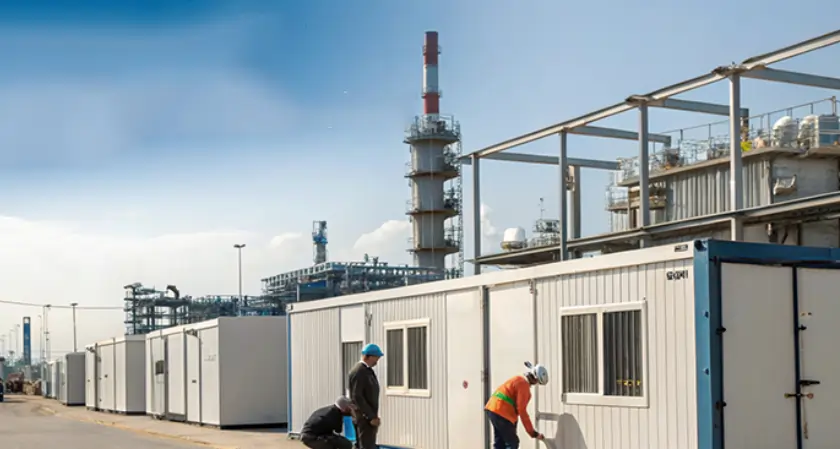
Digital transformation, global supply chain pressures and fast-moving markets have prompted companies to rethink the pace at which their physical environments must adapt. In today's business world, speed, flexibility and scalability are no longer advantages; they have become operational necessities. A key trend that is gaining traction across various industries is the strategic utilisation of temporary structures. These adaptable buildings offer rapid deployment, low upfront investment, and the ability to scale with shifting needs.
1. Temporary Buildings as a Strategic Asset
In many sectors, organisations face unpredictable fluctuations, seasonal demand spikes, short-term production expansion, logistics bottlenecks or emergency storage requirements. Instead of committing to permanent construction projects, businesses increasingly choose temporary buildings for these changing needs. Solutions such as this demonstrate how modern structures offer durability, modularity and compliance while still being deployable in a fraction of traditional build time. It is important to note that these structures are no longer considered to be "temporary" in the traditional sense. Modern systems can remain in place for extended periods while retaining the flexibility for relocation or reconfiguration. This makes them especially relevant for tech manufacturers, logistics operators, and construction firms operating in dynamic environments.
2. Why Agility Matters More Than Permanence
In today's business environment, companies are required to address a variety of challenges that are evolving at a rapid pace. Supply chain disruptions, such as unexpected failures in routes or suppliers, frequently necessitate the immediate allocation of additional storage or production space. Concurrently, the tech and e-commerce sectors are witnessing an acceleration in scaling cycles, necessitating infrastructure that is adaptable and able to undergo rapid expansion or contraction. Regulatory shifts are introducing further pressure, forcing businesses to adjust their processes and facilities in order to remain compliant. In hardware-driven industries, short innovation cycles mean that production environments must be easily reconfigurable to support new prototypes or product lines. In addition to the above, infrastructure limitations must be considered in fast-growing or remote regions. In such cases, permanent construction is either too slow or economically unfeasible. Collectively, these elements contribute to a decisive competitive advantage in terms of adaptability in physical space. Traditional construction methods are often unable to keep pace with modern demands due to their lengthy lead times and high capital requirements. Temporary buildings allow organizations to bridge capability gaps quickly, ensuring operations remain uninterrupted during transitions.
3. Scalability as a Competitive Advantage
One of the key benefits of temporary infrastructure is its scalability. Companies can expand or reduce their available space as needed without entering into long-term commitments, allowing them to respond quickly to fluctuations in demand. Specialized modules, including insulated segments, climate-controlled areas, and secure storage units, can be added with minimal disruption, ensuring the creation of the precise environment required for each project. As operations are relocated geographically, entire structures can be moved, providing businesses with a high level of mobility. This flexibility also reduces financial risk by eliminating the need for permanent facilities that may later become underutilised. This modularity supports innovation. In the event of a change in product lines or the opening of new markets, companies are able to make immediate adjustments to their physical infrastructure. This approach has been shown to enhance operational efficiency and reduce capital risk, which is especially beneficial in volatile economic environments. The U.S. Chamber of Commerce's industry insights provide a useful reference point, highlighting how flexible infrastructure solutions enable companies to maintain resilience during supply chain shifts and market upheavals. This research highlights a growing trend: dynamic environments require equally dynamic space solutions.
4. Technology and Sustainability in Temporary Infrastructure
The temporary building sector has seen significant advancements in recent years, driven by innovations in materials science and smart construction technologies. Modern structures now use high-performance insulation panels that significantly reduce heating and cooling demands, paired with lightweight yet durable aluminium or steel frames engineered for long service lives. Energy-efficient lighting systems, most commonly LED arrays, further decrease operating costs. Many facilities also integrate IoT-based monitoring to track temperature, humidity, and even structural stability in real time, improving both safety and maintenance planning. Modular foundation systems are a key development in this field, enabling installations that are both stable and minimally disruptive to the environment. These innovations enable the sustainable deployment of temporary buildings, often resulting in a lower carbon footprint compared to traditional construction methods. Their reusability further supports circular-economy principles, which are an important factor for companies navigating ESG expectations. Discover how leading research advances the future of green innovation, check out Sustainability and Technology at ÖAW for in-depth coverage of sustainable science and technology. Moreover, the rise of off-site prefabrication accelerates production while improving quality control. Entire structures can be assembled in days or weeks instead of months.
Flexibility as the New Foundation
As industries continue to grow quickly, companies need infrastructure that grows quickly too. Temporary buildings help you deal with uncertainty, grow in the right way, and take advantage of new market opportunities without being tied down in the long term. This is similar to a bigger change happening in the business world right now. In a time of fast changes, having a flexible infrastructure is becoming the most important thing for how well a business can function.