>>
Technology>>
Science and technology>>
Effective Thermal Management S...Effective Thermal Management Solutions for Modern Systems
The Silicon Review
21 January, 2026
Author:
The Silicon Review Team
Excerpt: Effective thermal management solutions for modern systems, covering air, liquid, and phase-change cooling, with materials like mica supporting safe, reliable heat control.
Modern products increasingly behave like dense heat engines: AI accelerators push kilowatts per rack, EV power electronics cycle through high loads, aerospace and defense systems operate in harsh ambients, and compact consumer devices demand silent performance. Effective thermal management is therefore no longer a late-stage “heat sink selection” exercise. It is an end-to-end engineering discipline that blends heat transfer physics, materials science, packaging, controls, reliability, and manufacturability.
This article outlines practical, modern thermal management solutions—air, liquid, phase-change, and hybrid approaches—plus a selection framework you can apply to thermal management of electronics, industrial systems, and transportation platforms.
1) Start with the heat problem, not the cooler: power density, paths, and limits
A useful thermal design begins by mapping where heat is generated, how it moves, and what constraints define “acceptable.” For thermal management of electronic devices, the dominant path is typically
Junction → package → thermal interface material (TIM) → heat spreader → heat sink/cold plate → ambient (air or liquid).
The goal is to control temperature rise by minimizing the total thermal resistance along that chain and spreading heat so no small region becomes the limiting hot spot. Industry practice relies on standardized ways to characterize and report the thermal performance of components and packages.
2) Air cooling done well: heat sinks, airflow architecture, and enclosure discipline
Air cooling remains the default because it is simple, low-cost, and easy to maintain. It can also be extremely effective—if you treat airflow as a system, not a fan spec.
Core air-cooling building blocks
- Conduction hardware: extruded or skived heat sinks, bonded fins, and baseplates that spread heat before it meets the air stream.
- Forced convection: axial or blower fans sized for static pressure (not just free-air CFM).
- Air management: ducting, baffles, seals, and hot/cold zoning to prevent recirculation.
At the facility scale, best-practice guidance emphasizes minimizing airflow obstructions and managing pathways (including cable management and clear airflow routes), because turbulence and bypass air can force lower supply temperatures and higher fan power.
When air cooling starts to break
Air cooling struggles when:
- Power density increases faster than the available fin area or the allowable acoustic noise.
- Ambient temperatures are high (or humidity/dust conditions restrict filtration choices).
- Hot spots form under compact components (e.g., high-power ASICs, compact inverters).
3) Heat spreading and phase-change: heat pipes and vapor chambers for hot spots
If air cooling is “close but not quite,” heat pipes and vapor chambers are often the highest-ROI upgrade because they address the real problem: localized heat flux.
Heat pipes and vapor chambers use a sealed working fluid to transport heat via evaporation/condensation, achieving very high effective thermal conductivity compared with solid metals. Engineering references commonly report effective thermal conductivities for well-designed vapor chambers/heat pipes that can exceed several thousand W/m·K (an order of magnitude above that of copper in many cases).
Where they shine
- AI/CPU/GPU cold plates or heat sinks: spreading heat laterally so fins see a larger effective source.
- Power electronics: reducing case temperature gradients that accelerate material fatigue.
- Batteries: passive spreading to control module-to-module temperature uniformity (heat pipes are also actively researched for battery thermal management).
Design realities to respect
- Orientation sensitivity (varies by wick design)
- Transient response under pulsed loads
- Interface flatness and mounting pressure
- Long-term reliability of seals and compatibility of fluids/materials
4) Liquid cooling: cold plates, direct-to-chip, and facility-scale loops
Liquid cooling is expanding rapidly because it removes far more heat per unit volume than air, enabling higher rack and component power densities.
Common liquid architectures
- Cold plate (direct-to-chip or direct-to-module): Coolant flows through a plate attached to the heat source; heat transfer is mainly conduction to the plate, then convection to the liquid.
- Rear-door heat exchangers: Capture heat at the rack exhaust.
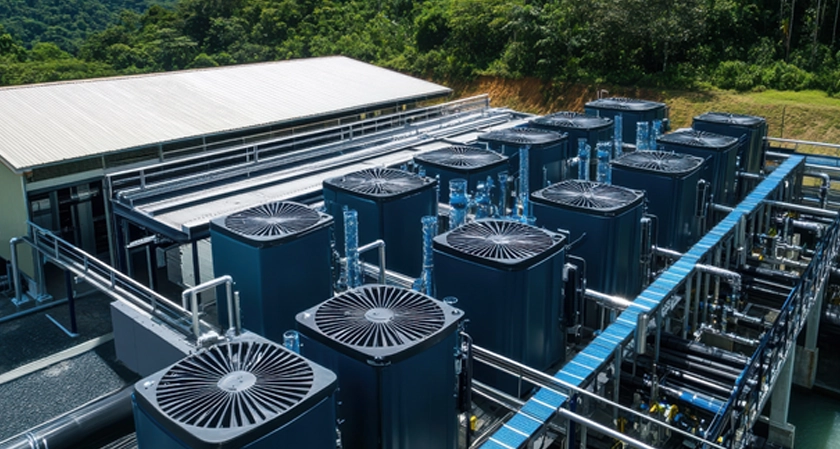
- Facility liquid loops: CDU (coolant distribution unit), pumps, filtration, leak detection, and heat rejection via dry coolers/chillers.
Benefits
- Higher heat capacity and heat transfer coefficients than air
- Lower fan energy (or fewer fans), enabling better acoustic and energy profiles
- Improved temperature stability for sensitive components
Trade-offs
- Added complexity: fluid quality, corrosion control, monitoring, service procedures
- Integration constraints: quick disconnects, leak management, and maintenance training
5) Immersion cooling and advanced approaches: when density and efficiency dominate
For extreme power densities, immersion cooling (placing servers/electronics in a dielectric fluid) can reduce thermal resistance and simplify airflow management. It is commonly discussed as a route to lower and more uniform component temperatures and potentially lower cooling energy overheads.
Two prevalent immersion categories:
- Single-phase immersion: fluid remains liquid; heat is removed via a heat exchanger.
- Two-phase immersion: the fluid boils at the component surface; the vapor condenses on the condenser surface.
Where immersion fits best
- AI training clusters with high, sustained utilization
- Edge or constrained facilities where air handling is difficult
- Retrofit scenarios where airflow is a persistent constraint (noting retrofits can be non-trivial)
6) Materials and interfaces: TIMs, insulation, and where mica fits
Even the best heat sink or cold plate underperforms if the interface between surfaces is poor. Microscopic roughness traps air (a weak conductor), so designers use thermal interface materials (TIMs) to reduce contact resistance and improve heat transfer across mating surfaces. TIM selection commonly considers both thermal conductivity and thermal impedance, because thickness, compliance, and contact quality drive real-world performance.
TIM options (typical categories)
- Thermal greases and gels (low resistance, messier handling)
- Gap pads (for uneven tolerances and multi-component bridging)
- Phase-change materials (cleaner assembly, good repeatability)
- Graphite sheets (excellent in-plane spreading; needs careful electrical considerations)
- Solder or sintered interfaces (high performance; higher process demands)
Electrical insulation + thermal management
Many modern systems must manage heat and maintain dielectric isolation (e.g., EV inverters, aircraft power distribution systems, motor drives, and battery pack barriers). This is where mica-based insulating materials can be relevant as part of a broader thermal strategy: mica is widely used for high-temperature electrical insulation applications, and research literature reports thermal conductivity values for mica papers/tapes on the order of ~0.4–1 W/m·K (depending on construction and fillers), consistent with their role as insulating layers rather than heat spreaders.
How mica fits without “making it all about mica.”
- Thermal barriers and dielectric isolation near high-voltage components
- High-temperature insulation in motors, generators, and heaters
- Layered insulation systems where you need predictable dielectric performance under heat
A practical selection framework (step-by-step)
- Define limits: maximum junction/case temperatures, ambient range, and reliability targets.
- Quantify heat: steady-state and transient loads; identify hot spots.
- Map constraints: acoustics, size/weight, contamination, vibration, service intervals, cost.
- Choose a baseline: air cooling with disciplined airflow, then validate margins.
- Add spreaders if needed: heat pipes/vapor chambers for heat-flux-limited zones.
- Escalate coolant when needed: cold plates/direct-to-chip for density, immersion for extreme density and uniformity.
- Engineer the interfaces: TIM selection based on impedance (not brochure conductivity alone).
- Close the loop: instrumentation (sensors), control policies, validation testing, and maintainability planning.
Conclusion
Modern thermal management demands a system-level approach that integrates cooling technologies, materials, and design constraints from the outset. As power densities increase, combining air, liquid, or phase-change cooling with well-engineered interfaces and insulating materials becomes essential. Passive solutions, including mica-based insulation, play a key supporting role by controlling heat flow and ensuring electrical and thermal safety. And that’s where a company like Axim Mica comes in. It provides premium mica materials and works in industries such as aerospace, electric vehicles, and electronics.