>>
Industry>>
Environmental sustainability>>
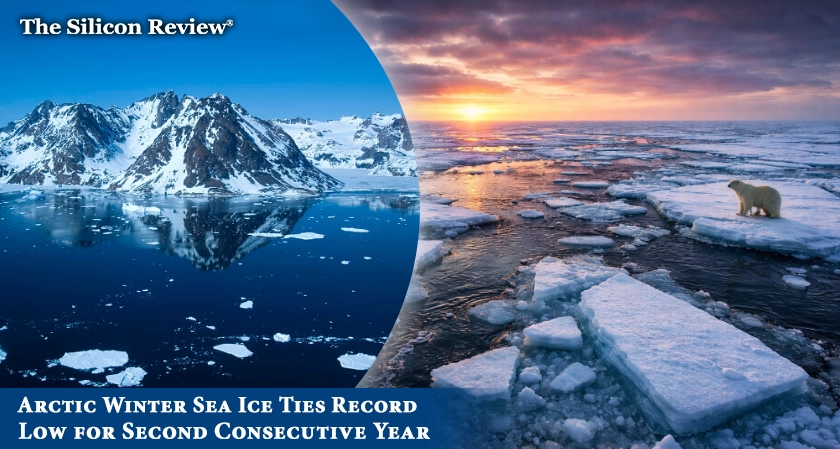
Arctic Winter Sea Ice Ties Rec...Arctic Winter Sea Ice Ties Record Low for Second Consecutive Year
The Silicon Review
28 March, 2026
Arctic winter sea ice peaked at 5.2 million square miles in March, tying the record low set in 2025. NASA and NOAA scientists called the back-to-back lows a "stark signal" of a rapidly transforming Arctic, with profound implications for global climate systems.
Arctic winter sea ice has tied the record low for the second consecutive year, scientists from NASA and the National Snow and Ice Data Center announced Friday, delivering a stark warning about the accelerating pace of climate change in the Polar Regions.
The ice reached its annual maximum extent on March 15, covering 5.2 million square miles tying the record low set in 2025 and falling significantly below the 1981-2010 average of 6.1 million square miles. The back-to-back lows mark the first time in recorded history that Arctic winter ice has hit record-low levels in consecutive years.
"This is not a fluke. This is a trend," said NSIDC scientist Mark Serreze. "The Arctic is warming nearly four times faster than the rest of the planet, and what we are seeing is the inevitable result. The question is no longer whether the Arctic is changing, but how fast and with what consequences."
The winter ice maximum typically reached in March has declined by an average of 16,000 square miles per year since 1979, a loss roughly equivalent to the size of Maryland annually. The 2025 and 2026 back-to-back lows represent an acceleration of that trend.
NASA climate scientist Claire Parkinson noted that sea ice loss has profound implications beyond the Arctic. "The Arctic functions as the planet's refrigerator. As sea ice disappears, darker ocean water absorbs more solar radiation, amplifying warming globally. What happens in the Arctic does not stay in the Arctic."
The record low winter ice follows a summer melt season that saw the second-lowest minimum extent on record. Scientists warn that continued loss of winter ice leaves the Arctic more vulnerable to summer melt, creating a feedback loop that accelerates ice loss year over year.
The findings come as the Trump administration continues to roll back climate regulations and promote expanded oil drilling in the Arctic. Environmental groups seized on the data to criticize the administration's policies.
"We are watching the Arctic disappear in real time," said a spokesperson for the Natural Resources Defense Council. "The science could not be clearer. Yet the administration is doing everything in its power to accelerate the very activities driving this crisis."
As Arctic winter sea ice ties a record low for the second year running, The Silicon Review examines what the rapid transformation of the polar region means for global climate systems, coastal communities, and the policy decisions that will shape our response to a world without summer sea ice.
MOST VIEWED ARTICLES
RECOMMENDED NEWS







LATEST NEWS


TOP NEWS
YOU MAY ALSO LIKE


_2025-11-17_06-38-14.webp)