>>
Industry>>
Food and beverages>>
China Pet Food Market Heats Up...China Pet Food Market Heats Up as Local Brands Challenge Global Giants
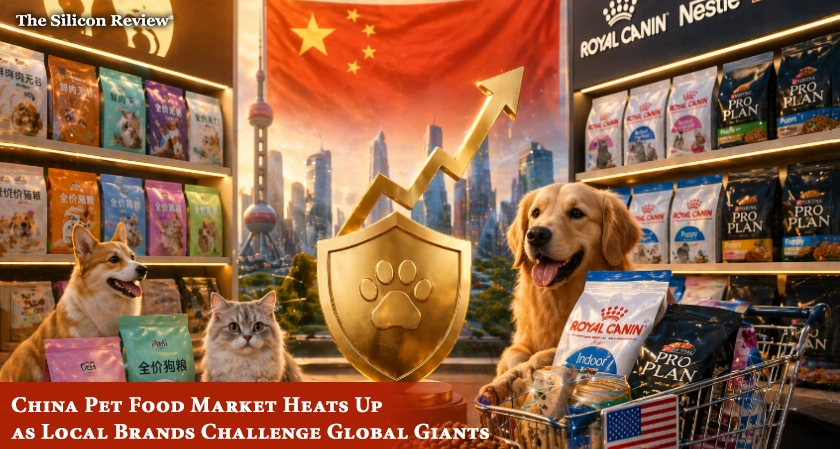
China's $24 billion pet food market is heating up as local brands gain ground on global players like Nestle and Mars. The Silicon Review reports on how domestic firms are winning over pet owners with fresh ingredients, attractive pricing, and aggressive e-commerce strategies.
China's pet food market has grown into a more than $24 billion industry, with annual sales rising sixfold between 2014 and 2024. The sector has become one of the brightest spots in the consumer economy, even as the broader market struggles with a property crisis, stagnant wage growth, and job security concerns.
Domestic brands are now challenging global players like Nestle's Purina, Mars' Royal Canin, & Canada's Orijen. Local producers focus on attractive packaging, a variety of flavors and kibble shapes, and aggressive spending on e-commerce platforms including ByteDance's Douyin. Many offer gifts in-store or online and are now moving up the value chain, adding more meat and fresher ingredients to their recipes.
"Domestic firms can reach more than 90% animal protein in some cat foods, while many foreign brands use plant proteins such as soy," said Li Bingnan, sales director at Steo International Trade Co, a pet food producer founded in 2023. Li said its sales jumped 40% in 2025.
Large domestic firms are entering the sector seeking new revenue streams. China's $260 billion liquor maker Kweichow Moutai plans to develop pet food from protein byproducts of its fermentation process. Pork producer Wens Foodstuff acquired pet food maker Qingdao Shuang'an Biotechnology Co, while WH Group, owner of Smithfield Foods, invested in Zhongyu Pet Food last year. Dairy companies Mengniu and Yili, as well as drugmaker Yunnan Baiyao Group, have also launched pet food lines.
China produced 1.9 million metric tons of pet food in 2025, up 17.9% from a year earlier, the China Feed Industry Association said in March, calling it the fastest-growing segment of the animal feed industry.
Still, safety concerns persist. "There is a low threshold for making pet food; anyone can do it," said Andy Wong, vice chairman at the China Association for Quality Inspection's pet food and supplies committee. There are no national standards for the industry, which is overseen by the Ministry of Agriculture. "Pet food is not the same as animal feed but that's how they are being categorised and regulated right now," said Fu Zhenzhen, an analyst at Beijing Orient Agribusiness Consultants.
As China's $24 billion pet food market heats up and local brands challenge global players like never before, The Silicon Review examines how domestic firms are winning over a new generation of pet owners and why even industry giants like Mars are being forced to rethink their China strategy.
About the Author
Sashindra Suresh is an experienced writer specializing in artificial intelligence, software development, and emerging technologies. With a strong ability to translate complex technical concepts into clear, engaging insights, she has contributed to a wide range of publications and platforms. Her work focuses on making cutting-edge innovations accessible to both industry professionals and curious readers alike.