>>
Industry>>
Capital Market>>
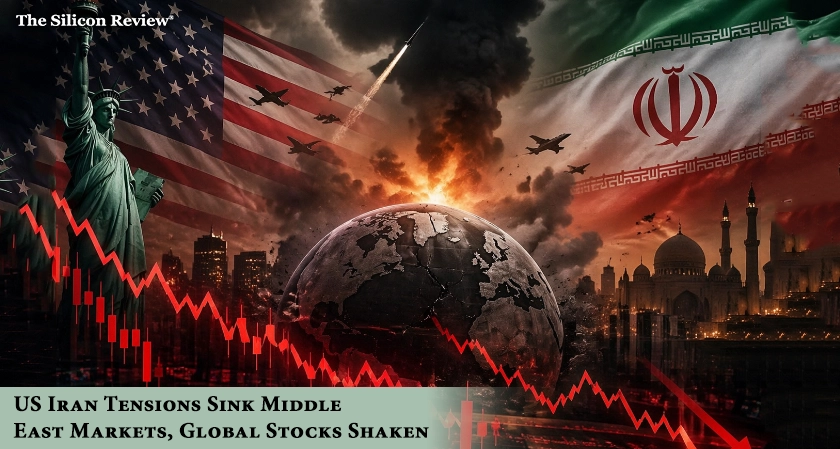
US Iran Tensions Sink Middle E...US Iran Tensions Sink Middle East Markets, Global Stocks Shaken
The Silicon Review
21 April, 2026
Author:
The Silicon Review Team
US Iran tensions sent Middle East stock markets plunging after Tehran vowed retaliation for a cargo ship seizure. The Silicon Review reports on the selloff as investors fear the fragile ceasefire could collapse before scheduled talks in Pakistan.
Middle East stock markets plunged on Sunday as US Iran tensions escalated sharply following Tehran's vow to retaliate for the seizure of an Iranian cargo ship near the Strait of Hormuz.
The Dubai Financial Market General Index fell 4.2%, its steepest single-day decline since the start of the Iran war in late February. Saudi Arabia's Tadawul All Share Index dropped 3.8%, while the Abu Dhabi Securities Exchange lost 3.5%. Qatar's QE Index fell 2.9%, and the Kuwait Stock Exchange declined 3.1%.
The selloff was triggered by Iran's military command, Khatam al-Anbiya, which condemned the US seizure of the Iranian-flagged cargo ship Touska as "armed piracy" and vowed "swift retaliation.” The statement came just three days before the fragile US-Iran ceasefire is set to expire, raising fears that the truce could collapse before scheduled talks in Pakistan.
Banking and petrochemical sectors led the declines. Saudi Basic Industries Corporation (SABIC) fell 5.2%, while Emirates NBD dropped 4.8% in Dubai. Qatar National Bank, the region's largest lender, declined 3.7%.
"Investors are pricing in a worst-case scenario where the ceasefire collapses and the Strait of Hormuz remains closed indefinitely," said Mohammed Ali Yasin, chief strategy officer at Al Dhabi Capital. "No one wants to hold regional stocks over the weekend with this kind of geopolitical risk."
Global stock market today showed early signs of contagion. U.S. futures fell 1.2% in overnight trading, while Asian markets opened lower, with Japan's Nikkei down 1.8% and Hong Kong's Hang Seng declining 1.5%.
Oil prices surged 3% in early Asian trading on Monday, with Brent crude climbing back above $105 per barrel after closing at $102.50 on Friday. The Strait of Hormuz remains effectively closed for the seventh consecutive week, choking off approximately 20% of global oil supplies.
The US has imposed a naval blockade on Iranian ports and has warned that any Iranian military response will be met with "overwhelming force." President Donald Trump has deployed additional naval assets to the Gulf, including a second aircraft carrier strike group.
As tensions send Middle East markets tumbling and threaten to collapse the fragile ceasefire, The Silicon Review examines how investors are pricing in the worst-case scenario and whether global stocks can withstand another shock to energy markets already reeling from weeks of disruption.
About the Author
Sashindra Suresh is an experienced writer specializing in artificial intelligence, software development, and emerging technologies. With a strong ability to translate complex technical concepts into clear, engaging insights, she has contributed to a wide range of publications and platforms. Her work focuses on making cutting-edge innovations accessible to both industry professionals and curious readers alike.









-Recovered-Recovered-Recovered_2026-07-25_10-24-34.webp")

-Recovered-Recovered-Recovered_2026-07-25_10-03-12.webp")