>>
Industry>>
Legal>>
AI Laws Need Rethinking Amid D...AI Laws Need Rethinking Amid Disruption: PM Wong
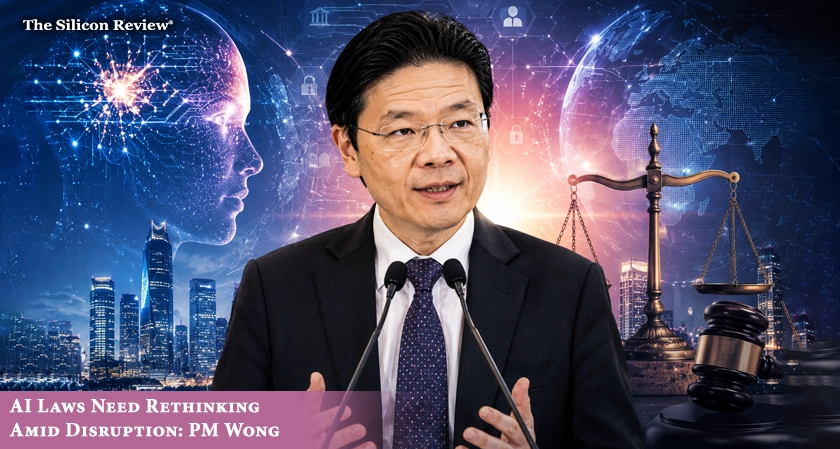
AI laws must be rethought as machines now make consequential decisions, said PM Lawrence Wong. The Silicon Review reports on Singapore's call to reimagine legal responsibility, liability and accountability in the age of intelligent machines.
Singapore Prime Minister Lawrence Wong issued a clarion call on May 13, 2026, for a fundamental rethink of AI laws, warning that legal frameworks worldwide were not designed for a world where machines can make "consequential decisions."
Speaking at the SGLaw200 Youth Forum at Singapore Management University, Wong declared that assumptions about artificial intelligence governance must evolve. "When an AI system causes harm a wrong medical diagnosis, a fatal accident involving a self-driving car who should be held accountable? The developer who built it? The company that deployed the machine? Or the person who used it?" he asked.
The Prime Minister acknowledged the tension regulators face. "Move too slowly, and the law falls behind while potentially people get hurt. Move too quickly and we risk stifling innovation. We must strike the right balance between safety & progress, between control and creativity," he said.
High Court Justice Philip Jeyaretnam reinforced this urgency at the Asia-Pacific Legal Congress 2026, identifying three characteristics of AI that challenge traditional law: opacity or black boxes, autonomous adaptation, and multi-actor development pipelines. These make it difficult to identify causes when things go wrong or assign responsibility when multiple parties participate in AI creation.
Justice Jeyaretnam cited the landmark Canadian case Moffatt v Air Canada, where a tribunal held Air Canada liable for negligent misrepresentation after its chatbot gave a customer incorrect bereavement fare information. The tribunal firmly rejected the airline's argument that the chatbot was a separate legal entity, but left unanswered what standard of care a deployer must meet when AI systems are inherently unpredictable.
Contracts formed by AI agents present another frontier. The Singapore International Commercial Court's decision in B2C2 Ltd v Quoine Pte Ltd addressed deterministic algorithms, with the majority focusing on the programmer's mental state. However, one judge proposed an alternative "reasonable trader" test for truly autonomous systems where machine learning has evolved beyond what programmers originally contemplated.
Wong emphasized that human judgment must remain central. "Machines can assist, analyse & recommend, but questions of responsibility, fairness & justice cannot be delegated entirely to algorithms. These are human questions, which humans must decide and that must always remain so," he concluded.
As Prime Minister Lawrence Wong calls for fundamental assumptions about AI laws to be rethought, The Silicon Review examines a legal revolution in the making where algorithms make consequential decisions but humans must answer for them.
Q: What did PM Lawrence Wong say about AI laws in Singapore?
A: Prime Minister Lawrence Wong said that fundamental assumptions about AI laws need to be rethought because legal frameworks worldwide were not designed for machines that can make "consequential decisions." He spoke at the SGLaw200 Youth Forum at Singapore Management University on May 13, 2026. He emphasized that questions of responsibility, fairness and justice cannot be delegated entirely to algorithms.
Q: Why do AI laws need to change in Singapore and globally?
A: AI laws need to change because traditional legal frameworks assume a human decision-maker. When an AI system causes harm such as a wrong medical diagnosis or a fatal self-driving car accident current laws struggle to assign accountability. Prime Minister Wong noted that developers, companies and users all have partial responsibility, but existing law does not clearly allocate liability.
Q: What is Singapore doing about AI governance & regulation?
A: Singapore launched the world's first Model AI Governance Framework for Agentic AI in January 2026, focusing on autonomous systems. The framework requires meaningful human accountability, transparency in AI decision-making and clear lines of responsibility. Singapore's judiciary is also training judges and lawyers on AI-related disputes through its dedicated "AI and the Law" resource page.
Q: What is the Moffatt v Air Canada case about AI liability?
A: Moffatt v Air Canada is a landmark Canadian case where an airline was held liable for negligent misrepresentation after its chatbot gave a customer incorrect bereavement fare information. The tribunal rejected Air Canada's argument that the chatbot was a separate legal entity. However, the case did not answer what standard of care a company must meet when AI systems are inherently unpredictable a question Singapore's legal framework is now exploring.
Q: How does Singapore's B2C2 Ltd v Quoine Pte Ltd case affect AI contracts?
A: The B2C2 Ltd v Quoine Pte Ltd case, decided by the Singapore International Commercial Court, addressed whether deterministic algorithms can form binding contracts. The majority focused on the programmer's mental state. However, one judge proposed an alternative "reasonable trader" test for truly autonomous systems where machine learning has evolved beyond what programmers originally contemplated. This case sets a precedent for how Singapore courts may handle future AI contract disputes.
Q: Who is responsible when an AI system causes harm in Singapore?
A: According to Prime Minister Lawrence Wong, there is no simple answer. Developers, companies that deploy AI systems and users may all share responsibility depending on the circumstances. Singapore's approach emphasizes "meaningful human accountability" meaning humans must remain in the loop for consequential decisions. The government is actively working on legal frameworks that balance safety with innovation, moving neither too slowly nor too quickly.