>>
Industry>>
EdTech>>
China Promotes AI Education Bu...China Promotes AI Education But Emphasizes Prudent, Phased Approach
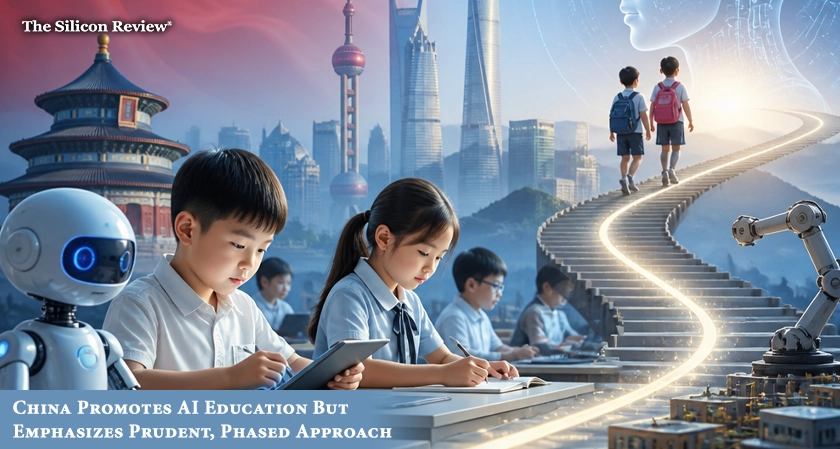
China is actively promoting AI education across primary and secondary schools while emphasizing the need to proceed prudently. The Silicon Review reports on the balance between innovation and protecting young students.
China's Ministry of Education has issued new guidelines promoting artificial intelligence education across primary and secondary schools while explicitly warning against rushing implementation or overburdening students with advanced concepts. The directive strikes a careful balance between Beijing's ambition to lead in AI and concerns about child development.
The AI education guidelines require all elementary and middle schools to offer introductory AI courses beginning in the 2026-2027 academic year. Primary students will learn basic concepts through hands-on activities with robots and simple programming. Secondary students will progress to data literacy, model training fundamentals, and AI ethics.
The ministry emphasized the need to proceed prudently, stating that course design must be age-appropriate and that no standardized AI testing will be implemented until at least 2030. The directive explicitly prohibits schools from using AI courses as a competitive differentiator or from assigning homework that requires commercial AI tools.
The AI training programs component includes teacher certification requirements. By 2028, all computer science teachers must complete 120 hours of AI-specific professional development. Provincial education departments have been allocated 2.5 billion yuan, or approximately $350 million, to establish AI teaching labs and training centers.
China's approach contrasts sharply with the United States, where AI education is left to individual districts and private initiatives, and with the European Union, where the focus has been on AI literacy for older students only. Beijing sees early exposure as a strategic imperative, not optional enrichment.
By the 2030 academic year, the ministry expects AI literacy to be integrated into national college entrance examinations, though testing will focus on concepts and ethics rather than technical implementation. The ministry is also developing age-appropriate AI textbooks for grades 1 through 12, with pilot programs beginning in 100 schools this fall.
The Silicon Review's analysis indicates that China's prudent approach to AI education reflects a sophisticated understanding that training the next generation of AI researchers requires balancing early exposure with developmental appropriateness. The ministry's phased rollout and teacher investment suggest Beijing is playing the long game, not chasing quick headlines.
Q: What are China's new AI education guidelines for primary and secondary schools?
A: All elementary and middle schools must offer introductory AI courses beginning in the 2026-2027 academic year. Primary students will learn basic concepts through robotics and simple programming.
Q: What does the Ministry of Education emphasize about implementing AI education?
A: The ministry emphasized the need to proceed prudently, stating that course design must be age-appropriate and that no standardized AI testing will be implemented until at least 2030.
Q: How many teacher training hours are required for AI education certification?
A: By 2028, all computer science teachers must complete 120 hours of AI-specific professional development.
Q: How much funding has been allocated for AI teaching labs and training centers?
A: Provincial education departments have been allocated 2.5 billion yuan, approximately $350 million, to establish AI teaching labs and training centers.
Q: How does China's AI education approach compare to the United States?
A: China's approach contrasts sharply with the United States, where AI education is left to individual districts and private initiatives. Beijing sees early exposure as a strategic imperative, not optional enrichment.
Q: When will AI literacy be integrated into national college entrance examinations?
A: By the 2030 academic year, the ministry expects AI literacy to be integrated into national college entrance examinations, focusing on concepts and ethics rather than technical implementation.