>>
Industry>>
Space>>
DARPA Readies space robotic de...DARPA Readies space robotic deep-space repair satellite for summer 2026 launch
The Silicon Review
26 May, 2026
Author:
Sashindra Suresh
DARPA's space robotic servicing of Geosynchronous Satellites will launch this summer to repair and refuel spacecraft 22,000 miles above Earth. The Silicon Review reports on the mission poised to transform satellite operations.
DARPA is finally ready to launch its long-delayed space Robotic Servicing of Geosynchronous Satellites (RSGS) demonstrator as soon as this summer, marking a major step toward repairing and refueling spacecraft in high orbit. The mission aims to service satellites in geosynchronous orbit (GEO), roughly 22,236 miles above Earth, where spacecraft typically have no options when they run out of fuel.
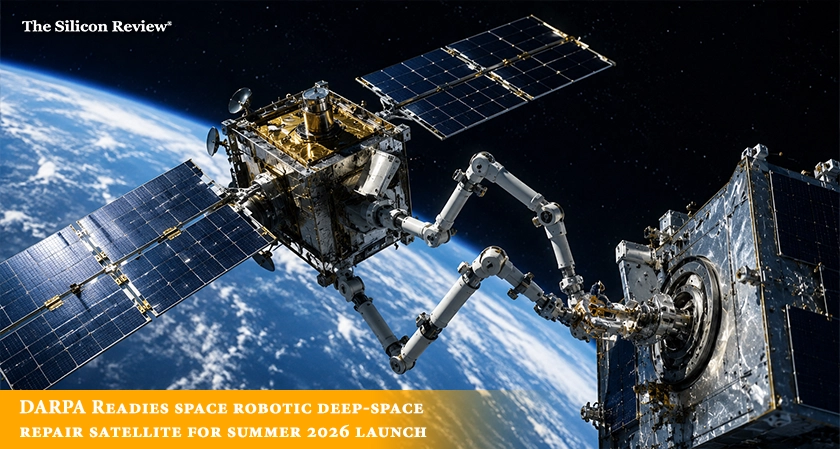
The heart of the mission is a highly dexterous robotic servicing suite developed by the U.S. Naval Research Laboratory. The system features two multi-axis robotic arms capable of performing on-orbit upgrades, inspections, anomaly resolution, and satellite relocation. The robotic payload recently completed critical thermal vacuum testing at NRL, confirming it can withstand the punishing heat, cold, and vacuum conditions of space.
The space robotics system is integrated onto Northrop Grumman SpaceLogistics' Mission Robotic Vehicle (MRV) platform, the same bus that successfully docked with two live Intelsat satellites in 2020 and 2021. After launch, RSGS will use electric propulsion for an approximately ten-month journey to GEO, with full servicing demonstrations expected to begin around 2027.
NASA and the U.S. Naval Research Laboratory are key partners on the mission. NRL spent over 20 years maturing the technology, with engineers testing avionics, cameras, lights, and both robotic arms across the range of temperatures they will face on-orbit . The system carries a sophisticated Rendezvous and Proximity Operations suite with multiple cameras, sensors, and infrared imaging to allow safe approach to client satellites.
"By transitioning from a paradigm of disposable space assets to one of sustainable, upgradable, and resilient satellites, RSGS aims to fundamentally alter space operations for both the public and private sectors," DARPA officials wrote in a statement.
The satellite servicing market represents a significant opportunity. A typical geostationary satellite costs hundreds of millions of dollars and lasts about 15 years, but without refueling or repair options, they are often decommissioned early. The North American on-orbit servicing market is projected to reach $1.3 billion by 2026.
Assuming an on-time launch, RSGS will begin work in 2027 after its journey to geosynchronous orbit. The program aims to demonstrate that routine satellite maintenance is not only possible but commercially viable, potentially creating a new paradigm for space operations where satellites can be upgraded, refueled, and repaired rather than replaced.
DARPA's robotic satellite repair mission is poised to demonstrate that a single, reusable servicing craft can materially reduce mission risk, extend GEO asset lifetimes, and contribute to a more sustainable orbital environment. The Silicon Review's analysis indicates that RSGS represents the culmination of over two decades of research and could open the door to a commercial on-orbit servicing industry worth billions.
Q: What is DARPA's RSGS mission?
A: RSGS is the Robotic Servicing of Geosynchronous Satellites mission, a DARPA-led program to demonstrate robotic repair, refueling, and upgrading of satellites in high Earth orbit using a dexterous dual-arm robotic system.
Q: When will DARPA launch the RSGS satellite?
A: RSGS is scheduled to launch as soon as summer 2026. After launch, it will use electric propulsion for an approximately ten-month journey to geosynchronous orbit, with full servicing demonstrations expected to begin around 2027.
Q: How far above Earth will RSGS operate?
A: RSGS will operate in geosynchronous orbit (GEO), approximately 22,236 miles or 35,786 kilometers above Earth, which is about 90 times higher than the International Space Station.
Q: What can the RSGS robotic system do?
A: The dual robotic arms can perform on-orbit upgrades, inspections, anomaly resolution, satellite relocation, refueling, and even install new hardware modules on satellites that were never designed to receive them.
Q: Who built the RSGS robotic system?
A: The U.S. Naval Research Laboratory developed the robotic payload for DARPA over more than 20 years. Northrop Grumman SpaceLogistics integrated it onto their Mission Robotic Vehicle platform. NASA also contributed technical expertise.
Q: Why is satellite servicing important?
A: Geostationary satellites cost hundreds of millions of dollars but cannot be repaired or refueled after launch. Servicing can extend their operational life, reduce space debris, and lower costs by enabling upgrades rather than full replacements.