>>
Industry>>
Capital Market>>
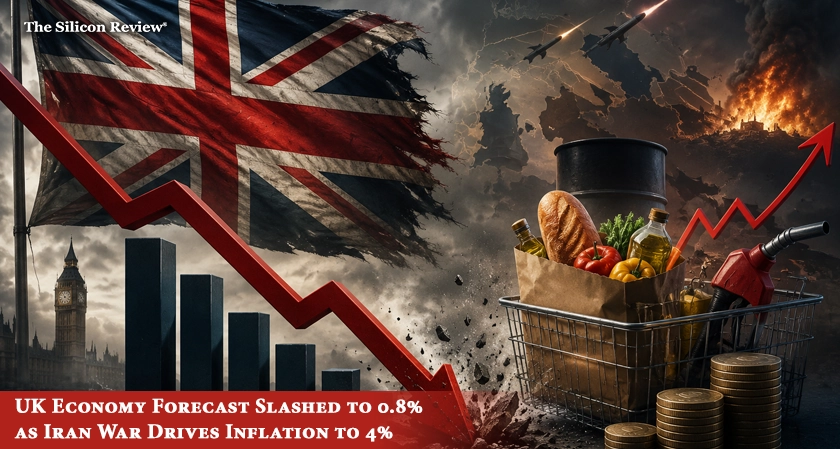
UK Economy Forecast Slashed to...UK Economy Forecast Slashed to 0.8% as Iran War Drives Inflation to 4%
The Silicon Review
14 May, 2026
Author:
Sashindra Suresh
The UK economy is set to grow just 0.8% in 2026 as the Iran war sends inflation to 4% by year-end. The Silicon Review reports on the EY forecast and £32bn budget hit.
Britain‘s economy is forecast to grow just 0.8 per cent in 2026, sharply downgraded from pre-war expectations of 1.3 per cent, as the Iran war drives energy costs higher and pushes inflation to 4 per cent by the end of the year, according to the EY ITEM Club .
The UK economy grew a stronger-than-expected 0.6 per cent in the first quarter of 2026, driven by a bumper February before the conflict began. However, economists warn this “will be the high point for the year,” with growth expected to stall or even contract in the second and third quarters.
Inflation is already rising. The Consumer Prices Index increased to 3.3 per cent in March, up from 3.0 per cent in February, with motor fuel prices as the greatest contributor. Food inflation has also accelerated to 3.7 per cent. The Food and Drink Federation has revised its forecast to over 9 per cent by the end of 2026, driven by energy and supply-chain shocks.
The National Institute of Economic and Social Research has warned that a prolonged closure of the Strait of Hormuz could wipe as much as £68 billion from the UK economy, pushing unemployment to 5.8 per cent a rate not seen since 2014 and inflation to 5 per cent .
The Bank of England is now expected to hold interest rates at 3.75 per cent throughout 2026, with rate cuts not expected until spring 2027. Prior to the conflict, cuts had been anticipated. Financial markets no longer expect any reductions this year, and some economists suggest a hike remains possible.
The conflict has also strained public finances. The Institute for Public Policy Research estimates the war will add £8 billion annually to the UK budget, rising to approximately £32 billion by 2030 through higher debt interest payments and lost tax revenues.
Households are pulling back. Consumer spending growth is forecast to slow to just 0.3 per cent in 2026, down from 0.9 per cent pre-conflict, with discretionary spending bearing the brunt.
As the Iran war slashes UK growth forecasts to 0.8% and drives inflation toward 4%, The Silicon Review examines how higher energy costs, rising mortgage rates and £32bn in budget pressure could reshape Britain‘s economic landscape for years to come.
Q: How has the Iran war affected UK economic growth forecasts?
A: The UK economy is now forecast to grow just 0.8 per cent in 2026, down sharply from the pre-war forecast of 1.3 per cent. EY warns growth could fall to just 0.3 per cent if the Strait of Hormuz remains closed all year.
Q: What is the current UK inflation rate and why is it rising?
A: UK inflation rose to 3.3 per cent in March 2026, up from 3.0 per cent in February, driven largely by higher motor fuel prices. The Bank of England expects inflation to reach 4 per cent by the end of the year.
Q: Will the Bank of England cut interest rates in 2026?
A: No. Prior to the Iran war, rate cuts had been expected, but the Bank of England has now held rates at 3.75 per cent. Financial markets expect no cuts in 2026, with the next reduction not anticipated until spring 2027.
Q: How will the Iran war affect UK household spending?
A: Consumer spending growth is forecast to slow to just 0.3 per cent in 2026, down from 0.9 per cent pre-war. Discretionary spending will be hit hardest, with retail, hospitality and events sectors particularly exposed.
Q: What is the worst-case economic scenario for the UK if the war continues?
A: If the Strait of Hormuz remains closed, NIESR warns the UK could face recession, with unemployment rising to 5.8 per cent a rate not seen since 2014 & inflation reaching 5 per cent.
Q: How much is the Iran war costing the UK government?
A: The IPPR estimates the war will add £8 billion annually to the UK budget, rising to approximately £32 billion by 2030 through higher debt interest payments and lost tax revenues.