>>
Industry>>
Energy and Utility>>
US Energy Storage Additions Hi...US Energy Storage Additions Hit First-Quarter Record, Report Shows
The Silicon Review
21 May, 2026
Author:
Vinay Kumar
US energy storage installations hit a first-quarter record with 3.2 gigawatts deployed, driven by solar-plus-storage projects. The Silicon Review reports on the battery storage boom and accelerating renewable energy integration.
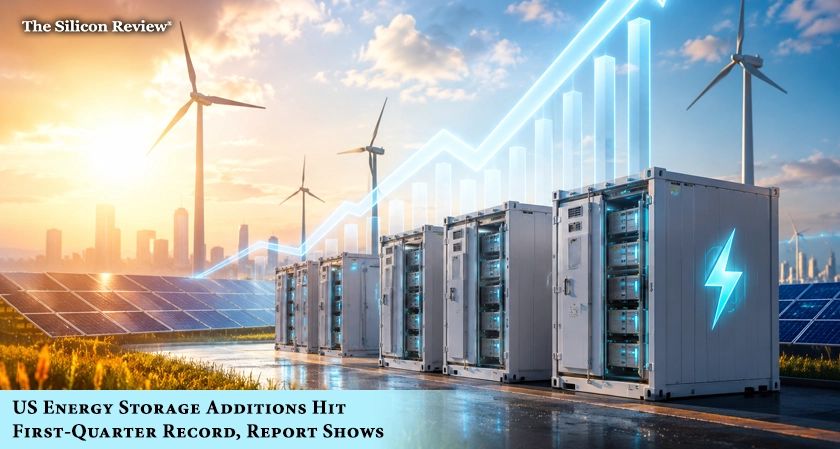
The United States installed a record 3.2 gigawatts of energy storage in the first quarter of 2026, a 26 percent increase from the previous record set in the fourth quarter of 2025, according to a new report from Wood Mackenzie and the American Clean Power Association.
Battery storage systems have become the fastest-growing segment of the US power sector. The first-quarter installations were dominated by utility-scale projects at 2.9 gigawatts, while residential and commercial installations accounted for the remaining 300 megawatts.
The renewable energy storage growth was driven by three factors: falling battery prices, the expiration of supply chain constraints that plagued the industry in 2023 and 2024, and the completion of solar-plus-storage projects that had been delayed by interconnection queue backlogs.
The battery storage boom is concentrated in four states. California led with 1.1 gigawatts of new storage, followed by Texas at 900 megawatts, Arizona at 500 megawatts, and Nevada at 300 megawatts. These states have aggressive renewable energy mandates and have streamlined permitting for storage projects.
The energy storage industry is also seeing technology improvements. The average duration of utility-scale battery storage systems has increased from 2.4 hours in 2023 to 3.7 hours in the first quarter of 2026, allowing grid operators to shift solar power deeper into evening hours.
The storage boom is accelerating renewable energy integration. Battery systems allow solar and wind farms to store excess generation and dispatch it when demand peaks. Without storage, renewable energy output would be curtailed when generation exceeds demand.
The Silicon Review's analysis indicates that the energy storage record reflects a structural shift in US power markets. Batteries are no longer niche grid assets but mainstream infrastructure competing directly with natural gas peaker plants. The storage boom is happening despite federal policy uncertainty, suggesting market forces are now driving the transition.
Q: How much energy storage was installed in the US in Q1 2026?
A: The US installed a record 3.2 gigawatts of energy storage in the first quarter of 2026, a 26 percent increase from the previous record set in Q4 2025.
Q: Which four states led the energy storage boom?
A: California led with 1.1 gigawatts, followed by Texas at 900 megawatts, Arizona at 500 megawatts, and Nevada at 300 megawatts.
Q: How has battery storage duration improved?
A: The average duration of utility-scale battery storage systems has increased from 2.4 hours in 2023 to 3.7 hours in the first quarter of 2026.
Q: What factors drove the first-quarter storage record?
A: Falling battery prices, the expiration of supply chain constraints, and the completion of solar-plus-storage projects that had been delayed by interconnection queue backlogs.
Q: How much total US storage does Wood Mackenzie project for full year 2026?
A: Wood Mackenzie projects that total US storage installations for the full year will reach 14 gigawatts, doubling the 7 gigawatts installed in 2025.
Q: Why are battery storage systems critical for renewable energy integration?
A: Battery systems allow solar and wind farms to store excess generation and dispatch it when demand peaks, preventing renewable energy from being curtailed when generation exceeds demand.