>>
Industry>>
Digital marketing>>
Beyond the Surface: Why Materi...Beyond the Surface: Why Material Accuracy Matters in Digital Product Assets
The Silicon Review
25 May, 2026
Author:
The Silicon Review Team
A product model with correct geometry can still look wrong. The shape is accurate, the proportions match the physical object, and yet something about the surface reads as flat, synthetic, or unconvincing. In a marketing render this might pass. In an AR preview on a customer's phone, in a product configurator where someone is choosing between finish options, or in a virtual showroom that a sales team is using in a client presentation — the problem becomes visible in ways that cost real decisions.
Companies investing in digital product content are increasingly discovering that the geometry of a 3D model is only part of what makes it useful. Surface quality is the other part, and for many product categories, it is the part that determines whether the asset can actually do what it is intended to do.
Assets being used in more places
The operational context for digital product assets has expanded considerably beyond the marketing image library.
An accurate 3D model of a sofa, a watch, a lighting fixture, a flooring tile, or a kitchen appliance may now be expected to serve as the basis for a white-background ecommerce image, a lifestyle render, a product configurator where customers choose finishes, an AR preview on a mobile device, a virtual showroom experience, a sales presentation deck, and in some categories, a digital twin that supports after-sales and maintenance documentation.
Each of these applications has different rendering requirements, different platform constraints, and different audience expectations. The surface material has to perform under all of them. A texture that looks adequate in one context may reveal problems in another — particularly when lighting conditions, rendering engines, or display environments change.
As brands reuse the same product assets across ecommerce pages, AR previews, configurators, and sales materials, 3d model texturing services can help ensure that surfaces such as fabric, wood, metal, glass, and leather look believable across different visual formats. This is not primarily a creative question. It is a quality control question — one that becomes more consequential the more applications a single asset is expected to serve.
What inaccurate surfaces actually do
The effects of weak material treatment on digital product assets are specific and predictable.
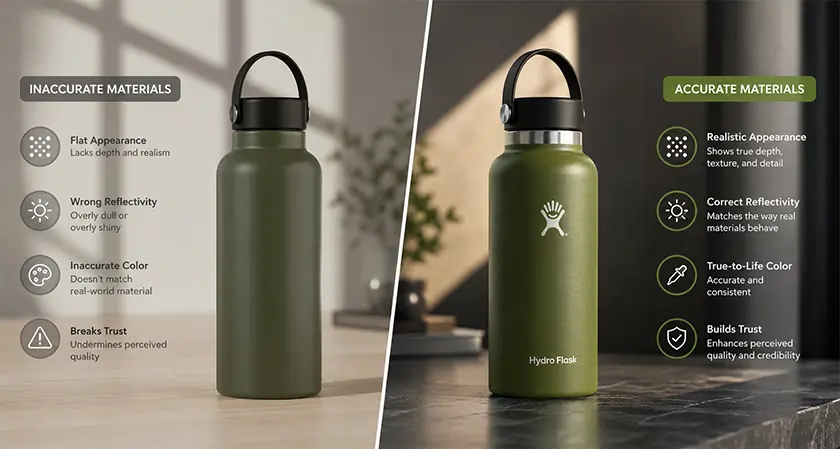
Wood that is rendered without believable grain reads as a flat coloured surface. Fabric without visible weave structure looks like moulded plastic. Leather without the characteristic micro-texture that makes it recognisable loses the quality signal that justifies premium pricing. Metal without appropriate reflectivity control can look either too dull or unrealistically shiny depending on the rendering environment. Stone without pattern variation across its surface looks synthetic even when the geometry is accurate.
For product categories where the material is central to the value proposition — luxury goods, home furnishings, high-end appliances, premium fashion accessories — these are not incidental visual failures. They are brand credibility failures. A product that looks cheaper in its digital representation than it is in reality is actively working against the purchasing decision it is supposed to support.
Texture resources and production pipelines
The practical challenge for teams managing larger product-visualization programs is sourcing and maintaining reliable texture material for a growing range of SKUs and finish variants.
For teams building their own asset libraries, choosing reliable textures for 3d models is a practical step toward more consistent surfaces, especially when working with PBR materials such as diffuse, roughness, metalness, normal, and ambient occlusion maps. PBR — Physically Based Rendering — is the current standard approach for ensuring that materials respond to light in a way that approximates real-world surface behaviour. A PBR-ready texture pack for, say, a specific fabric type will produce consistent results across different lighting conditions and rendering environments, which makes it a more reliable foundation for multi-channel asset production than a simpler approach would.
The sourcing decisions that matter here include resolution, format compatibility, licensing clarity, and the range of material types available. A texture library that covers the categories a brand actually needs — a range of wood species, fabric constructions, metal finishes, surface treatments — at the resolution required for close-up product imagery is a different tool than one that is broad but shallow.
Governance as material assets scale
When product visualization programs grow to cover hundreds or thousands of SKUs across multiple finish options, material governance becomes a practical business problem rather than a creative preference.
Questions that need answered systems rather than case-by-case decisions: Which materials are approved for which product categories? What resolution and format standards apply to different output channels? How are finish variants tracked and named so that teams working across campaigns, platforms, and markets can find the right material file? How is version control handled when a brand updates its finish options? What QA process ensures that a material developed for a product page renders correctly in the AR preview?
Companies that do not address these questions at the systems level tend to encounter them at the production level, where the cost of finding and fixing inconsistencies is considerably higher.
PBR and multi-environment consistency
The business case for PBR materials specifically comes from the multi-environment reality of modern product asset use.
A product asset may be viewed in a professionally lit ecommerce studio environment, in the ambient natural light condition of a customer's living room through an AR viewer, in a high-performance real-time rendering engine used in a virtual showroom, and in a lower-fidelity mobile environment where computational constraints require optimised versions. A material built without PBR discipline may look acceptable in the first environment and clearly wrong in the others.
Diffuse maps carry the base colour and surface appearance information. Roughness maps control how sharp or scattered reflections are — a matte fabric versus a polished metal. Metalness maps indicate whether a surface behaves as a metal or a non-metal under lighting. Normal maps add surface detail and micro-texture without increasing geometry complexity. Ambient occlusion maps simulate how light is absorbed differently in creases and recesses. Together, these components produce materials that behave consistently across different lighting and rendering contexts, which is exactly what multi-channel asset programs require.
Reusable assets as strategic infrastructure
The direction of travel in product visualization is toward assets that can move between channels, applications, and time periods while maintaining material integrity and brand consistency.
This is a different paradigm from producing images. An image is an output. A well-built 3D asset with accurate, maintained materials is infrastructure — something that can support future campaigns, new channel requirements, AR and configurator applications that may not have existed when the asset was first produced, and future product line extensions that share the same finish vocabulary.
Companies treating digital product assets as infrastructure rather than campaign deliverables are building a capability that becomes more valuable as more of the product discovery and purchasing journey moves through digital channels. The material quality embedded in those assets is part of what makes them usable over time.
Surface detail is not a finishing touch in digital product visualization. For product categories where customers are judging materials as much as shapes, it is part of the core asset quality that determines whether the digital representation can support the business decisions it is intended to influence.








_2026-06-24_13-28-21.webp")


_2026-06-24_12-35-51.webp")