>>
Industry>>
Oil and gas>>
Australian Gas Exploration Sur...Australian Gas Exploration Surges to 10-Year High as Energy Security Takes Center Stage
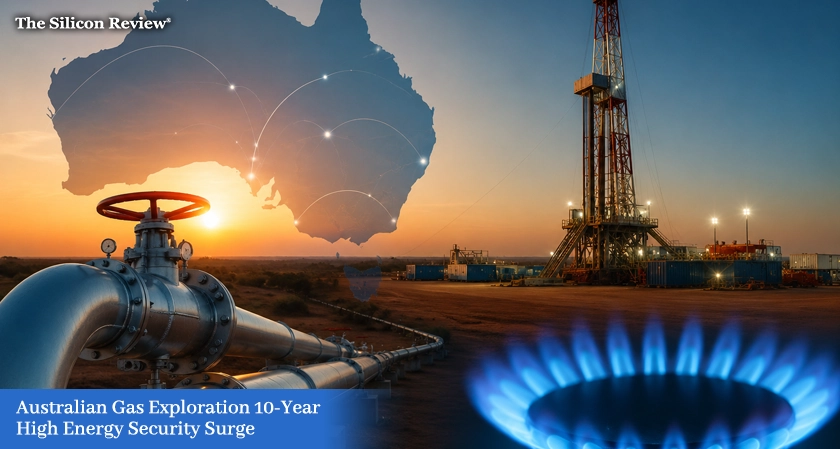
Australian gas exploration spending has hit a 10-year high; with AUD$471 million invested in the March quarter alone as war and Asian demand underscore the urgency to secure domestic supply. The Silicon Review examines how the world's second-largest LNG exporter is doubling down on gas at a time when energy security has become a national priority.
Australia is in the midst of a gas drilling boom. Quarterly oil and gas exploration spending hit AUD$471 million ($329 million) in the March quarter, the highest level in a decade. Rystad Energy forecasts full-year spending will top $1 billion, an increase of about 10 per cent.
Three regions are leading the charge: the Otway Basin offshore western Victoria, the Beetaloo shale in the Northern Territory, and the Taroom Trough in Queensland.
The Otway Basin is the most established and closest to existing infrastructure. In the Beetaloo, the Northern Territory government is pushing development of what it hopes can become an LNG-scale shale resource, offering new acreage and co-funding. Santos is set to drill three appraisal wells there this year, while Japan's Inpex took a stake in a Beetaloo permit in March.
"We're seeing renewed interest in frontier and unconventional plays as modern techniques de-risk development," said Krishan Pal Birda, vice president at Rystad Energy.
The boom is driven by multiple factors. The Iran war has underscored the urgency to develop supply after years of sluggish spending. Asian gas demand continues to surge. And technological advances are reducing exploration costs.
But the surge comes with tension. Canberra last month mandated that 20 per cent of gas be set aside for domestic use, sparking industry backlash. Australian Energy Producers CEO Samantha McCulloch warned that the country "must not let our gas industry become the next essential sector to be driven out of Australia.” She argued that fossil fuels still account for 80 per cent of global primary energy consumption and 91 per cent in Australia.
Here is the question this exploration surge raises. Australia is the world's second-largest LNG exporter, yet faces a domestic gas shortfall by the end of the decade. The government is demanding 20 per cent be reserved for local use. The industry is pushing back. When a nation is exporting gas while warning of domestic shortages, who is the priority, the customer in Tokyo or the manufacturer in Melbourne?
New South Wales launched its first gas exploration tender in 10 years earlier this year. Queensland has backed a new oil project. Even offshore exploration, costlier and riskier, is on the rise. ConocoPhillips completed a wildcat well in the Otway Basin at the end of 2025, with one discovery and another well under assessment.
As Australian gas exploration surges to a 10-year high, The Silicon Review asks a final question. When energy security takes centre stage and exploration spending hits record levels, is this the beginning of a new era for Australian gas or just a final boom before the world moves on?
FAQ:
Q: How much did Australian gas exploration spending reach in the March quarter?
A: Australian gas exploration spending hit AUD$471 million ($329 million) in the March quarter, the highest level in a decade.
Q: Which regions are driving the Australian gas exploration surge?
A: The three key regions are the Otway Basin offshore western Victoria, the Beetaloo shale in the Northern Territory, and the Taroom Trough in Queensland.
Q: What is the Beetaloo Basin and why is it important?
A: The Beetaloo Basin in the Northern Territory is a shale gas formation estimated to hold some 500 trillion cubic feet of gas, with the territory government hoping it can become an LNG-scale production hub.
Q: What is the Taroom Trough project?
A: The Taroom Trough in Queensland is backed by the state government and would be the first new oil project approved in Australia in 50 years.
Q: What is the government's domestic gas reservation requirement?
A: Canberra has mandated that 20 per cent of gas production be set aside for domestic use to address a looming shortfall by the end of the decade.













Comments