>>
Industry>>
Healthcare>>
Bird Flu Australia: Deadly H5N...Bird Flu Australia: Deadly H5N1 Spreads to Second State as Fears Grow for Native Wildlife
The Silicon Review
24 June, 2026
Author:
Sashindra Suresh
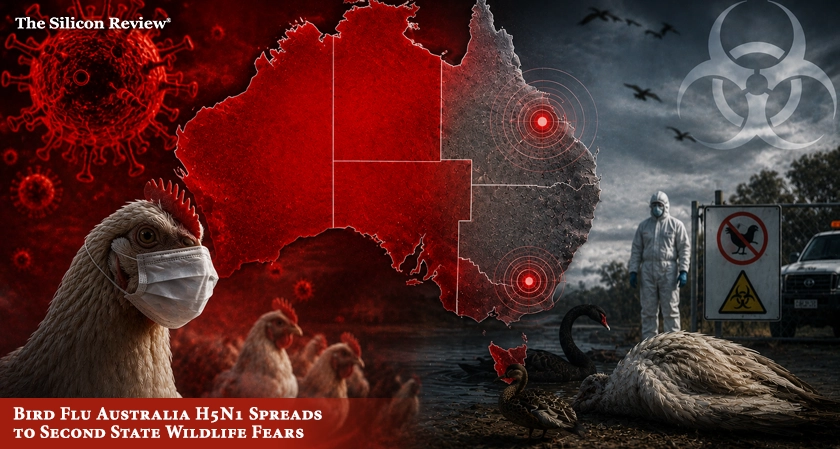
Bird flu Australia has confirmed its first mainland cases of H5N1 in Western Australia, with the virus now detected in a second state as migratory seabirds carry the deadly strain across the continent. The Silicon Review examines what this means for Australia's unique wildlife and biosecurity.
Australia's long-held status as the last continent free of H5N1 bird flu has ended. And the virus is already spreading.
On June 20, Agriculture Minister Julie Collins confirmed the first mainland case in a brown skua found at Cape Le Grand National Park near Esperance in Western Australia. A second bird, a giant petrel from the same region, also tested positive. Then, within days, bird flu Australia fears escalated when two dead seabirds and a pelican were found at Fowlers Bay in South Australia, more than 1,200 kilometres away.
"This is obviously concerning, but given the spread of H5 globally it is not unexpected that other migratory birds may have arrived at other locations across the Australian coastline," Collins told reporters.
The H5N1 strain has devastated wildlife globally since 2021. Earlier this year, researchers estimated the virus killed more than 13,000 southern elephant seal pups on Australia's sub-Antarctic Heard Island a mortality rate exceeding 75 per cent. Scientists believe the virus was introduced to Heard Island in August 2025 by migrating birds from the French-owned Crozet Islands, about 1,800 kilometres away. The brown skua and giant petrel found in Western Australia are sub-Antarctic migratory species and likely arrived from that region, blown off course while sick.
Here is the truth about what is happening. Australia has spent $113 million on preparedness, tightened farm biosecurity, vaccinated vulnerable species, and conducted response simulations. But the virus arrived anyway. Migratory birds do not respect borders, and they do not respect budgets. The question is not whether Australia could have stopped it. The question is how many native species will pay the price.
Invasive Species Council policy director Carol Booth called the detection "deeply concerning." "We desperately hope this is not the realisation of our worst dreams," she said. The government's own risk assessment predicts "potentially catastrophic impacts on native birds," while the virus's increasing ability to infect mammals raises the prospect of severe impacts on marine mammals and other wildlife.
At this stage, there is no evidence of infection in poultry or mass mortalities. Australia's poultry sector remains free of the virus, though one of the country's largest producers has locked down farms in Western Australia. Human risk remains exceptionally low, with no evidence of human-to-human transmission. Eggs and poultry meat are safe to eat provided they are handled and cooked according to standard practices.
Neighbouring Papua New Guinea briefly suspended poultry imports from Australia, though the ban has since been lifted with some exceptions.
As bird flu Australia spreads into a second state, The Silicon Review asks a final question. When the virus has already killed 13,000 seals and now threatens penguins, sea lions, and black swans, what will be left of Australia's unique wildlife if this outbreak takes hold?
FAQ:
Q: Where was the first case of bird flu Australia found?
A: The first bird flu Australia case was found in a brown skua, a migratory seabird, at Cape Le Grand National Park near Esperance in Western Australia on June 14, 2026.
Q: Has bird flu Australia spread to a second state?
A: Yes, bird flu Australia has spread to South Australia after two dead seabirds and a pelican were found at Fowlers Bay on June 22, 2026.
Q: Will H5N1 bird flu spread to Australian poultry farms?
A: There is no evidence of infection in poultry at this time, and Australia's poultry sector remains free of the virus.
Q: Can humans catch H5N1 bird flu from infected birds?
A: H5 bird flu is a low health risk to the public as it rarely affects humans unless there is direct and close contact with sick birds.
Q: What should I do if I find a sick or dead bird in Australia?
A: Do not touch it. Avoid contact. Record what you see. Report it to the Emergency Animal Disease Hotline on 1800 675 888.



















Comments