>>
Industry>>
Compliance and governance>>
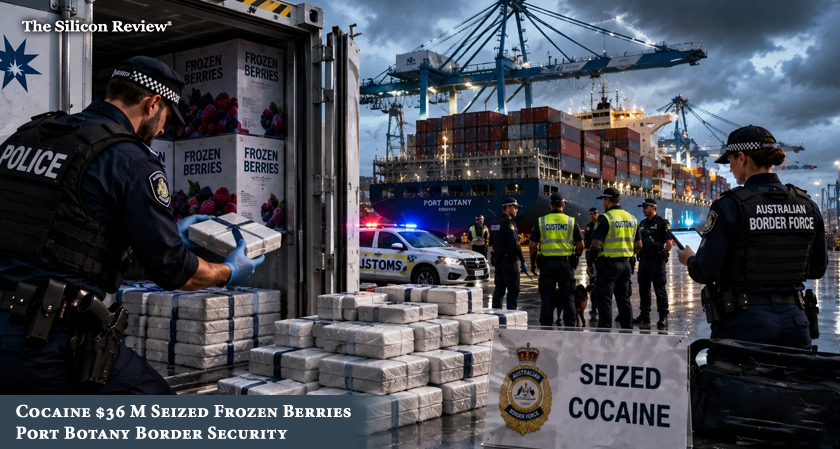
Cocaine worth $36 Million Seiz...Cocaine worth $36 Million Seized From Frozen Berry Shipment at Port Botany but It's a 23% Surge That Has Authorities Most Worried
The Silicon Review
29 June, 2026
Author:
Sashindra Suresh
Authorities have intercepted 110 kilograms of cocaine worth $36 million hidden inside a refrigerated shipment of frozen berries from Chile at Port Botany, as border seizures spike 23 per cent compared to last year. The Silicon Review examines how organised crime's relentless push into Australia's supply chains is being met with increasingly sophisticated detection.
It was meant to be a routine delivery of frozen berries. Instead, a shipping container bound for northwest Sydney held something far more sinister.
On June 24, Australian Border Force officers at Port Botany identified suspicious packages inside a refrigerated container from Santiago, Chile. Hidden among the berries were 110 single-kilogram bricks of compressed white powder. Testing confirmed it was cocaine. The street value? An estimated $36 million.
The matter was immediately referred to the Australian Federal Police, who seized the entire haul. No arrests have been made. Investigators are now appealing to the public for any information that could identify the criminal syndicate responsible.
"Criminal networks which attempt to bring harmful drugs into our country have no regard for the devastation these substances cause to individuals, families and communities," said AFP Detective Acting Superintendent Aaron Burgess. "The communities are our eyes and ears, and any information, however big or small, may help us identify those responsible for this failed importation."
The frozen berry bust is part of a larger trend that has authorities deeply concerned. ABF Acting Superintendent Noleen Shankar confirmed that cocaine detections at Australia's border have risen by 23 per cent compared with the same time last year.
"This highlights the expertise of ABF officers, leveraging intelligence-led targeting and their advanced operational capabilities to protect Australia's border," Shankar said. "No matter the methods criminals use to try and hide illicit goods, the ABF and our law enforcement partners will continue to target the syndicates behind these activities and dismantle their operations" .
Here is the question these numbers raise. A 23 per cent increase in cocaine seizures means one of two things. Either authorities are getting better at finding the drugs, or criminals are sending more of them. If organised crime is flooding Australia with cocaine at record rates, how many other frozen berry containers slipped through before this one? And when a syndicate loses $36 million, what lengths will they go to next?
The AFP is working with international partners to track the origins of this shipment. Anyone with information is urged to contact Crime Stoppers on 1800 333 000.
As authorities seize cocaine worth $36 million from a frozen berry shipment at Port Botany, The Silicon Review examines how a shipment that was supposed to look like a grocery delivery has become the latest front in Australia's war against organised crime.
FAQ:
Q: How much cocaine was seized at Port Botany?
A: Authorities seized 110 kilograms of cocaine, concealed as 110 single-kilogram bricks hidden among frozen berries.
Q: What is the street value of the seized cocaine?
A: The seized cocaine has an estimated street value of $36 million.
Q: Where did the frozen berry shipment come from?
A: The shipment originated from Santiago, Chile, and arrived at Port Botany in Sydney.
Q: When was the cocaine discovered?
A: Australian Border Force officers intercepted the shipment on June 24, 2026.
Q: How much have cocaine seizures increased at Australia's border?
A: Cocaine detections at Australia's border have risen by 23 per cent compared with the same time last year.
Q: Have any arrests been made?
A: No arrests have been made yet. Investigators are seeking public assistance to identify the criminal syndicate responsible.
















Comments