>>
Technology>>
Science and technology>>
Deep-Sea Animals Are Living Pr...Deep-Sea Animals Are Living Proof That Evolution Still Has Surprises Left
The Silicon Review
19 June, 2026
Author:
Jishnuu
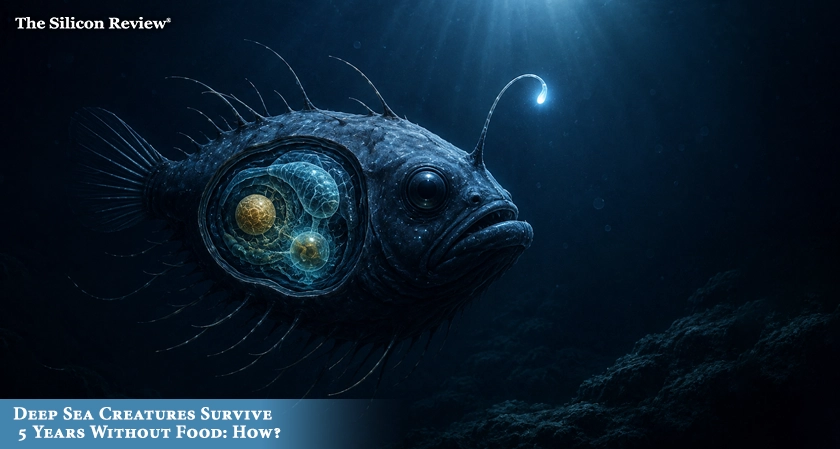
Deep in the ocean where light disappears and pressure crushes everything familiar, life isn’t just surviving. It is bending the rules of survival itself. Some deep-sea creatures can go years without eating, and scientists now think the explanation is far more unsettling than expected.
In the deepest parts of the ocean where food appears only once in years and darkness never ends, some creatures don’t just survive, they pause life itself. Deep-sea animals have evolved a strange biological system that lets them stretch a single meal across years, almost as if hunger has been rewritten out of the equation.
Researchers studying deep-sea animals, especially giant isopods, have uncovered a survival system that feels almost engineered. These creatures live in extreme darkness, where food arrives only occasionally as drifting organic debris from the surface. No hunting strategy can guarantee the next meal. So evolution did something radical: it slowed life down until time itself became an advantage.
These deep-sea creatures can survive more than five years without food by combining two extreme adaptations. First, a massively expanded stomach that acts like a biological storage tank. Second, a metabolism so slow it barely registers as active life.
It’s not evolution as we know it. It’s evolution rewriting its own rules.
But the real shock is not anatomy. It is genetics.
In a discovery that is surprising scientists, researchers from the Chinese Academy of Sciences identified a gene called ND1 that appears to have originated in bacteria before becoming part of the DNA of deep-sea animals through a rare process known as horizontal gene transfer. In other words, these creatures may have inherited a survival advantage from microbes, gaining an extra tool to manage energy in one of the most unforgiving environments on Earth. The finding suggests that nature may have quietly borrowed a bacterial solution to help deep-sea animals endure years of hunger, extreme cold, and crushing ocean pressure.
That gene behaves like a control system, fine-tuning how fast or slow energy is burned depending on environmental conditions. In experiments using other organisms, it showed a strange dual effect: boosting metabolism in normal conditions but helping conserve energy under cold stress.
It’s not just adaptation anymore. It starts to look like biological programming.
Inside deep-sea creatures, microbes linked to fat storage may help turn rare meals into slow-burning energy, almost like a built-in battery that releases fuel over years instead of hours. Some researchers call it an “earn more, spend less” survival model, while others argue we’re still missing the full picture.
Species like Bathynomus jamesi live in crushing depths where food is unpredictable, so their oversized stomachs store what little they get and stretch it across years.
The ocean's most remarkable survival trick isn't finding food. It's surviving without it
The ND1 gene adds another twist, helping control energy use under extreme cold and scarcity, raising questions about how flexible metabolism really is. Deep-sea creatures aren’t just surviving the ocean’s hardest conditions. They’re quietly redefining what survival even means.
The Silicon Review asks: If scientists can one day understand and replicate the extreme energy-saving mechanisms found in deep-sea creatures, could that transform how humans think about aging, survival, and the limits of life itself?
FAQ:
Q: How long can deep-sea animals survive without food?
A: Some giant deep-sea isopods can survive for more than five years without eating due to their slow metabolism and large energy reserves.
Q: Why can deep-sea creatures go years without food?
A: They combine an oversized stomach, extremely low energy consumption, and efficient nutrient storage to survive long periods of food scarcity.
Q: What is the ND1 gene discovered in deep-sea animals?
A: ND1 is a gene linked to energy regulation that researchers believe was acquired from bacteria through horizontal gene transfer.
Q: What is horizontal gene transfer?
A: Horizontal gene transfer is the movement of genetic material between unrelated organisms rather than from parent to offspring.
Q: Which deep-sea animals were studied?
A: Researchers focused on giant isopods, including Bathynomus doederleini and Bathynomus jamesi.
Q: Why is this deep-sea discovery important?
A: The findings could improve understanding of metabolism, energy conservation, survival under extreme conditions, and future biological research.
Q: Could this research help humans live longer?
A: The study does not show lifespan extension in humans, but it may provide insights into energy use, aging, and survival biology.





















Comments