>>
Industry>>
Lifestyle and fashion>>
How to Dress for a Summer Wedd...How to Dress for a Summer Wedding Without Overheating or Getting It Wrong
The Silicon Review
17 June, 2026
Author:
Guest
Summer wedding dressing is less about finding a pretty outfit and more about making a practical decision under constraints: heat, venue, dress code, travel time, and how long you need to stay presentable. The right outfit should look intentional without becoming uncomfortable halfway through the event. This guide gives you a practical way to decide what to wear before you buy, rent, sew, or alter anything.
What to Wear to a Summer Wedding as a Guest by Dress Code
Most wedding dress codes slot into one of four tiers. The confusion usually comes from language that sounds formal but isn't, or casual phrasing that still expects some effort. Here's a quick reference:
|
Dress Code |
What It Actually Means |
Safe Choice for Women |
Safe Choice for Men |
|
Black Tie / Formal |
Evening-length, structured, dressy |
Floor-length gown or formal midi |
Dark suit or tuxedo |
|
Cocktail |
Knee to midi length, polished but not stiff |
Midi dress, tailored jumpsuit |
Suit with or without tie |
|
Garden Party / Casual Elegant |
Relaxed but still put-together |
Floral or solid midi, wide-leg trousers |
Linen suit, chinos + blazer |
|
Casual / Beach |
Comfortable, weather-appropriate |
Sundress, light co-ord |
Linen shirt + trousers |
When in doubt, err one tier up rather than down. Overdressed guests fade into the background; underdressed ones get remembered.
Black Tie and Formal — When to Go Long
A floor-length gown is always correct at a black-tie wedding, but a formal structured midi in a rich color — deep navy, emerald, burgundy — works equally well at summer events, especially if the ceremony is outdoors and heels on grass are a concern.
Cocktail Attire — The Most Common and Most Confusing
Cocktail is the dress code people interpret most differently. The safest read: polished without being stiff. A well-cut midi dress, a tailored jumpsuit, or a blazer-and-skirt combination all work. "Cocktail" does not mean mini-length is required — especially in summer heat.
Casual and Garden Party — Relaxed Doesn't Mean Anything Goes
Floral prints, softer colors, and lighter silhouettes are welcome here. The real boundary is between "relaxed" and "I forgot there was a wedding." Avoid anything you'd also wear to a picnic — sundresses are fine, but leave the denim and athletic slides at home.
How to Plan a Summer Wedding Guest Outfit for Outdoor Venues
Heat, Humidity, and Why Your Outfit Needs to Work All Day
An outdoor summer wedding typically runs four to six hours — ceremony, cocktail hour, reception. Your outfit needs to hold up through all of it: sun, shade, dancing, and the inevitable moment when the air conditioning is too cold inside and the terrace is too hot outside.
The single most practical thing you can do is choose garments made from materials that breathe. If you're shopping or sewing your own, look for lightweight, natural-fiber dress fabrics — they move with you, handle sweat better than synthetics, and tend to wrinkle less dramatically over a long day.
A few other things worth thinking through before the day:
- Lining matters. A lined dress in a breathable fabric sits better and keeps its shape, but a heavy lining defeats the purpose in heat.
- Color affects heat absorption. Lighter colors reflect more sunlight, which matters if the ceremony is fully exposed.
- Sleeves aren't always the enemy. A sheer or flutter sleeve can actually protect your shoulders from sunburn without adding warmth.
The Footwear Problem Nobody Talks About
If the wedding has any outdoor element — a garden ceremony, a lawn reception, a gravel path between the parking lot and the venue — heels become a genuine problem. A stiletto sinks into the grass. A block heel is workable but slow. Flat sandals or a low kitten heel are the most honest choice for an outdoor venue.
If you're set on heels, bring a flat pair in your bag for the reception. Nobody will notice, and your feet will thank you by hour three.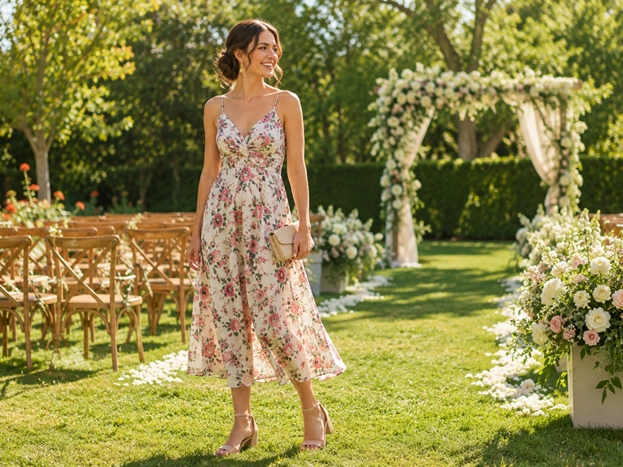
What to Actually Wear — Silhouettes, Colors, and What to Avoid
Colors and Prints That Work (and the Ones That Don't)
The one rule everyone knows: don't wear white, ivory, or anything that could be mistaken for the bride's color. Beyond that, summer is genuinely the time to use color.
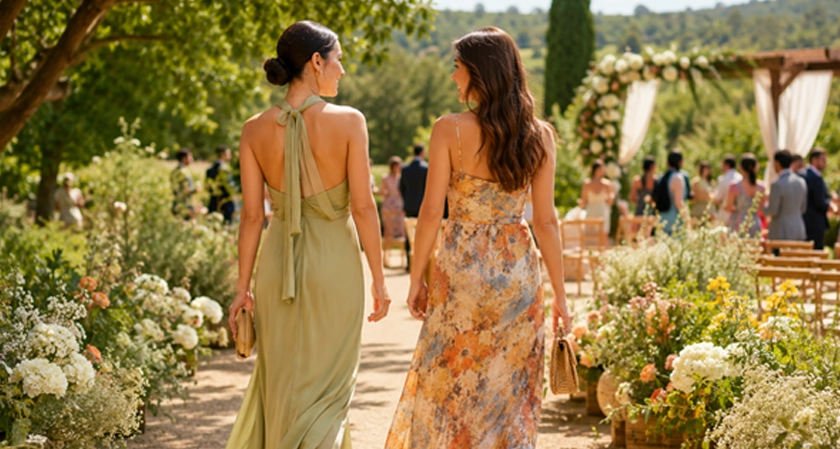
Pastels (dusty rose, soft blue, sage green, lavender) read as an appropriately summer wedding without being loud. Bold solids — coral, cobalt, warm yellow — work well if the dress code is relaxed enough to support them. Floral prints are almost always welcome, provided the base color isn't white.
What tends to miss: all-black in the middle of a July outdoor wedding (it reads more funeral than fashion), and anything with sequins or heavy embellishment before 6 pm.
Silhouettes Worth Considering
Midi length is the most universally useful silhouette for summer weddings. It clears the ground (practical for outdoor venues), works across dress codes, and suits a wide range of body types. An A-line or fit-and-flare midi in a lightweight fabric is the closest thing to a guaranteed correct answer.
Jumpsuits have become a fully accepted alternative to dresses at most cocktail or garden-party weddings, especially when the fabric has enough structure to hold its shape. Wide-leg trousers with a fitted top can also work for casual, elegant venues. If you sew or alter your own outfit, choosing reliable fabric by the yard can make the difference between a garment that only looks good at home and one that holds up through heat, movement, and hours on your feet.
What to Wear to a Summer Wedding as a Guest on a Budget
Wedding guest dressing doesn't require a new outfit for every event, and it doesn't require spending a lot to look polished. A few practical approaches:
- Invest in one neutral base piece that works across multiple dress codes — a well-cut midi in a neutral tone, worn with different accessories, reads differently at a cocktail wedding versus a garden party.
- Accessories do a lot of work. The same dress looks more formal with heels and structured jewelry, more relaxed with flat sandals and simple earrings.
- Rental platforms are also a legitimate option for one-occasion dressing, especially when the dress code is formal and you do not expect to wear the piece again.
Where to Find What You Need
For ready-to-wear, department stores and mid-range retailers tend to have the most reliable size range and return policies during wedding season. For anyone who sews or works with a seamstress, having the garment made to fit is the single most reliable way to ensure a summer wedding outfit holds up — both in terms of fit and material quality. In either case, the fabric choice matters more than most people realize before they experience a long hot day in the wrong material.
A strong summer wedding outfit is the result of practical planning, not overbuying. The best choice accounts for the venue, time of day, dress code, temperature, and how long the outfit needs to perform. Start with those conditions, then choose color, silhouette, shoes, and fabric around them. That approach keeps the look appropriate without sacrificing comfort.










_2026-06-17_13-25-19.webp")














Comments