>>
Industry>>
Compliance and governance>>
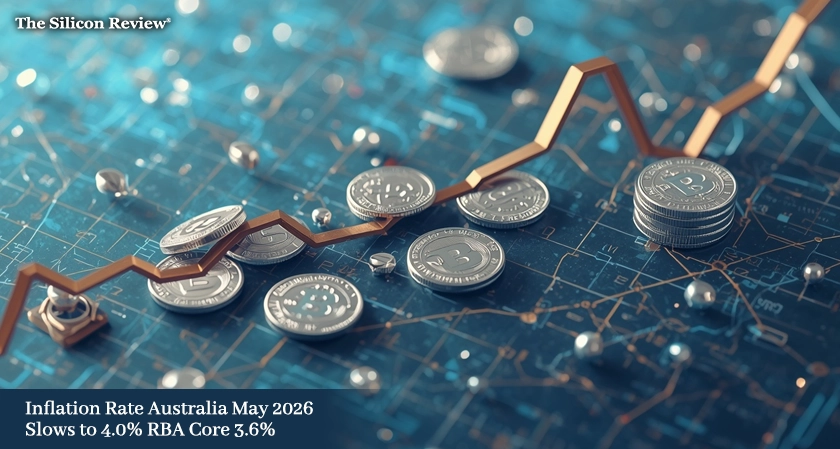
Inflation Rate Unexpectedly Sl...Inflation Rate Unexpectedly Slows to 4.0%, Lowest in Months. But a Sticky Core Is Still Keeping the RBA Awake at Night.
The Silicon Review
24 June, 2026
Author:
Vinay Kumar
Australia's inflation rate unexpectedly slowed to 4.0% in the 12 months to May, its lowest level in three months and the second consecutive month of cooling price pressures. The Silicon Review breaks down what this means for your wallet and the economy.
The numbers are in. And they are a mixed bag.
Australia's headline inflation rate fell to 4.0% in the 12 months to May, down from 4.2% in April and confounding economist expectations of a slight rise. It was the lowest figure since the war in Iran began in February. Even the monthly Consumer Price Index fell 0.7% the first decline since August 2025.
The fall was driven largely by an 11.9% dip in fuel prices for the month, as the reopening of the Strait of Hormuz after the US-Iran peace deal eased global oil supply pressures. But here is the catch. The "trimmed mean" the Reserve Bank's preferred measure of core inflation that strips out volatile items like fuel actually rose to 3.6%, up from 3.4% in April.
Let us be honest about what this inflation rate report is really saying. The headline numbers look good. But they are being masked by falling petrol prices, not by a genuine cooling in the economy. Housing costs surged 6.5% over the year, with electricity prices up a staggering 21.1% after government rebates expired. Rents, new dwellings, and food prices all continue to climb. The RBA's preferred measure is heading in the wrong direction, and that is the number that decides whether interest rates go up or down.
Treasurer Jim Chalmers welcomed the unexpected decline but warned that the consequences of the war will play out for some time. "This is a very welcome set of numbers, which shows that inflation fell once again for the second month in a row," he said.
But economists are split on what happens next. KPMG chief economist Brendan Rynne warned the mixed consumer price report adds to the case for another rate hike. "Unfortunately today's data adds to the case for a rate hike," he said. Oxford Economics head of economic research Harry Murphy Cruise also said there was still a chance of another rate hike.
Others are more optimistic. ANZ economists Madeline Dunk and Adam Boyton said the trimmed mean is tracking lower than the RBA's forecast of 3.8% for the June quarter, suggesting "the cash rate has peaked." AMP chief economist Shane Oliver noted that if core inflation comes in below expectations, it could spell an end to the hiking cycle.
The RBA has raised interest rates three times in 2026, bringing borrowing costs to 4.35%. Markets are finely balanced, with a 30% chance of an August hike priced in, climbing to 60% by November.
As the inflation rate unexpectedly slows to its lowest level in months, The Silicon Review asks a final question. When headline inflation cools but core inflation keeps rising, who is the RBA supposed to believe the number that looks good or the one that tells the real story?
FAQ:
Q: What is the current inflation rate in Australia?
A: The inflation rate fell to 4.0% in the 12 months to May 2026, down from 4.2% in April and the lowest level in three months.
Q: Why did Australia's inflation rate unexpectedly drop?
A: The inflation rate was driven down by an 11.9% drop in fuel prices as the US-Iran peace deal reopened the Strait of Hormuz, easing global oil supply pressures.
Q: What is the core inflation rate that the RBA watches?
A: The trimmed mean inflation rate, which excludes volatile items like fuel, rose to 3.6% in the 12 months to May, up from 3.4% in April.
Q: Will the RBA hike interest rates again?
A: Economists are split. KPMG and Oxford Economics say the mixed report adds to the case for another hike, while ANZ and AMP suggest the cash rate may have peaked.
Q: What is driving Australia's inflation pressures?
A: Housing costs surged 6.5% over the year, with electricity up 21.1% after government rebates expired, and rents, new dwellings, and food prices all continuing to climb .
Q: What is the RBA's target inflation rate?
A: The Reserve Bank of Australia targets an inflation rate of 2-3% over the medium term.


















Comments