>>
Other>>
Politics>>
China and North Korea Didn't M...China and North Korea Didn't Meet to Celebrate Friendship - They Met Because the World Is Changing
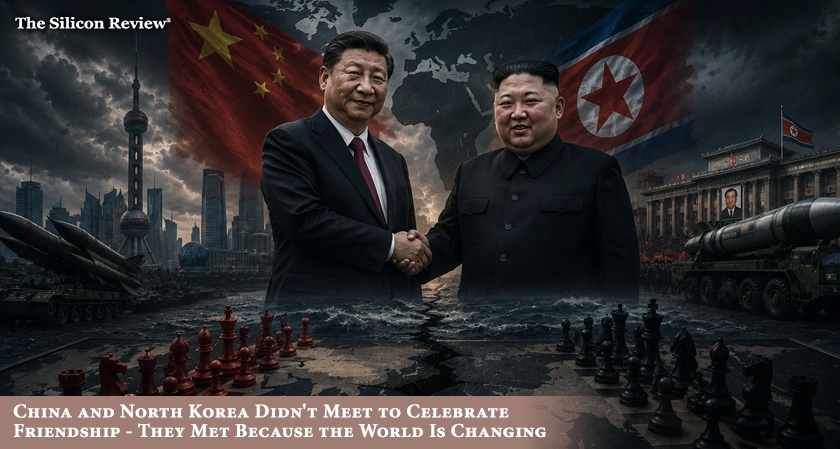
The latest summit between China and North Korea was officially framed as a celebration of stronger ties. But nations don't conduct high-level diplomacy out of emotions. As geopolitical tensions rise, the meeting raises questions about what strategic calculations are taking shape behind closed doors.
North Korea and China just held a summit. Official headlines described it as a reaffirmation of friendship, cooperation, and regional stability. The leaders smiled for the cameras, shook hands, exchanged promises of mutual support, and gave the world the diplomatic script everyone expected.
But nobody should believe that top leaders meet at this level simply to exchange compliments and take photos. Nations do not operate on emotions. They operate on power, competition, and selfish interests.
And that is why the most important part of this summit is not what was said publicly. It is what was not said at all.
The reason China and North Korea are drawing closer is simple: the world around them is changing.
The global order that dominated the post-Cold War era is under pressure. Competition between major powers is intensifying. Economic blocs are becoming more politically divided. Security alliances are expanding. Trade routes, technology supply chains, and military partnerships are increasingly being viewed through a geopolitical lens.
In that environment, every country is reassessing where it stands.
For China, North Korea remains more than a neighbor. It is a strategic buffer, a source of regional leverage, and a key factor in the security balance of Northeast Asia. As geopolitical competition grows, Beijing has every reason to ensure that Pyongyang remains stable, predictable, and within its sphere of influence.
For North Korea, the calculation is equally obvious. Closer ties with China mean greater diplomatic backing, economic opportunities, and access to one of the few major powers willing to maintain a working relationship with the regime. In an increasingly fragmented world, reliable partners become more valuable than ever.
This is why the summit matters.
Not because friendship was celebrated. Not because leaders exchanged warm words.
Because both governments understand that the international landscape is becoming less predictable and more competitive.
Let us stop pretending that diplomacy is primarily about symbolism. Every diplomatic photo op is theater. The real meeting happens before the cameras arrive and after they leave. The public sees the smiles. Governments discuss the strategy.
That does not mean there is a secret conspiracy unfolding behind closed doors. It means something far more ordinary and arguably more important. States are adapting to changing realities.
Major governments do not spend political capital on high-profile summits unless they expect tangible returns. Whether those returns involve economic cooperation, security coordination, trade arrangements, or broader geopolitical planning, the objective is always the same: preparing for the future.
And that is the real story here.
China and North Korea did not meet because of the past. They met because they are looking at the same future and both believe the world that is emerging will require stronger partnerships than the one that is disappearing.
Q: Why do North Korea and China hold summits if the real decisions happen privately?
A: Public summits provide diplomatic cover while strategic negotiations occur in undisclosed settings away from media scrutiny.
Q: Does China actually trust North Korea as a strategic partner?
A: China views North Korea primarily as a geographic buffer, not a trusted ally, and acts to protect its own security interests first.
Q: What does North Korea gain from closer ties with China?
A: North Korea gains economic support, diplomatic protection, and a strategic channel to bypass international sanctions pressure.
Q: Are the public statements from North Korea-China summits ever truthful?
A: Public statements are carefully crafted for political messaging and rarely reveal the actual strategic outcomes of the meeting.
Q: Could closer North Korea-China ties threaten regional stability?
A: Yes, undisclosed strategic coordination between Pyongyang and Beijing could shift the balance of power in the Asia-Pacific region.
Q: How many nuclear weapons exist in the world right now?
A: The nine nuclear powers possess an estimated 12,187 nuclear warheads as of January 2026.
Q: Which country has the most nuclear weapons?
A: Russia leads with approximately 5,420 warheads, followed closely by the United States with 5,042 warheads.
Q: Did India and Pakistan actually fight a war despite both having nuclear weapons?
A: Yes, India and Pakistan fought a brief armed conflict in May 2025, directly contradicting deterrence theory predictions.
Q: What happened to the New START nuclear treaty between the US and Russia?
A: New START expired in February 2026 with no replacement treaty agreed upon, ending the last major US-Russia arms control agreement.
Q: Why is the US spending $1.2 trillion on missile defense if deterrence works?
A: The US is investing in missile defense because nuclear deterrence alone does not feel sufficient for national security planners.
Q: How fast is China expanding its nuclear arsenal?
A: China now has about 620 warheads and is expanding faster than any other nuclear power, with hundreds of new missile silos under construction.