>>
Industry>>
Space>>
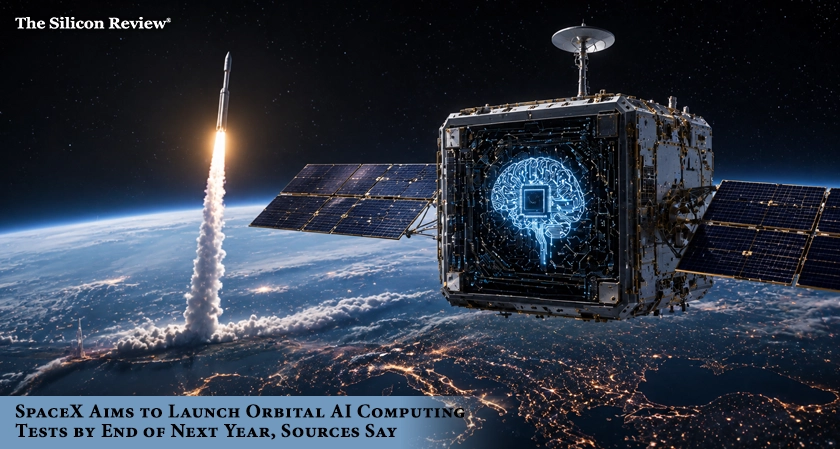
SpaceX Aims to Launch Orbital ...SpaceX Aims to Launch Orbital AI Computing Tests by End of Next Year, Sources Say
The Silicon Review
10 June, 2026
Author:
Sashindra Suresh
SpaceX is planning to launch orbital AI computing tests by the end of next year, according to sources, marking a significant step toward autonomous space operations and onboard data processing.
SpaceX is targeting to launch orbital tests of advanced AI computing systems by the end of next year, according to sources. The tests would involve deploying AI-optimized hardware and software on board SpaceX satellites or the Dragon spacecraft, enabling real-time data processing without relying on ground-based computing. Currently, most space-based data must be transmitted to Earth for processing, creating delays that can range from minutes to hours depending on satellite positioning and ground station availability.
SpaceX aims to change that by putting AI computing power directly into orbit. The system would allow satellites to analyze imagery, detect anomalies, and make autonomous decisions without waiting for commands from mission control.
The orbital AI computing tests are expected to leverage SpaceX's Starlink satellite infrastructure. Starlink already operates the largest satellite constellation in history, with thousands of satellites in low Earth orbit. Adding AI computing capabilities to these satellites or future iterations could dramatically improve their functionality.
Space technology experts say onboard AI processing is a critical enabler for next-generation space applications. Earth observation satellites could identify and classify objects in real time. Communications satellites could optimize bandwidth allocation dynamically. Science missions could filter and prioritize data before transmission, saving valuable downlink capacity.
SpaceX has not publicly confirmed the timeline or specific details of the orbital AI computing tests. Sources requested anonymity because the plans are still under development and subject to change.
The move would put SpaceX in direct competition with other companies pursuing in-space AI capabilities. Several startups and defense contractors are developing radiation-hardened AI processors designed to withstand the harsh space environment, including extreme temperatures, vacuum, and ionizing radiation.
SpaceX has the advantage of vertical integration. The company designs and manufactures its own satellites, rockets, and ground systems. Adding AI computing to its existing hardware stack could be faster and cheaper than for competitors who rely on third-party components.
The orbital AI computing tests would also serve SpaceX's broader ambitions beyond Earth orbit. The company's Starship spacecraft, currently in development, is designed for missions to the Moon and Mars. Autonomous AI systems will be essential for those missions because communication delays make real-time control from Earth impossible.
A signal from Earth to Mars takes between four and twenty-four minutes each way. A round-trip command could take nearly an hour. AI systems that can make decisions independently are not optional for deep space exploration. They are mandatory.
Sources did not specify which SpaceX vehicles would host the initial orbital AI computing tests. Options include Starlink satellites, the Dragon spacecraft, or dedicated test platforms launched on rideshare missions.
The timeline of late next year is ambitious but plausible given SpaceX's development pace. The company has a history of aggressive schedules, though delays are common.
As SpaceX aims to launch orbital AI computing tests by the end of next year, The Silicon Review tracks how the convergence of space technology and artificial intelligence is reshaping what satellites can do without human intervention.
FAQ:
Q: What is SpaceX planning to test in orbit by the end of next year?
A: SpaceX is planning to launch orbital AI computing tests that would enable real-time data processing without relying on ground-based computers.
Q: Why does space technology need onboard AI computing?
A: Space technology needs onboard AI because transmitting data to Earth for processing causes delays from minutes to hours depending on satellite positioning.
Q: Will SpaceX use Starlink satellites for the orbital AI computing tests?
A: SpaceX is expected to leverage its Starlink satellite constellation for the orbital AI computing tests, though the company has not confirmed specifics.
Q: How would orbital AI computing benefit deep space missions to Mars?
A: Orbital AI computing is essential for Mars missions because communication delays of four to twenty-four minutes each way make real-time Earth control impossible.
Q: What are the challenges of running AI computing in space?
A: AI hardware in space must withstand extreme temperatures, vacuum, and ionizing radiation, requiring specialized radiation-hardened components.
Q: Has SpaceX confirmed the timeline for orbital AI computing tests?
A: SpaceX has not publicly confirmed the timeline, which comes from sources familiar with the company's plans and remains subject to change.