>>
Industry>>
Capital Market>>
US Iran Conflict: Pentagon Cal...US Iran Conflict: Pentagon Calls It 'Self-Defense.' Wall Street Calls It a Crash. The American People Call It Oil War. So Why Is No One Asking Who Profits?
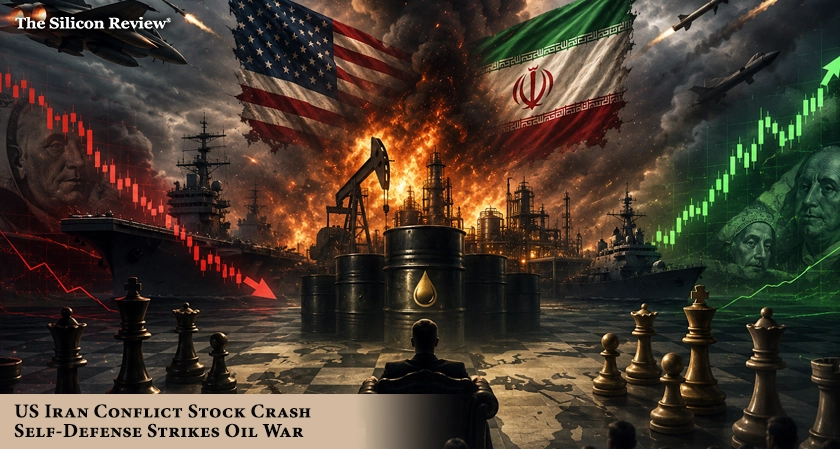
Stock futures tumbled overnight after the United States launched what it calls "self-defense strikes" against Iran. The Silicon Review asks: if this is self-defense, why is Wall Street running for cover like it is a full-blown war?
Stock futures are down. Dow futures dropped more than 400 points overnight. S&P 500 futures fell 1.8 percent. NASDAQ futures tumbled 2.2 percent. Oil prices spiked above ninety dollars a barrel. Gold is up. Bonds are rallying.
Wall Street just got the news it feared most. The US Iran conflict is no longer a threat. It is a reality.
The Pentagon called them "self-defense strikes." The president called them "proportionate and necessary." The market called them something else entirely. A reason to sell first and ask questions later.
Let us decode what Wall Street actually heard when the Pentagon said "self-defense strikes." They did not hear justice. They did not hear patriotism. They heard oil supply disruptions, shipping route closures, defense spending spirals, and a Federal Reserve that cannot cut interest rates while the world is on fire.
Here is the truth that no one will say. The stock market does not care about the Apache helicopter. It does not care about Iranian radar installations. It cares about one thing. Certainty.
And the US Iran conflict has destroyed every ounce of certainty in global markets.
Oil traders are already pricing in a closure of the Strait of Hormuz. Twenty percent of the world's oil passes through that narrow channel. If Iran blocks it, oil hits one hundred and fifty dollars per barrel. If Iran mines it, oil hits two hundred dollars. If the US Navy tries to clear it, war.
The Dow Jones does not like two hundred dollar oil. Neither does the S&P 500. Neither does your 401k.
Defense stocks are up. Lockheed Martin jumped 4 percent. Northrop Grumman gained 5 percent. Raytheon rose 3 percent. War is good for business if you make the weapons. Everyone else gets collateral damage.
Tech stocks are getting hammered. Apple gets its components from Asia. Shipping routes go through the Persian Gulf. Supply chains are already fragile. A US Iran conflict snaps them completely.
Tesla is down. Nvidia is down. Amazon is down. The entire NASDAQ looks like it just saw a ghost.
The Federal Reserve is now trapped. It wants to cut interest rates to stimulate a slowing economy. It cannot cut rates while inflation is spiking because of oil prices. The US Iran conflict just handed the Fed the worst possible scenario. Stagflation. Slow growth. Rising prices. No good options.
President Trump will blame the market drop on Iran. That is what presidents do. Iran will blame the market drop on the United States. That is what adversaries do.
Here is the question that actually matters. If the Pentagon knew that self-defense strikes would tank the stock market, why did they announce them at 2 PM Eastern time, just before the close? And if they did not know, what does that say about how prepared they are for the financial consequences of the US Iran conflict?
The smart money is already hedging. Institutional investors are buying put options. They are rotating into cash. They are moving money to Swiss francs and Japanese yen. They are not waiting to see what happens next. They are assuming the worst.
Because the worst is not the US Iran conflict itself. The worst is the uncertainty of where it goes from here.
As stock futures slip after the United States launches self-defense strikes against Iran, The Silicon Review asks a final question. If the US Iran conflict escalates into a full war, how low can the markets go before someone in Washington finally admits that the economic cost of fighting Iran is worse than whatever Iran was doing in the first place?
FAQ:
Q: How did the US Iran conflict affect stock futures immediately after the strikes?
A: Dow futures dropped over 400 points with S&P 500 down 1.8 percent and NASDAQ down 2.2 percent following the US Iran conflict escalation.
Q: Why does the US Iran conflict because oil prices to spike?
A: The US Iran conflict threatens the Strait of Hormuz where twenty percent of global oil passes through, pushing oil above ninety dollars per barrel.
Q: Which stock market sectors gain during the US Iran conflict?
A: Defense stocks including Lockheed Martin, Northrop Grumman, and Raytheon rose as investors expect increased military spending.
Q: How does the US Iran conflict affect Federal Reserve interest rate decisions?
A: The Fed cannot cut rates to stimulate growth because the US Iran conflict is pushing oil prices and inflation higher.
Q: Why are tech stocks falling during the US Iran conflict?
A: Tech companies rely on Asian supply chains that pass through Persian Gulf shipping routes now threatened by the US Iran conflict.
Q: What are institutional investors doing to protect against the US Iran conflict?
A: Big investors are buying put options, rotating to cash, and moving money to Swiss francs and Japanese yen as hedges.