>>
Industry>>
Industrial Automation>>
Australia manufacturing Approv...Australia manufacturing Approves $693M Titanium Mine as Global Supply Chains Reshape
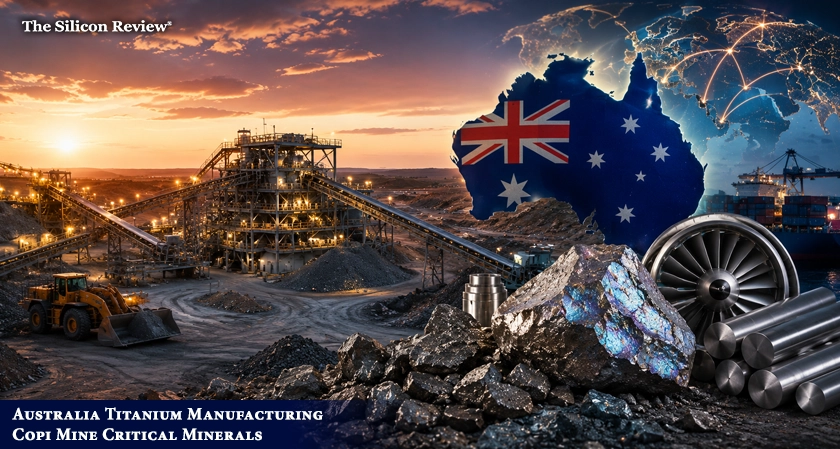
A $693 million critical minerals project in NSW has received government approval to extract titanium minerals, premium zircon, and rare earth elements. The project comes as global demand for titanium surges, driven by aerospace, defense, and renewable energy sectors.
Australia's titanium manufacturing capability is getting a significant boost. The New South Wales Government has granted development approval for the $693 million Copi critical minerals project, which will produce titanium minerals, premium zircon, and rare earth elements, including monazite and xenotime.
Located about 75 kilometres north-west of Wentworth and 180 kilometres south-west of Broken Hill, the Copi project sits on one of the world's largest critical minerals deposits. It is expected to process up to 27 million tonnes of material and produce up to 400,000 tonnes of critical mineral ore per year for 18 years.
The approval marks a defining moment for the project and Australia's critical minerals ambitions, according to RZ Resources founder and executive chairman David Fraser. "Copi is a globally significant critical minerals opportunity that will help Australia and its allies secure supply chains for the materials that underpin energy, manufacturing and defence," Fraser said.
"Copi is a globally significant critical minerals opportunity that will help Australia and its allies secure supply chains for the materials that underpin energy, manufacturing and defence."
The project has attracted significant international backing. Japan's JX Advanced Metals Corporation and Marubeni Corporation have invested in the project, and the US Export–Import Bank has provided an indicative term sheet for up to $550 million under the US - Australia Critical Minerals Framework. The project is expected to create up to 480 direct jobs during construction, with 240 ongoing operational roles and an estimated $97 million annual contribution to the local economy.
The Copi mine is just one part of Australia's broader titanium push. In Western Australia, a massive titanium discovery is reshaping global supply chains. Empire Metals' Pitfield Project, located about 160 kilometres south of Geraldton, contains an estimated 2.2 billion tonnes at 5.1 per cent titanium dioxide, making it the world's largest known titanium deposit. The deposit was discovered by accident in 2023 when Empire was exploring for copper.
"We drilled down 400m and every metre was in ore," said Empire Metals managing director Shaun Bunn. "It ended in ore, but the geophysics trace this thing down 5km into the basin."
The Pitfield Project's titanium dioxide purity has reached 99.25 per cent in test work, and the company is targeting commercial production of titanium metal, a market valued at approximately $24 billion annually. Empire's ore contains no thorium, uranium, chromium, or vanadium, contaminants that often plague other titanium deposits.
"Western aircraft manufacturers and defence departments want long-term supply security as they're reluctant to lock into supply chains with only one country," Bunn said. "We're offering a Tier 1 location with the scale and infrastructure to become a genuine alternative source."
Meanwhile, Murdoch University researchers are developing a lower-cost, lower-emission alternative to traditional titanium production using molten salt electrolysis powered by renewable energy. In Western Australia's Eucla Basin, McLaren Minerals is advancing a "green titanium" project with a 15.9-year mine life and estimated revenue of $2.78 billion over its operational period, using solar and wind power to produce ilmenite.
Here is the question this titanium push raises. Australia is home to the world's largest titanium deposit, a $693 million mine approved in NSW, and multiple projects developing greener production methods. Yet much of Australia's critical mineral value is still realised overseas. When the country has the resources, the research, and the international partners, why is so much of the value chain still leaving our shores?
As Australia strengthens its titanium manufacturing capability and advances projects from NSW to WA, The Silicon Review asks a final question. When the world's largest titanium deposit is in WA and the government is approving billions in critical minerals investment, is Australia finally ready to process its own minerals into finished products or will the titanium still leave as sand and return as parts?
FAQ:
Q: What is the Copi critical minerals project?
A: The Copi project is a $693 million mineral sands mine in far south-western NSW that will produce titanium minerals, premium zircon, and rare earth elements. It is expected to create 480 construction jobs and 240 ongoing roles.
Q: What is the Pitfield titanium project?
A: The Pitfield Project in Western Australia contains an estimated 2.2 billion tonnes of titanium dioxide, making it the world's largest known titanium deposit. It was discovered in 2023 when Empire Metals was exploring for copper.
Q: Why is titanium a critical mineral for Australia?
A: Titanium is used in aerospace, defence systems, medical implants, and renewable energy technologies. It is prized for its exceptional strength, low weight, and resistance to corrosion. Supply chains are currently dominated by China, making alternative sources strategically important.
Q: How will Australia's titanium projects strengthen manufacturing?
A: Projects like Copi and Pitfield aim to move beyond raw material extraction to processing and refining in Australia. This reduces reliance on overseas processing, creates local jobs, and strengthens sovereign capability.
Q: What is green titanium production?
A: McLaren Minerals is developing a "green titanium" project using renewable energy sources like solar and wind power to process ilmenite, contrasting with conventional, energy-intensive production methods.











Comments