>>
Technology>>
Quality assurance>>
Food Groups Fail: Only 4.3% of...Food Groups Fail: Only 4.3% of Aussies Eat Enough Veggies, ABS Data Reveals 'Dietary Quality' Audit Exposes National Health Gap
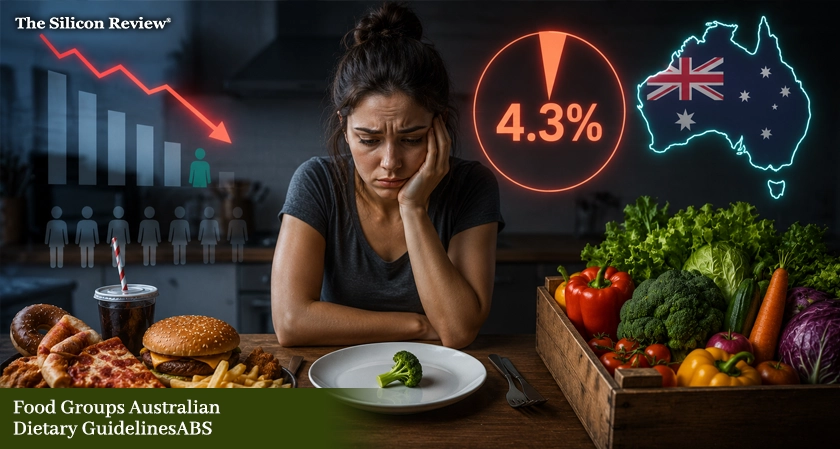
Only 4.3% of Australians are eating enough vegetables, according to new ABS data a figure that serves as a stark national 'quality assurance' audit of the nation's diet. The Silicon Review examines how the findings reveal a significant gap between dietary recommendations and actual consumption across almost every food group.
The Australian Bureau of Statistics has released its latest data on consumption of the five food groups from the Australian Dietary Guidelines, and the findings are stark. The data, drawn from the 2023 National Nutrition and Physical Activity Survey (NNPAS), provides a comprehensive audit of what Australians are actually eating and the results point to a significant shortfall in dietary quality across the population.
Only 4.3% of Australians met the recommendation for vegetables, legumes and beans, while 23.1% met the recommendation for fruit. For grains and cereals, 27.8% of the population met the target, while 20.6% met the recommendation for lean meat and alternatives an improvement from 14.7% in 2011–12. The dairy and alternatives group fared worst, with just 7.2% of people meeting the recommendation.
The data also reveals a concerning pattern between children and adults. For vegetables, only 2.1% of children aged 2-17 met the recommendation, compared to 4.8% of adults aged 18 and over. For fruit, 50.7% of children met the recommendation, but this dropped to 15.9% for adults. For dairy and alternatives, 12.7% of children met the recommendation, compared to just 5.8% of adults. This pattern suggests that eating habits often decline as people move into adulthood.
The NNPAS 2023 ran from January 2023 to March 2024, and this is the third release of nutrition results from the survey. The analysis focuses on usual consumption of the five food groups as an estimate of what people eat and drink over the long-term, aligning with the recommendations of the Australian Dietary Guidelines.
In the context of public health, this data functions as a national Quality Assurance audit. The Australian Dietary Guidelines are the established standard for a healthy diet, developed by the National Health and Medical Research Council (NHMRC). The NNPAS data measures compliance with that standard. The findings highlight that the majority of Australians are not meeting the "quality" benchmark for their diet. This gap can serve as a key indicator for health organisations and policymakers to assess the effectiveness of current public health strategies and identify areas needing improvement.
Here is the question this data raises. When less than 5% of the population can meet the recommendation for vegetables and only 7% for dairy, is the problem the guidelines, the food environment, or the public health messaging?
As the ABS data provides a stark 'Quality Assurance' check on the Australian diet, The Silicon Review asks a final question. When the majorities of Australians consistently fail to meet dietary recommendations across almost every food group, are these guidelines too ambitious, or is the gap between knowledge and behaviour the real health crisis?
FAQ:
Q: What are the five food groups in the Australian Dietary Guidelines?
A: The five food groups are: vegetables, legumes and beans; fruit; grain and cereal foods; lean meat and poultry, fish, eggs, tofu, nuts and seeds and legumes/beans; and milk, yoghurt, cheese and/or alternatives.
Q: How many Australians met the vegetable recommendation?
A: Only 4.3% of people met the recommendation for vegetables, legumes and beans.
Q: Which food group saw the biggest improvement in consumption?
A: The lean meat and alternatives group saw the biggest improvement, with 20.6% meeting the recommendation in 2023, up from 14.7% in 2011–12.
Q: What is the National Nutrition and Physical Activity Survey?
A: The NNPAS is a survey run by the ABS that collects detailed information about the food and nutrient consumption of Australians. The 2023 survey ran from January 2023 to March 2024.
Q: What is the difference between children and adults?
A: Adults are much less likely to meet their fruit recommendation (15.9%) compared to children (50.7%). Adults are also less likely to meet their dairy recommendation (5.8%) compared to children (12.7%).













Comments