>>
Technology>>
Software>>
how to buy enterprise live cha...how to buy enterprise live chat software for regulated industries and support teams

The Silicon Review
16 July, 2026
Author:
Guest
One stray chat can cost millions. Banks, hospitals, and government agencies know every message may carry sensitive data, and regulators are watching. Data-protection fines across Europe now top €7.1 billion (2026), a clear sign that enforcement is only getting tougher.
Most “Top 10” lists gloss over what compliance officers care about, and polished demos skip the audit drill. That leaves you caught between legal mandates and impatient customers.
This guide shows you how to pick a live-chat platform that satisfies regulators and delights support teams. By the end, you’ll know exactly what to ask, which red flags to spot, and how to buy with confidence.
Ready? Let’s get started.
Why regulated industries are different
Live-chat buyers in healthcare, finance, and the public sector face higher stakes than teams in retail or SaaS. One slip can trigger an investigation, freeze customer accounts, or put your firm on the front page for the wrong reasons.
Regulators write that risk into law. Hospitals must keep every patient message within HIPAA’s guardrails. Banks juggle PCI-DSS for card data, KYC for identity checks, and an expanding web of anti-money-laundering rules. Government agencies follow data-sovereignty mandates that dictate where every byte lives. The margin for error keeps shrinking.
Customers feel that pressure, too. A patient who opens a chat window expects the same confidentiality offered in an exam room. A retail investor chatting with a broker assumes portfolio details will never leak to a public cloud. Lose that trust and you often lose the customer for good.
Off-the-shelf chat widgets rarely meet this bar. Many rely on shared SaaS infrastructure, lack audit trails, or treat encryption as a premium add-on. They look tidy until Legal asks where transcripts are stored or how long backups last. Then the façade cracks.
Compliance involves Security, Legal, Risk, and Support, so the platform you choose must weave governance into its core. That means role-based permissions, tamper-proof logs, and data-center options that match your jurisdictional needs. Anything less invites trouble at audit time.
Bottom line: regulated industries do not just need another chat channel. They need a secure communications system that proves, line by line, who said what, when, and where the data rests. Only vendors built for that reality belong on your shortlist.
Compliance and security feature checklist
Encryption and proof of security
First, lock the doors before decorating the house. Every message must travel under transport-layer encryption and rest inside a database protected by strong at-rest encryption. Aim for TLS 1.2 or higher on the wire and AES-256 when the data stops moving. Anything weaker invites trouble.
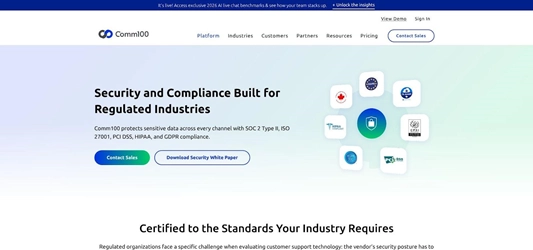
Certificates matter because they show a neutral party has checked the locks. Look for SOC 2 Type II or ISO 27001 front and center, dated within the past twelve months. Ask for the audit report, review the exceptions, then share it with your security team. If the provider hesitates, keep searching.
Comm100 Trust Center compliance certifications screenshot
One vendor that practices this transparency is Comm100. Its enterprise live chat software advertises SOC 2 Type II, ISO 27001, HIPAA, and GDPR alignment in a public Trust Center updated for 2026. Security teams can request the full audit reports under NDA before any data leaves your environment, which speeds procurement and calms regulators.
These badges are more than vanity. Regulators and cyber-insurers treat them as baseline proof that security controls exist and operate. Choosing a tool without them is like parking a cash truck with the engine running: possible, yet reckless.
Audit trails and retention controls
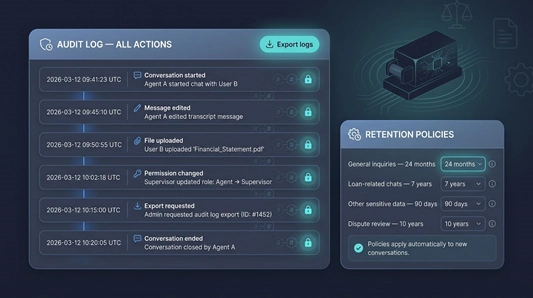
A regulated chat platform needs memory like an airplane’s black box. Every conversation, edit, and file transfer must record who did what and when. Without that lineage, you face an uphill battle in any dispute or review.
Look for immutable logs that even an admin cannot alter. The system should track agent actions, from transcript edits to permission changes, in real time and let you export those records on demand. Auditors appreciate cryptographically sealed logs because mathematics confirms nothing changed.
Retention rules complete the picture. Finance teams may need to hold chats for years, while privacy laws let a consumer ask you to erase data tomorrow. Your tool must handle both extremes. Ideally, you set policies in minutes: keep general inquiries for 24 months, store loan-related chats for seven years, and remove everything else after 90 days. One console, no scripts, no late-night calls to IT.
Granular access control and data hygiene
Even the best encryption fails when the wrong person holds the keys. Your chat platform should let you slice permissions so finely that a level-one agent sees only what they need, nothing more. Supervisors view escalations, compliance staff pull transcripts, and finance teams download billing records. Everyone else stays in their lane
Create roles once, assign them in bulk, and audit regularly. Good software makes this painless with a visual matrix: rows list features, columns list roles, and checkmarks grant access. The best software adds an immutable log so you can prove who changed what and when.
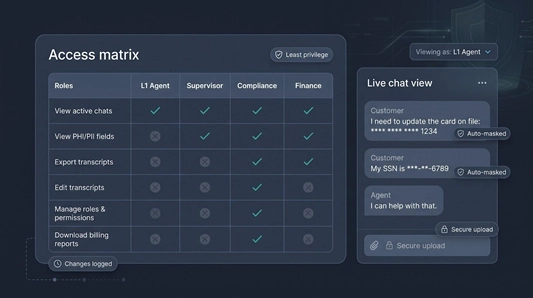
Data hygiene tools round out the picture. Automatic masking strips card numbers and Social Security details the moment a customer presses Send. Secure file-transfer windows keep sensitive documents out of email chains. These guards free agents from manual workarounds and reassure regulators that sensitive data never appears in clear text.
When the platform handles access and redaction automatically, agents focus on helping customers instead of playing part-time security officer. That keeps speed high, risk low, and everyone sleeping better at night.
Data hosting and privacy guarantees
Where your chat transcripts live matters as much as how they travel. Many countries now enforce data-sovereignty rules that keep personal information within specific borders. If you serve EU residents, regulators expect that data to sit on EU soil. A United States public-sector agency may require a FedRAMP-authorized cloud or an on-prem deployment.
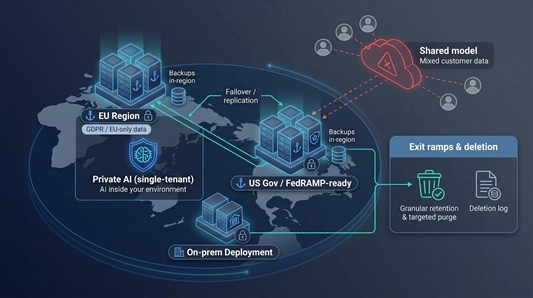
Ask each vendor to map their data centers, failover pairs, and backup locations. Get the answers in writing. If a provider cannot anchor your data in a compliant region, remove them from the list early.
Privacy questions multiply when artificial intelligence enters the chat window. Some platforms feed your transcripts into a shared large-language model to “improve accuracy,” which is helpful for them but risky for you. Choose vendors that isolate your data, train models in a single-tenant environment, and promise they never blend your chats with content from other customers. Private-cloud or on-prem AI keeps sensitive text under your control while still offering smart suggestions to agents.
Finally, build defensible exit ramps. The same tool that stores data securely must also delete it on command. Look for granular retention schedules, targeted purge options, and logged proof that a deletion request occurred. Regulators may audit that trail, and customers will appreciate the respect.
Integration and workflow fit
CRM and ticketing integrations
Live chat delivers maximum value when it plugs straight into tools your team already uses. Picture an agent chatting with a borrower about a loan question: with a proper connection, the customer profile, account balance, and three most recent support tickets sit next to the chat window. The agent confirms identity, answers the question, and updates records without copying a single field.
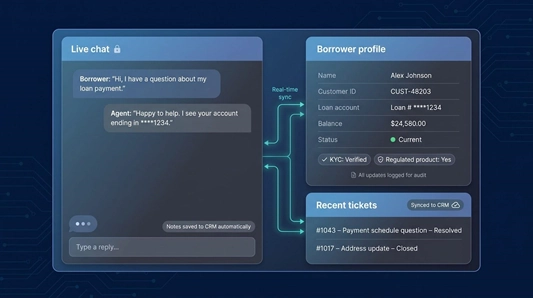
That tight hand-off trims handle times and prevents keystroke errors that frustrate compliance reviews. It also creates one source of truth: every note, tag, and disposition code lands in the CRM instantly, so auditors need only one database to reconstruct the story.
Test integrations early in the buying cycle. Spin up a sandbox, connect to your staging CRM, and push real data through. If setup turns into a weekend coding hobby, treat it as a warning. Strong vendors ship prebuilt connectors or low-code tools that stand up in hours, not weeks, and pass security reviews on the first try.
Unified omnichannel interface
Agents work faster when every channel funnels into one inbox. Shifting among email, chat, phone notes, and social DMs breaks focus and invites mistakes. A unified console stitches those threads together so an agent sees the whole conversation history at a glance.
The benefits go beyond speed. When data masking, role permissions, and audit logging span channels automatically, you avoid the risk of a compliant chat turning into a non-compliant email. Consistency becomes the default, not a checklist.
During trials, sign in as an agent and count the clicks needed to get from a live chat to the customer’s last email. If you hit double digits, keep evaluating. Leading platforms surface every touchpoint in two clicks or fewer, with real-time updates and zero browser-tab chaos.
A unified view also simplifies coaching. Supervisors monitor queues, sentiment scores, and SLA timers without juggling dashboards. That oversight lets you spot bottlenecks early and refine workflows before they snowball into customer complaints.
Bottom line: an omnichannel hub turns fractured support into a coherent customer story, boosting efficiency and protecting compliance in one move.
Emerging trends and future-proofing
AI adoption: bridging the hype gap
Generative AI promises chatbots that never sleep, yet regulated industries remain cautious. A recent Deskpro survey shows most banks and hospitals still run limited pilots, shelving projects that lack strong security controls.
The caution makes sense. Many cloud chatbots feed transcripts into shared language models, a non-starter when messages include account numbers or pathology reports. Forward-looking vendors counter with private-cloud or on-prem models that learn only from your data and stay inside your firewall. Agents still get suggested replies, auto-summaries, and sentiment flags, while sensitive text stays private.
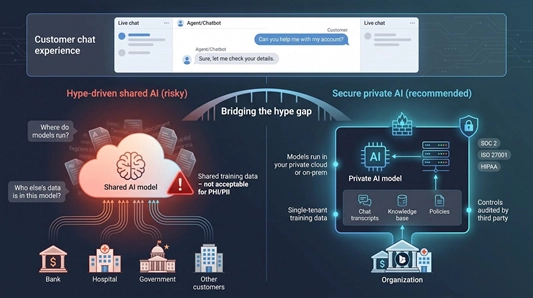
When you review road maps, press each supplier on three points: where their models run, how they isolate training data, and whether a third party has audited those controls. If any answer feels slippery, assume the architecture is, too.
New entrants built for compliance from day one
Legacy names still dominate analyst quadrants, but a fresh wave of support platforms is winning contracts by solving compliance headaches out of the gate. Many founders are industry veterans who know the pain of retrofitting security, so they bake certifications, audit dashboards, and data-sovereignty options into version 1.0.
One startup reached nine-figure annual revenue in under two years by offering outcome-based pricing and a menu of preapproved deployment patterns for banking and healthcare. Procurement teams liked the math: pay per resolved conversation, skip license gymnastics, and clear every infosec gate on the checklist.
Competition pushes incumbents to improve. Established vendors now promote single-tenant clouds, FedRAMP pursuits, and bring-your-own-LLM options that were rare three years ago. Even if you choose a market leader, you can cite these challengers during negotiations to secure features such as built-in identity verification or auto-redaction.
An ever-tightening regulatory climate
Regulators seldom loosen the reins. New privacy laws arrive each quarter, while enforcement bodies set record fines, including more than €7.1 billion under GDPR as of 2026. For live-chat buyers, today’s nice-to-have safeguards become tomorrow’s must-haves. Encryption standards rise, audit-log retention stretches from three to seven years, and accessibility rules expand to cover every pixel of your widget.
Architecture matters, too. Platforms with modular, API-first designs can swap encryption libraries or logging frameworks without forklift upgrades. Legacy monoliths tend to lag, forcing costly workarounds that auditors spot in minutes.
Conclusion
The safest bet: pick a provider that views regulatory change as a chance to outpace competitors, not a chore handled at the last minute. Run every vendor through the encryption, audit-trail, access-control, and data-hosting checklist above before signing anything, and demand proof, not promises, on certifications. Platforms like Comm100 that publish their compliance posture openly in a public Trust Center make that verification step far easier for the security and legal teams who ultimately have to sign off.




















Comments