>>
Industry>>
Waste Management>>
One Vape, 500°C: Byron Bay Ma...One Vape, 500°C: Byron Bay Man's Pants Ignite as Australia's Lithium-Ion Waste Crisis Reaches a Boiling Point
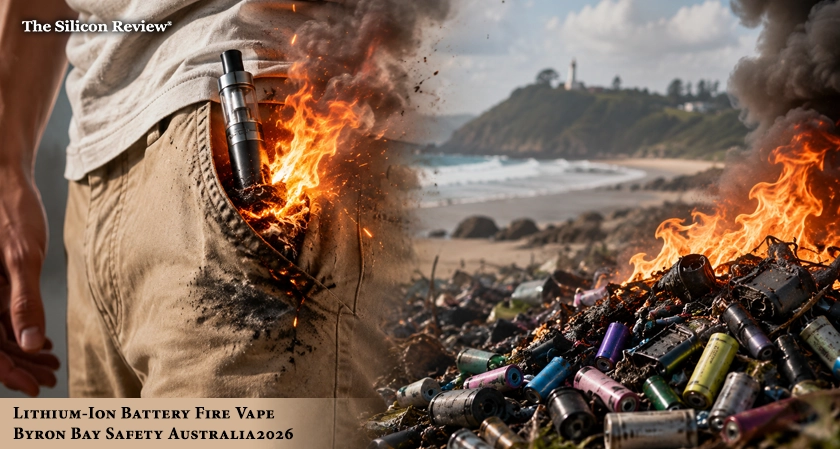
A 56-year-old man suffered burns to his leg after a vape battery ignited in his pocket at Byron Bay's Main Beach, the latest incident in Australia's escalating lithium-ion battery fire crisis. Fire and Rescue NSW has already responded to 60 battery fires this year, with vapes, power banks and e-bikes blamed for a surge in toxic waste and catastrophic blazes across the country.
A Brisbane man's pants caught fire in Byron Bay after a vape battery and coins came into contact in his pocket. The 56-year-old was treated for a minor burn to his leg at Byron Central Hospital and has been referred to the Royal Brisbane Hospital's burns clinic for review. The incident occurred as Fire and Rescue NSW renewed warnings about the dangers of lithium-ion batteries, which have become one of the agency's highest priorities.
"Fire and Rescue attend quite a number of calls to fires caused by damaged lithium-ion batteries or batteries that are overcharging. It's one of our high priorities, as far as fire prevention is concerned," said FRNSW Duty Commander Fraser Hindry.
"This is not the first time a vape has exploded and caused serious burns and unfortunately it won't be the last. This is an awful reminder about how harmful these products are both as a highly flammable gadget if they're damaged or overheated or poorly manufactured, on top of the toxic chemicals and huge nicotine heat your body is not designed to handle."
The risk is escalating rapidly. In 2025, Fire and Rescue NSW recorded 332 lithium-ion battery incidents. In just the first half of 2026, there have already been 62 community fires, 12 in garbage trucks, and at least 103 suspected battery-related waste fires. Across the country, it is estimated there are at least 10,000 battery-related fires and heat events annually across waste and recycling streams.
The problem extends far beyond vapes. In September 2025, a Melton West mother and her child escaped unharmed when a modified e-bike battery exploded while charging in a bedroom, destroying the home. Fire Rescue Victoria determined the battery had been altered to boost performance, practice authorities have warned against. In July 2025, a Virgin Australia Boeing 737 experienced a lithium-ion battery fire in an overhead locker mid-flight after a passenger's power bank ignited, forcing the crew to extinguish the blaze with fire extinguishers and water while still airborne.
"When a vape with a coin in a pocket can reach 500°C and a modified e-bike battery can destroy a home, and 60 fires have already occurred this year this is not a handful of incidents. This is a national crisis."
The toxic waste crisis is growing in parallel. Currently, only about 10 per cent of lithium-ion batteries in Australia are collected and recycled, with the rest either stockpiled or ending up in landfill. The CSIRO warns Australia's annual battery waste is projected to soar from 3,300 tonnes to 137,000 tonnes by 2035. A University of Technology Sydney study modelled annual waste volumes from electric vehicle batteries alone could reach between 500,000 and 900,000 tonnes by 2050.
In response, NSW has become the first state to introduce mandatory battery regulation, requiring brand owners to take responsibility for safe collection and recycling from October 1. Non-compliant suppliers face penalties of up to $880,000. The NSW EPA's "Never Bin a Battery" campaign is expanding, and vapes can now be disposed of at 34 community recycling centres under an embedded battery trial.
The Byron Bay vape fire adds to a growing list of lithium-ion battery incidents that have sparked renewed warnings from authorities across the country. The South Australian Metropolitan Fire Service has reported a near ten-fold increase in callouts to lithium-ion battery fires over the past five years, with 39 incidents in the first half of 2025 alone. In Victoria, the Melton West house fire destroyed the entire property.
A Monash University-led team has developed a new technique using a mild, sustainable solvent to recover more than 95 per cent of nickel, cobalt, manganese and lithium from spent batteries. But researchers say "urgent action" is needed from governments to invest in infrastructure, implement clear regulations, and provide incentives to promote the recycling industry.
Here is the question this crisis raises. When a vape with loose change can reach 500°C and 60 fires have already occurred this year when Australia's battery waste is projected to soar 40-fold, and we are losing valuable critical minerals to landfill are we really doing everything we can to prevent the next explosion, or are we still waiting for the one that kills someone?
As Australia's lithium-ion battery crisis reaches a boiling point, The Silicon Review asks a final question. When a man's pants catch fire on a public beach, an e-bike explosion destroys a home, and a mid-flight fire nearly causes a plane to crash how many more warnings do we need before we treat battery waste like the emergency it is?
FAQ:
Q: How many lithium-ion battery fires have occurred in Australia in 2026?
A: Fire and Rescue NSW has already responded to 60 battery-related community fires in 2026, plus 12 in garbage trucks and at least 103 suspected waste industry fires.
Q: What causes lithium-ion batteries to catch fire?
A: Lithium-ion battery fires are most commonly caused by physical damage, overcharging, using incorrect chargers, modifying battery packs to boost performance, manufacturing defects, or improper disposal.
Q: How hot can a lithium-ion battery fire get?
A: A lithium-ion battery can reach temperatures of 500°C or more during thermal runaway, a chain reaction that releases flammable toxic gas and can ignite nearby materials.
Q: Where can I dispose of lithium-ion batteries safely?
A: In NSW, lithium-ion batteries and vapes can be disposed of at 34 community recycling centres under the EPA's embedded battery trial. Do not place them in household bins.
Q: How much battery waste will Australia produce by 2035?
A: Australia's annual lithium-ion battery waste is projected to soar from 3,300 tonnes to 137,000 tonnes by 2035.
Q: What is black mass in battery recycling?
A: Black mass is the powdered mixture of graphite and metal oxides (including nickel, cobalt, manganese and lithium) recovered from shredded lithium-ion batteries. It can be processed to recover critical minerals for use in new batteries.















Comments