>>
Platform>>
Wireless>>
Starlink Mobile Plans Threaten...Starlink Mobile Plans Threaten Australia's Telcos: 552,000 Subscribers and a $1.1 Billion Earnings Warning
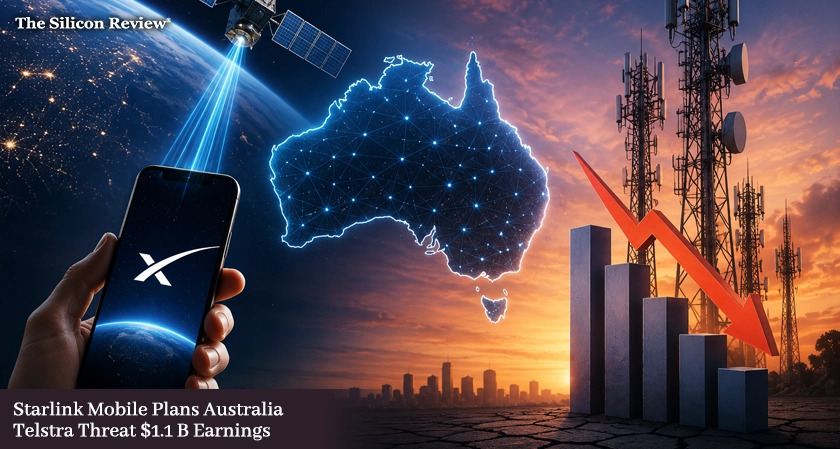
Starlink's rapid Australian expansion: 552,000 subscribers and counting have triggered major bank downgrades of Telstra and other telcos. The Silicon Review examines how Elon Musk's satellite empire is reshaping the economics of Australian telecom.
Starlink has put AKustralia's telcosK on notice. Investment banks Morgan Stanley and Jarden have downgraded Telstra and other ASX-listed telecommunications companies, citing fears that Elon Musk's SpaceX and its Starlink satellite internet service will attract customers from the concentrated industry.
Analysts cut share price projections by up to 10 per cent for Telstra, TPG Telecom, Aussie Broadband, and Spark New Zealand . The banks highlighted Australia as an "attractive market" for Starlink, which had 552,000 Australian subscribers by late last year, following its recent blockbuster initial public offering.
"SpaceX would be a 'genuine disrupter' in the Australian market," Morgan Stanley analysts Andrew McLeod and Angela Sutcliffe told clients, urging investors to recognise the threat.
Jarden's Liam Robertson and Charles Strong downgraded Telstra to an "underweight" rating from "neutral," warning that Telstra's significant competitive advantage from its expansive mobile coverage is being eroded by the rise of satellite direct-to-device connectivity, the technology Starlink uses. Government plans requiring all major carriers to enhance coverage, partly via satellite, are also expected to impact Telstra, potentially shrinking its earnings before interest, taxes, depreciation, and amortisation by up to $1.1 billion.
The Satellite Shift
Starlink is not just a broadband alternative. Its Direct to Cell technology is moving beyond emergency messaging toward broader mobile connectivity. Telstra and Optus have already signed deals with SpaceX to let their customers use satellite phone services when out of traditional phone coverage. Telstra commercially launched Starlink-backed satellite-to-mobile messaging in June 2025, with its engineers sending more than 55,000 test messages.
But the technology has limitations. Current satellite-to-mobile services support only SMS text messaging, not voice calls, MMS, or internet-based messaging apps. Indoor coverage remains a major limitation users must be outdoors with a clear view of the sky. However, SpaceX's next generation of V3 satellites, to be deployed using Starship, could dramatically expand capacity and capabilities.
Government Concerns
The rapid expansion has not gone unnoticed. Government officials are privately flagging the risks of Australia's growing reliance on Starlink, a foreign-owned, privately controlled satellite network. An internal Department of Home Affairs presentation warned of "availability risks due to the offshore nature of Starlink."
The Australian Signals Directorate raised the alarm about satellite internet operators having "significant" control over their networks, noting that "this influence may exceed the regulatory capacity of individual nations, raising concerns about sovereignty and the protection of national interests."
The Universal Outdoor Mobile Obligation
From June 30, 2026, mobile operators must publish standardised 4G and 5G coverage maps using four categories: good, moderate, basic and no coverage. The Federal Government's proposed Universal Outdoor Mobile Obligation would require Optus, Telstra and TPG to provide baseline outdoor mobile coverage across Australia, expected to add up to 5 million square kilometres of basic outdoor SMS and voice coverage.
Here is the question this threat raises. When Starlink already has 552,000 Australian subscribers and could shrink Telstra's earnings by $1.1 billion, when government officials are warning about sovereignty risks and the ACCC is pushing for universal coverage, is Starlink a disruptor that will finally force Australian telcos to compete harder or a new monopoly that Australia can't afford to regulate?
As Starlink's mobile plans put Australia's telcos on alert and analysts slash price targets, The Silicon Review asks a final question. When a foreign-owned satellite network can reshape the economics of a $50 billion industry and challenge the sovereignty of national communications, is Australia prepared for the Starlink era or just hoping the disruption passes?
FAQ:
Q: How many Starlink subscribers does Australia have?
A: Starlink had 552,000 Australian subscribers by late 2025, according to analysts.
Q: Why are Starlink's mobile plans a threat to Australian telcos?
A: Starlink's Direct to Cell technology is eroding Telstra's competitive advantage from its expansive mobile coverage, with analysts warning it could shrink Telstra's earnings by up to $1.1 billion.
Q: Can I use Starlink mobile plans to make voice calls?
A: No. Current satellite-to-mobile services support SMS text messaging only, not voice calls, MMS, or internet messaging apps.
Q: What is Starlink's partnership with Australian telcos?
A: Telstra and Optus have signed deals with SpaceX to let their customers use satellite phone services when outside traditional phone coverage.
Q: Do I need a special phone for Starlink mobile plans?
A: Yes. Telstra's Starlink-backed satellite messaging is currently limited to specific devices, including Samsung Galaxy S25 series phones with updated software.

















Comments