>>
Industry>>
Compliance and governance>>
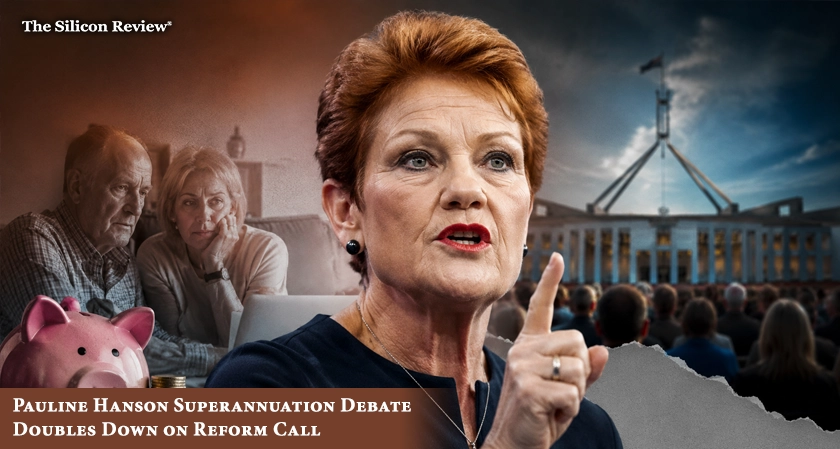
Pauline Hanson Doubles Down on...Pauline Hanson Doubles Down on Contentious Superannuation Call amid Growing National Debate
The Silicon Review
17 August, 2026
Author:
Sashindra Suresh
Pauline Hanson has reignited the superannuation debate by suggesting low-income earners may be better off receiving their compulsory super contributions as wages, fuelling a growing national debate over the $4 trillion retirement system.
One Nation leader Pauline Hanson has doubled down on her call to end compulsory superannuation for low-income earners, arguing that Australians struggling with the cost of living should have access to their retirement savings now. The comments have intensified a growing national debate over the future of Australia's $4 trillion superannuation system.
"Now many Australians are doing it tough. They're struggling to pay their mortgages. In some ways, I think we should give it back to them to help them with the cost of living. That's their money. They sacrificed it for a pay rise," Hanson told News 24.
The One Nation leader has also echoed concerns raised by Liberal frontbencher Andrew Bragg, who has labelled compulsory superannuation a "failed policy" that has not reduced the number of Australians relying on the Age Pension. Bragg has called for a complete rethink of the system, which requires employers to pay 12% of ordinary time earnings into superannuation accounts.
"It was supposed to be for old age so the government doesn't have to pay the full pension to these people. So many people are taking out their super, spending it, and still ending up on the pension. To be honest, I think the whole system is broken," Hanson said.
The Broader Superannuation Debate
The debate comes amid significant changes to Australia's superannuation system. From July 1, 2026, the "Payday Super" reforms require employers to pay superannuation contributions within seven calendar days of payday, ending the old quarterly system. The government is also moving to tax superannuation balances above $3 million at a higher rate, affecting approximately 90,000 Australians, while Labor and the Greens have pushed to ban SMSFs from borrowing for residential property.
"The superannuation system has a lot of issues in it," Hanson said, noting that she has previously supported policy allowing Australians to access super for housing deposits, a move she said could help people "through crisis."
Reaction and Implications
Hanson's comments have drawn criticism from industry groups and superannuation funds, which argue that compulsory superannuation is essential for ensuring Australians can fund their retirement. HESTA's pre-budget submission for 2026-27 called for reforms to deliver a "fairer and simpler super system that works for everyone."
Here is the question this debate raises. With Australia's superannuation system holding over $4 trillion in retirement savings, the question of who should have access to these funds and when is becoming a central political battleground. When a growing number of Australians are struggling with the cost of living, is it time to rethink how we approach retirement savings?
As the national debate over superannuation reform intensifies, The Silicon Review asks a final question. When the cost of living crisis and the retirement savings crisis collide, whose vision for the future of superannuation will prevail?
FAQ:
Q: What did Pauline Hanson say about superannuation?
A: Pauline Hanson suggested low-income earners may be better off receiving their compulsory super contributions as wages to help with the cost of living. She also raised concerns that the current system is "broken" and failing to reduce reliance on the Age Pension.
Q: What is compulsory superannuation in Australia?
A: Australia's compulsory superannuation system requires employers to pay 12% of ordinary time earnings into a superannuation fund for employees, which is then invested for retirement.
Q: What are the recent changes to Australia's superannuation system?
A: Recent changes include the "Payday Super" reforms requiring employers to pay contributions within seven days of payday from July 1, 2026, and proposed higher taxes on balances above $3 million.
Q: What is Andrew Bragg's position on superannuation?
A: Liberal frontbencher Andrew Bragg has called compulsory superannuation a "failed policy," arguing it has not reduced reliance on the Age Pension and has created a "viper's nest" for financial institutions .
Q: What is the size of Australia's superannuation system?
A: Australia's superannuation system holds over $4 trillion in retirement assets, making it one of the largest retirement savings pools in the world.




















Comments