>>
Industry>>
Environmental sustainability>>
Top 10 Waste Management Compan...Top 10 Waste Management Companies to Watch in 2026: The Silicon Review's Guide to Global Leaders and Innovators
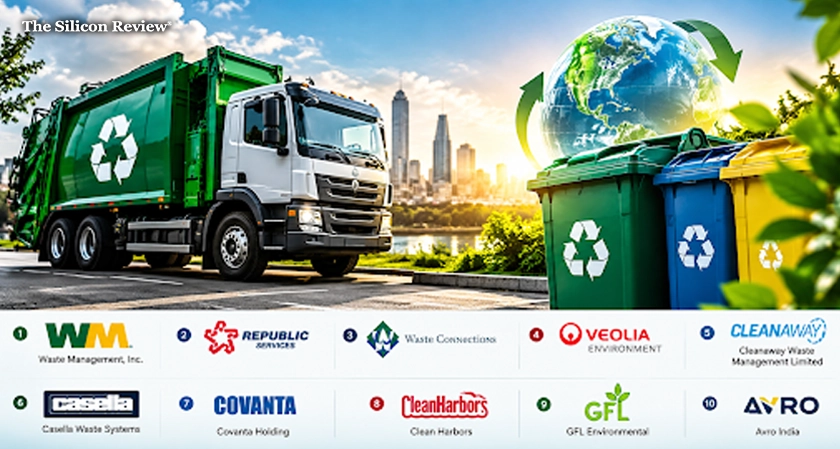
Let's be honest. The world has a waste problem. Rapid urbanization and industrial growth have significantly increased solid waste generation, creating serious environmental, economic, and public health challenges. Cities are struggling to manage growing waste streams efficiently, resulting in environmental degradation, public health risks, and economic burdens. Inadequate waste management causes soil pollution, water pollution, and greenhouse gas emissions. Improperly discarded waste leads to poor odor, rat infestation, and disease transmission. Traditional waste collection mechanisms are mostly manual, inefficient, and time-consuming, lacking real-time monitoring capabilities.
But here's the good news. The waste management industry is undergoing a transformation. Smart waste monitoring systems, advanced recycling technologies and IoT-enabled solutions are revolutionizing how we handle waste. From AI-powered segregation to UV-C sterilisation, from plastic-to-oil conversion to on-site biomedical waste processing, innovation is everywhere. That's why The Silicon Review ranked the world's No.1 digital magazine of the year 2026 has curated this list of the Top 10 Waste Management Companies to Watch in 2026. Whether you're an investor, a policymaker, or a business leader looking for sustainable solutions, this is your essential briefing.
How We Selected These Companies
We evaluated companies across five dimensions:
- Market Leadership: Revenue, market cap, and operational scale
- Innovation: Adoption of smart technologies, AI, and IoT
- Sustainability Impact: Environmental benefits and circular economy contributions
- Growth Trajectory: Expansion plans, funding, and capacity increases
- Global Reach: Presence across multiple regions and markets
Top 10 Waste Management Companies to Watch in 2026
1.Waste Management, Inc. (WM)
Revenue: $25.4B | Market Cap: $85.5B | Employees: 60,500 | Headquarters: Houston, USA | Founded: 1968
Waste Management, Inc. (WM) is the undisputed global leader in the waste management industry, with a commanding market cap of $85.5 billion as of 2026. The company provides comprehensive environmental solutions to residential, commercial, industrial, and municipal customers across the United States, Canada, Western Europe, and internationally. WM offers collection services, operates transfer stations, and owns and develops landfill gas-to-energy facilities that produce renewable electricity and renewable natural gas. The company also runs materials processing and commodities recycling services, recovering cardboard, paper, glass, metals, and plastics for resale or other purposes. Their regulated waste and compliance services handle medical, pharmaceutical, and hazardous waste, while their secure information destruction services ensure confidential document disposal.
Why They're #1: Waste Management combines the largest market presence with a comprehensive service portfolio. Their integration across the entire waste value chain from collection to energy recovery to recycling creates a moat that smaller competitors cannot replicate. Their investment in landfill gas-to-energy and renewable natural gas positions them at the intersection of waste management and clean energy.
2. Republic Services (RSG)
Revenue: $16.7B | Market Cap: $85.5B | Employees: 35,000+ | Headquarters: Phoenix, USA
Republic Services is the second-largest waste management company in the United States, with a market cap of $85.5 billion and TTM revenue of $16.7 billion. The company consistently ranks among the top three players in the environmental and facilities services sector. Republic Services provides collection, transfer, recycling, and disposal services for residential, commercial, and industrial customers. The company operates across the United States and has been expanding its recycling capabilities and landfill gas-to-energy projects.
Why they’re #2: Republic Services' consistent revenue growth and strategic focus on sustainability make it a key player in the industry. Their size and scale allow them to invest in advanced technologies while maintaining operational efficiency.
3. Waste Connections (WCN)
Revenue: $9.6B | Market Cap: $52.2B | Headquarters: Spring, Texas, USA
Waste Connections ranks as the third-largest waste management company, with a market cap of $52.2 billion and TTM revenue of $9.6 billion. The company has a strong presence across the United States and Canada. Waste Connections provides non-hazardous waste collection, transfer, disposal, and recycling services. The company has differentiated itself through its focus on secondary and rural markets where competition is less intense.
Why they’re #3: Waste Connections' strategic focus on underserved markets has allowed for steady growth and attractive margins. Their regional operating model provides flexibility and local expertise.
4. Veolia Environment S.A.
Headquarters: France | Industry: Waste Management, Water, and Energy
Veolia is a global leader in environmental solutions, offering waste management, water, and energy services across the world. In the waste management sector, Veolia competes directly with WM and Republic Services on the global stage. Veolia's waste management division handles collection, sorting, recycling, and disposal services for municipal, industrial, and commercial clients. The company has been expanding its hazardous waste capabilities and investing in advanced recycling technologies.
Why they’re #4: Veolia's global footprint, particularly in Europe and Asia, gives it a unique position in the market. The company's focus on circular economy principles aligns with growing regulatory demands for sustainable waste management.
5. Cleanaway Waste Management Limited
Revenue: $2.9B AUD | Employees: 8,000+ | Headquarters: Australia
Cleanaway is Australia's largest waste management company, providing services across collection, treatment, and disposal of waste. The company has seen consistent growth and operates across the Australian market. Cleanaway offers waste collection, resource recovery, and landfill management services. The company has been investing in advanced recycling facilities and renewable energy from waste projects.
Why they’re #5: Cleanaway's market leadership in Australia positions it for growth as the country implements stricter waste regulations and circular economy policies. Their investment in resource recovery aligns with future market trends.
6. Casella Waste Systems (CWST)
Revenue: $1.9B | Market Cap: $5.3B | Employees: 2,000+ | Headquarters: Rutland, Vermont, USA
Casella Waste Systems is a regional leader in waste management with a strong presence in the northeastern United States. The company has demonstrated consistent growth and market discipline. Casella provides solid waste management services, including collection, transfer, disposal, and recycling. The company has been expanding its recycling capabilities and renewable energy projects.
Why they’re #6: Casella's regional focus allows for deep customer relationships and operational efficiency. Their commitment to sustainability and community engagement has built a loyal customer base.
7. Covanta Holding
Headquarters: USA | Industry: Waste-to-Energy | Employees: 3,500+
Covanta is a global leader in waste-to-energy solutions, converting municipal solid waste into renewable energy. The company operates over 40 energy-from-waste facilities across the world. Covanta's waste-to-energy facilities process millions of tonnes of waste annually, generating electricity and recovering metals. The company positions itself at the intersection of waste management and renewable energy.
Why they’re #7: Covanta's waste-to-energy technology addresses two challenges simultaneously: waste disposal and energy generation. As landfill space decreases, waste-to-energy solutions become increasingly valuable.
8. Clean Harbors
Revenue: $3B | Employees: 10,000+ | Headquarters: Norwell, Massachusetts, USA
Clean Harbors is a leading provider of environmental and industrial services, including hazardous waste management. The company serves a wide range of industries and government clients. Clean Harbors provides hazardous waste disposal, emergency response, industrial cleaning, and environmental services. Their specialised capabilities in handling regulated waste give them a unique market position.
Why they’re #8: Clean Harbors' specialised focus on hazardous waste creates a moat that general waste management companies cannot easily replicate. Their regulated waste capabilities align with tightening environmental regulations.
9. GFL Environmental
Employees: 26,000+ | Headquarters: Canada
GFL Environmental is a North American leader in waste management and environmental services, serving over 5 million customers. The company has grown through strategic acquisitions and organic expansion. GFL provides solid waste collection, transfer, disposal, and recycling services, along with soil remediation, liquid waste management, and infrastructure services.
Why they’re #9: GFL's comprehensive service offerings and North American presence make it a major competitor. The company's growth trajectory positions it for further expansion.
10. Avro India
Employees: 100+ | Headquarters: Ghaziabad, India | Founded: 2016
Avro India is a rising Indian company in the plastic recycling space, with ambitious plans for capacity expansion. The company has invested ₹25 crore in its recycling plant and plans to invest an additional ₹30 crore by March 2027. Avro operates through a 100% owned subsidiary, Avro Recycling Limited, with manufacturing and recycling units in Ghaziabad, Uttar Pradesh. The company has developed a proprietary system capable of upcycling complex plastic waste like cement bags, salt bags, sugar bags, putty bags, and calcite packaging materials. Their recycled granules are utilized in manufacturing plastic furniture, air coolers, washing machines, and automotive components.
Why they’re #10: Avro India's rapid growth and capacity expansion plans position it as an emerging player in India's plastic recycling market. Their proprietary upcycling technology addresses the significant challenge of complex plastic waste in a market where less than 10% of plastic waste is currently recycled. The company's aggressive expansion plans reflect growing demand for circular economy solutions in India.
Emerging Innovators in Waste Management
PolyCycl
Headquarters: Chandigarh, India | Funding: $2.9M Series A | Founded: 2016
PolyCycl is a for-purpose company focused on addressing the challenge of recycling hard-to-recycle waste plastics. Their flagship technology enables conversion of landfill-extracted plastics to hydrocarbon oils using a patented fully-continuous pyrolysis process. The hydrocarbon oils have been evaluated and qualified by global petro-majors for manufacturing virgin plastics and circular economy products. Six international patent grants and three pending patents demonstrate the novelty of their approach.
Why It Matters: PolyCycl's technology paves the way for an endless plastic-to-plastic circular economy, whereby used plastics can be recycled in a closed loop to new plastic articles. The fully-continuous process enables capex reduction of up to 50% versus incumbent offerings. In January 2026, PolyCycl raised $2.9M in a Series A round led by Rainmatter Capital.
Neo San
Headquarters: Bengaluru, India | Founded: 2020
Neo San is a clean-technology company that has developed 'Neo-X', smart waste-processing units for on-site sanitary and biomedical waste treatment. The company won the WEF UpLink Yes/Bengaluru Urban Innovation Challenge, which brought together the Greater Bengaluru Authority (GBA) and a coalition of private sector partners.
Why It Matters: Open waste burning accounts for a significant share of Bengaluru's PM2.5 emissions. Every Neo-X unit has real-time IoT monitoring, tracking each cycle and every kilogram processed. The initiative aims to eliminate open burning and manual waste handling, reducing overall process emissions by 98%.
TRASHTRACK: Smart Waste Monitoring
Conference: IEEE (May 2026)
TRASHTRACK is a smart waste monitoring and automation system developed with UV-C sterilisation and plastic compression capabilities. The system integrates sensing, mechanical control, wireless communication, and real-time visual monitoring to improve waste collection efficiency.
Why It Matters: A sensor constantly monitors waste fill levels using an ultrasonic sensor. A servo motor provides automated lid opening, and a DC motor compresses plastic waste. The UV-C sterilisation unit minimizes microbial contamination. The system prevents overflow, increases sanitation, minimizes human intervention, and optimizes collection schedules.
IoT-Enabled Smart Bin
Publication: Taylor & Francis (2026)
An IoT-enabled smart bin designed for efficient segregation of wet and dry waste features an additional mechanism for liquid extraction. A rain sensor detects wet waste, and an HC-SR04 ultrasonic sensor identifies dry waste. The separation accuracy reaches up to 95%, supporting Sustainable Development Goal 11: Sustainable Cities and Communities.
Radioactive Waste Management: The Nuclear Challenge
Beyond municipal waste, the IAEA has been working on radioactive waste management across Europe and Central Asia. Over the last two years, the IAEA has trained more than 200 experts in Europe and Central Asia to manage radioactive waste safely and securely. Lithuania's Maišiagala radioactive waste storage facility was successfully decommissioned in 2026, providing a model for other countries. Regional collaboration has allowed countries like Georgia which once received capacity building support to now share expertise with others.
What These Companies Teach Business Leaders
First, scale matters. Waste Management's $85.5 billion market cap dwarfs competitors, demonstrating that scale provides a significant moat in waste management. Second, innovation is accelerating. Smart waste monitoring, IoT-enabled segregation, and UV-C sterilisation represent the future of waste management. Third, circular economy is the endgame. Companies like PolyCycl and Avro India are creating closed-loop systems where waste becomes feedstock. Fourth, specialised waste is a growth area. Biomedical waste and radioactive waste management require specialised expertise and command premium pricing. Fifth, emerging markets are the growth frontier. India's rapidly expanding waste management sector, led by companies like Avro India and startups like Neo San, represents the next wave of growth.
Conclusion
The waste management industry in 2026 is defined by scale, innovation, and sustainability. Waste Management, Republic Services, and Waste Connections dominate the market, while companies like PolyCycl, Neo San, and Avro India represent the future of circular economy solutions.
Stop treating waste as a problem. Start treating it as a resource.
Frequently Asked Questions (FAQs)
Q. Which is the largest waste management company in the world?
Waste Management, Inc. (WM) is the largest, with a market cap of $85.5 billion and revenue of $25.4 billion as of 2026.
Q. What are the top waste management companies in 2026?
Waste Management, Republic Services, Waste Connections, Veolia, Cleanaway, and Casella Waste Systems.
Q. What is smart waste management?
IoT-enabled systems using sensors, automation, and real-time monitoring to optimize waste collection, segregation, and processing.
Q. What is the market size of the waste management industry?
The global waste management market is valued at over $500 billion and is projected to grow to over $1 trillion by 2035.
Q. Which Indian companies are leading in waste management?
Avro India (plastic recycling), PolyCycl (plastic-to-oil conversion), and Neo San (biomedical waste processing) are emerging leaders.
Q. What is plastic-to-oil technology?
A process using pyrolysis to convert waste plastics into hydrocarbon oils that can be used to manufacture new plastics.
Q. What are the environmental benefits of advanced waste management?
Reduced landfill use, lower greenhouse gas emissions, decreased pollution, and conservation of resources through recycling.


















Comments