>>
Technology>>
Networking>>
Best Enterprise Ethernet Servi...Best Enterprise Ethernet Services in Michigan for Secure Multi-Site Connectivity

Reliable fiber isn’t a perk anymore—it’s the lifeline that keeps Detroit HQs, Grand Rapids plants, and Upper Peninsula clinics in sync with customers and cloud apps.
Still, choosing the right provider can feel like decoding a knot of acronyms, SLAs, and overlapping coverage maps. We analyzed the January 2026 FCC Broadband Collection alongside recent performance benchmarks to surface the networks that truly deliver.
Whether you rely on AT&T’s statewide backbone or choose enterprise Ethernet services from hometown favorite WOW! Business, this guide equips you with the facts—and confidence—to wire every Michigan location for growth.
How We Picked the Winners
We built this list to feel useful the moment you arrive, not after three calls with sales reps.
First, we pulled the January 2026 FCC Broadband Collection and matched it to GISuser’s statewide analysis. Any carrier that served fewer than eight percent of Michigan business addresses or lacked several thousand on-net buildings left our radar (link above).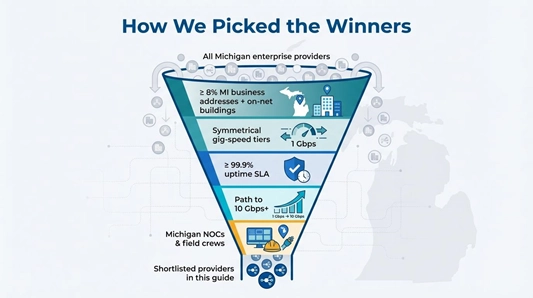
Coverage alone never closes the deal. We kept only providers that publish symmetrical gig-speed tiers and an uptime guarantee of at least 99.9 percent.
Next, we checked scalability. Networks had to offer a clear path to 10 Gbps or higher without forklift upgrades, which ruled out legacy DSL and coax plans dressed up as “business fiber.”
Last, we verified local investment: Michigan-based NOCs, field crews on standby, and fresh capital for new fiber routes. Operators still leaning on decade-old plant did not make the cut.
For example, WOW! Business’ Ethernet page lists dedicated fiber speeds from 5 Mbps to 10 Gbps and spells out a 99.9 percent uptime SLA—exactly the floor we enforced. Publishing those specs up front lets IT and finance teams validate capacity and risk tolerance before they even talk to sales.
The outcome is a concise shortlist you can rely on when every minute of uptime counts.
WOW! Business – local fiber partner with enterprise power
If your offices sit in Metro Detroit or stretch west toward Lansing, WOW! Business is likely nearby. The company’s fiber network runs along key commercial corridors—Livonia, Dearborn, Troy, East Lansing—giving roughly one in ten Michigan business addresses true enterprise-grade bandwidth.
Speed stays consistent. On its public-facing Business ethernet services page, WOW! details symmetrical fiber tiers from 5 Mbps up to 10 Gbps and backs them with a 99.9 percent uptime SLA and 24/7 U.S. support. Those Dedicated Internet and Ethernet Private Line circuits give plenty of head-room for bursty CAD files, cloud backups, or sudden video-call surges. That ceiling leaves room for bursty CAD files, cloud backups, or sudden video-call surges.
WOW! separates itself from national giants through local presence. Sales engineers, project managers, and field technicians live here. When a new circuit turns up, the handshake happens in person. If a backhoe cuts fiber, the repair truck rolling out of the depot carries Michigan plates.
Cost-effective does not mean flimsy. Fiber SLAs pledge 99.9 percent uptime and 24/7 monitoring. While a notch below the 99.99 percent tier some rivals market, many mid-market firms welcome the savings and friendlier support line.
In 2025 WOW! expanded all-fiber builds across Livingston, Oakland, and Genesee counties, and construction continues in 2026. For businesses lucky enough to sit on-net, it remains a nimble choice that delivers high speeds with a neighborhood handshake.
AT&T Business – statewide backbone and global reach
AT&T’s network stretches from Detroit skyscrapers to clinics in Houghton. Legacy Bell plant, ongoing fiber builds, and central offices in nearly every ZIP code give the carrier access to roughly 80 percent of Michigan business addresses (GISuser, January 2026).
Coverage matters only when performance keeps pace. Dedicated Internet circuits start at 100 Mbps and scale above 10 Gbps on the same monitored glass. Each link carries a 99.99 percent uptime pledge, which equals fewer than five minutes of monthly downtime. That margin protects production lines and patient portals alike.

AT&T Business Dedicated Internet Page Highlighting Fiber Speeds and 99.99% SLA
AT&T peers directly into Chicago cloud exchanges, trimming milliseconds for AWS and Azure traffic. The latency savings keep Teams calls clear and database replication on schedule.
Support stays enterprise-class. A Michigan account team leads installs, and a national 24/7 NOC tracks every light level. Optional 4G and 5G failover adds another layer of resilience without adding vendors.
Choose AT&T when you want a single contract to serve every office, warehouse, and branch bank in the state, with room to grow to multi-gig traffic without a full redesign.
Comcast Business – scalable cable-to-fiber path
Comcast serves the corridors where Michigan commerce clusters: Detroit suburbs, Grand Rapids industrial parks, and dozens of cities along I-94 and I-96. About 64 percent of business addresses sit inside its cable plant (FCC Broadband Collection, January 2026), so many offices can light up service in days rather than weeks.
The real value is the step-up path. You can begin on affordable coax at 1 Gbps down and 35 Mbps up, then move to Ethernet Dedicated Internet when traffic or latency needs rise. The fiber tier delivers symmetrical speeds up to 10 Gbps and a 99.99 percent uptime pledge, which keeps mission-critical apps off “best effort” transport.
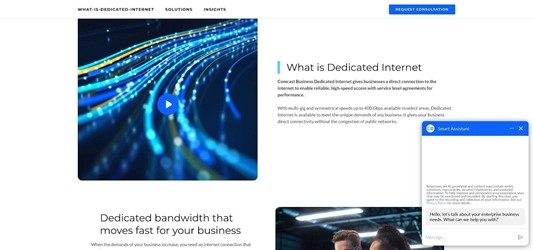
Comcast Business Dedicated Internet Page Illustrating Cable-to-Fiber Upgrade Path
Comcast supports that promise with practical touches such as LTE backup routers for automatic failover and ongoing node splits that reduce neighborhood congestion. You keep one invoice, one portal, and the freedom to scale without switching carriers.
Spectrum Business – no-contract flexibility up north
Charter’s Spectrum brand serves the areas where larger telcos thin out: Lansing, Flint, Kalamazoo, Traverse City, and the Upper Peninsula. That mid-Michigan coverage helps firms keep branch offices online far from Detroit’s fiber core.
Standard business cable activates quickly and, unlike most rivals, is available month-to-month. If you need a fast secondary circuit or leverage in contract talks, that flexibility matters. When traffic or latency demands climb, Spectrum Enterprise can upgrade the same account to fiber up to 10 Gbps with a 99.99 percent uptime pledge.
Because the coax often rides separate utility poles from incumbent telco fiber, many IT teams use Spectrum as a fully diverse backup path. One storm or construction mishap is less likely to drop both links at once.
Everstream – business-only fiber with high-capacity focus
Everstream built its reputation on a clear promise: no residential traffic. Every strand of glass is engineered for enterprises that monitor jitter as closely as raw speed.
In 2023 Everstream absorbed Rocket Fiber’s Detroit network and linked Lansing, Grand Rapids, and Kalamazoo. It has since pulled fresh, high-count cable across Michigan’s commercial heartland. That modern build delivers two benefits. First, it turns up 10 Gbps circuits as quickly as some carriers quote 1 Gbps. Second, it scales to 100 Gbps waves when data lakes start to overflow.
Because the network is younger, latency stays low and paths remain diverse by design. Need two entrances into your headquarters or a private link to a hyperscaler? Their engineers sketch the plan on site, then splice the glass in weeks, not quarters.
For firms that feel buried in a national telco’s ticket queue, Everstream provides deep fiber density where you work and a support team that treats every circuit like mission-critical infrastructure.
123NET – Michigan-born fiber for high-bandwidth workloads
123NET began in a Southfield garage and never lost its local focus. Today the carrier operates 4,500 miles of fiber, runs the Detroit Internet Exchange, and lights 100 Gbps waves between major Michigan data centers.
Latency is its calling card. A purpose-built Detroit–Chicago route trims milliseconds that matter for financial trading, real-time analytics, and rapid off-site backups. Inside the state, 123NET links Detroit, Grand Rapids, and Lansing with low-latency rings that keep multi-site applications responsive.
Reach keeps growing. In February 2025 123NET and Peninsula Fiber Network completed a high-count cable from Marquette to Southeast Michigan, giving Upper Peninsula branches a direct path to downstate resources without carrier handoffs.
Support remains local. Engineers, NOC staff, and field crews live in Michigan. When you request dark fiber or a 10 Gbps circuit, the decision maker is often a short drive away.
Choose 123NET when raw speed, custom routing, and hometown responsiveness top your priority list.
US Signal – network and data-center under one roof
Grand Rapids-based US Signal combines two assets every enterprise values: a 9,500-mile Midwest fiber backbone and carrier-neutral data centers across Michigan. That mix lets you order a 10 Gbps private link and a rack of disaster-recovery gear from the same playbook.
The company is investing further. In June 2025 US Signal committed $200 million to add 1,000 miles of high-density fiber and expand power at its Detroit-area data center, according to Crain’s Grand Rapids Business. The goal is to serve bandwidth-hungry AI workloads.
Practically, you gain richer route diversity between West Michigan, Metro Detroit, and Chicago, plus faster cross-connects to cloud nodes inside US Signal facilities. Latency stays below four milliseconds inside metro rings, and a 99.99 percent SLA backs every enterprise circuit.
Support keeps the hometown feel. A Michigan NOC monitors links around the clock, and account engineers speak both marketing and BGP in the same call. If you want network, colo, and managed cloud on one invoice, US Signal is the in-state specialist ready to help.
Other providers to consider
Michigan’s fiber map stretches far beyond any shortlist. A few specialized names deserve a quick look before you move on.
Peninsula Fiber Network commands the Upper Peninsula and northern counties. If you run clinics in Marquette or mines near Iron Mountain, PFN’s ring-protected routes often form the backbone national carriers rent behind the scenes.
Frontier and the newer Brightspeed can help when your branch sits in a small township. Years of copper are finally giving way to gig-capable fiber, and the pricing may surprise you.
Local CLECs such as ACD.net in Lansing or Clear Rate in Metro Detroit sometimes beat larger providers on turnaround time and personal service. They lease backbone capacity, layer on managed firewalls, and hand you one clean invoice.
Need dark fiber or a 100 Gbps wave between data centers? Zayo and Lumen keep metro Detroit conduits stocked with spare strands, even if they rarely advertise to everyday businesses.
If your geography or use case feels niche, pair a regional specialist with a statewide giant to create genuine path diversity without inflating the budget.
How to Choose the Right Enterprise Ethernet Provider
1. Pin your locations on the map first
Start with geography, not gigabits. List every office, plant, clinic, and data center you plan to connect, then plug each address into provider lookup tools or the FCC National Broadband Map. In minutes you will see which carriers reach every site and which ones leave outliers stranded.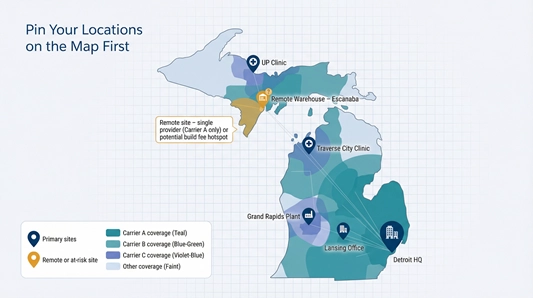
Why begin here? Coverage shapes bargaining power. If two providers can serve all of your buildings, you can pit their quotes against each other and negotiate sweeter terms. If only one touches the remote warehouse in Escanaba, you already know redundancy will require a second, regional carrier.
Plotting sites early also flags expensive builds before contracts land on your desk. A provider that looks cheapest on paper can become priciest once you add a six-figure construction fee for a single rural spur. Catch that now, not after budgets lock.
2. Validate the SLA, not just the speed
A gigabit that drops for an hour on payday costs more than a slower line that never blinks. Review service-level agreements before you admire bandwidth charts.
Focus on two numbers. Uptime shows how long the circuit should stay alive each month. Ninety-nine point nine percent allows roughly forty-four minutes of downtime. Ninety-nine point nine nine cuts that to under five minutes. Decide how much pain either window would cause, then budget accordingly.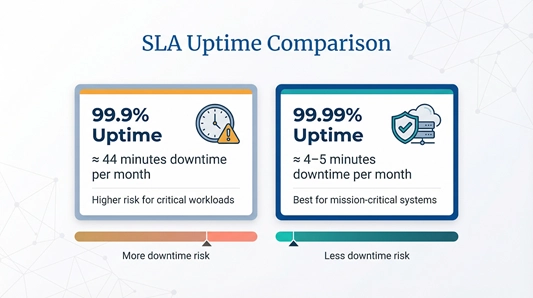
Mean time to repair is the next signal. A four-hour restore target means crews and spares nearby. Eight or twelve hours suggests the fix may wait for daylight or a third-party splice team. Ask providers to spell out credits, escalation paths, and whether they monitor your link proactively or wait for you to call.
Confirm path diversity, too. A “diverse” route should mean two physically separate cables all the way to the core, not two strands in the same conduit. Ask for diagrams. If the carrier hesitates, treat that as an answer.
3. Size for tomorrow, not yesterday
Bandwidth forecasts spoil quickly. Video meetings multiply, cloud backups double, and that “ample” 500 Mbps link soon wheezes under peak load.
Look at the heaviest hour your network pulled last quarter, then assume traffic grows at least twenty percent a year. If you plan a new ERP rollout, double that estimate. Order capacity that stays ahead of demand for three full contract years so you expand deliberately instead of scrambling for an emergency upgrade.
Test the upgrade path as well. Can the provider turn a 1 Gbps port to 10 Gbps with a configuration change, or does the jump require new optics, a forklift router, and months of paperwork? Ask for recent customer examples and what downtime, if any, occurred.
4. Judge support culture before you sign
Sales calls preview outage day. Notice how quickly emails get answered, how clearly engineers explain routing options, and whether pricing arrives in the format you requested. A provider that fumbles basics during courtship rarely transforms into a white-glove partner once the ink dries.
Ask who owns trouble tickets at 2 am. Is it a Michigan-based NOC that can dispatch local splice crews, or a national call center reading from scripts? Request a direct line to the escalation manager and test it. Good carriers share names and numbers without hesitation.
Check references that match your size and industry. A healthcare group concerned about HIPAA wants proof the carrier has handled PHI traffic without incident. A manufacturer facing shift-change surges benefits from hearing how the network holds up when thousands of workers clock in.
5. Balance budget against contract flexibility
Price always matters, yet the cheapest quote loses appeal if it locks you into a three-year term with steep exit fees.
Ask for two figures: the non-recurring cost to build each site and the monthly recurring charge at one-, two-, and three-year terms. Cable providers often waive construction when you choose the longer term, while fiber-only carriers may match that concession to stay competitive. Seeing the full matrix lets you measure true total cost of ownership.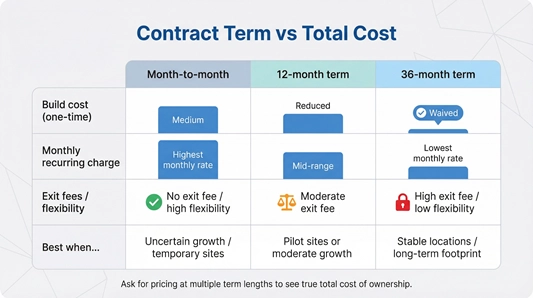
If your growth plans feel uncertain, paying slightly more for month-to-month service from Spectrum or a twelve-month promo from WOW! can save money later. If you control a stable portfolio of locations, locking a three-year fiber deal with AT&T or Everstream may secure lower monthly costs and predictable budgeting.
Savings and flexibility both have value. Contract language is negotiable, and carriers often bend on term length, install credits, or bandwidth ramp schedules when you ask, especially if a rival is eager to win the bid.
Conclusion
Selecting the right enterprise Ethernet provider demands a balance between coverage, performance guarantees, scalability, support culture, and budget flexibility. Use the criteria above, compare quotes, and negotiate terms so every Michigan location stays reliably connected.
Frequently Asked Questions
What is enterprise Ethernet and how is it different from standard business internet?
Enterprise Ethernet provides dedicated, symmetrical bandwidth over fiber and often bundles point-to-point or multi-site services. Standard business broadband shares capacity with neighbors and offers no formal uptime guarantee. Think of enterprise Ethernet as a private lane on the data highway rather than a faster on-ramp.
Can one provider really cover both peninsulas?
AT&T’s statewide plant reaches most addresses north and south of the Straits, and many downstate carriers ride Peninsula Fiber Network’s backbone to light circuits in the Upper Peninsula. Always verify each street address. You may still pair a primary carrier downstate with PFN or Spectrum at remote clinics to keep redundancy clean.
How much downtime does ninety-nine point nine percent versus ninety-nine point nine nine percent allow?
At ninety-nine point nine percent you plan for about forty-four minutes of unplanned outage each month. Raising the bar to ninety-nine point nine nine percent cuts the allowance to roughly four minutes. Weigh the impact on orders, lab results, or assembly lines before you choose.
Is 5G fixed wireless a viable backup?
Yes, as a secondary link. A small rooftop antenna and a failover router can keep point-of-sale and email alive if a fiber cut drops your primary circuit. Latency is higher and data caps may apply, so 5G complements fiber rather than replaces it for most enterprises.
When should we choose dark fiber instead of a managed Ethernet service?
Consider dark fiber when you need full control over optics, protocols, and scaling—and have staff to manage it. Universities moving petabytes between campuses or trading firms chasing microseconds often lease dark strands from 123NET or Zayo. For most businesses, a managed 10 Gbps wave is simpler and more cost-effective.
Have thoughts about this story? Contact us at https://thesiliconreview.com/