>>
Industry>>
Robotics>>
9 Best ERP for Warehouse Autom...9 Best ERP for Warehouse Automation That Handle Robotics Integration
The Silicon Review
10 March, 2026
Author:
The Silicon Review Team
Robots have left the pilot corner. They now haul totes, lift pallets, and pace beside pickers across full distribution centers.
Software—not hardware—decides whether that investment pays off. Thirty-eight percent of companies cite integration complexity as the top barrier to scaling automation (upliftnlove.com analysis), while early adopters report 300 percent returns within three years, according to Gitnux.
This guide distills six evaluation criteria and pressure-tests nine ERP platforms so you can pair the right brain with your growing fleet—and give the CFO results that stick.
Why your ERP choice matters
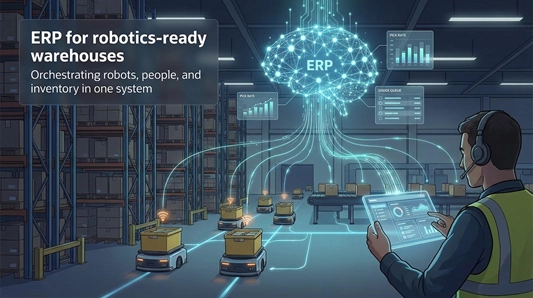
A warehouse runs only as well as the system issuing instructions.
Pick the wrong brain and you chase ghosts: robots wait, orders slip, and payback drifts past the CFO’s patience.
Integration headaches stall nearly four of every ten automation projects; the sites that solve them earn triple-digit returns within three years.
The difference is tight coordination. When an ERP or WMS assigns work to bots, people, and conveyors in the same beat, every tote moves with purpose and inventory data stays reliable.
Choose a platform that treats robots as first-class workers and you’ll gain faster throughput, lighter workloads, and an income statement that proves the investment.
Settle for software that needs bolt-on work-arounds and you’ll be parking expensive paperweights.
How we judge a robotics-ready ERP
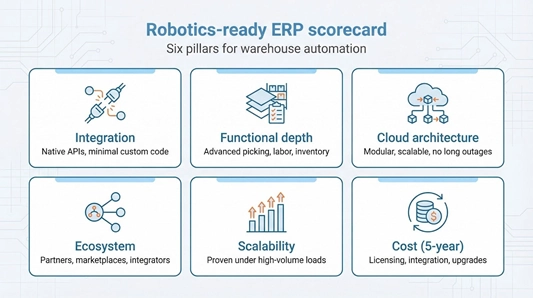
You deserve more than a beauty-pageant roundup, so we built a scorecard that mirrors the headaches you and your integrator face every day.
First, we looked for native plumbing. If a platform sends tasks to robots through pre-built APIs instead of brittle custom code, deployment time drops.
Second, we tested functional depth. A warehouse brain needs advanced picking logic, labor management, and real-time inventory control, or the bots pace in circles.
Next came cloud DNA. Modular services should scale during peak and absorb new tech without maintenance windows. On-prem installs still matter for regulated sites, but flexible capacity wins long term.
We then checked ecosystem reach. Partner networks, app marketplaces, and certified integrators shorten the path from pilot to payback.
After that, we measured raw horsepower. High-volume fulfillment pounds a system with millions of messages every shift; only platforms proven at that altitude qualified.
Finally, we calculated five-year cost. Licensing, integration, and upgrade work reveal the true price. A bargain sticker fades if you pay twice as much bolting on middleware later.
These six pillars (integration, functional depth, cloud architecture, ecosystem, scalability, and cost) guide every review that follows. Keep them close; they turn vendor slides into apples-to-apples reality.
SAP S/4HANA with Extended Warehouse Management
SAP dominates the enterprise tier. Its S/4HANA platform, paired with the Extended Warehouse Management module, treats every robot, conveyor, and AGV as a native part of the core ERP.
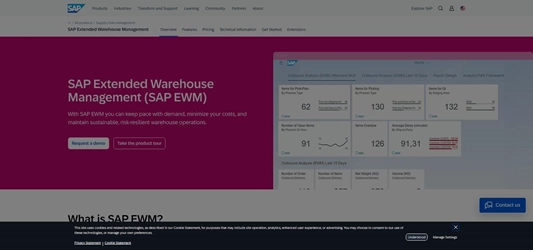
SAP S/4HANA Extended Warehouse Management automation capabilities screenshot
Issue a warehouse task, and EWM’s Material Flow System routes it to the correct fleet manager in milliseconds. Whether you run ten shuttle aisles or a blended fleet of Locus and Fetch AMRs, SAP connects through certified interfaces and open REST APIs. No fragile middleware, no confusion when a tote pauses.
Functional breadth is the other story. Slotting, labor planning, yard control, and real-time analytics share one in-memory database. When a robot completes a pick, inventory, finance, and production schedules update in the same second.
Complexity is the trade-off. Projects need skilled consultants and a healthy budget, yet the outcome is a single data source that scales from a pilot cell to a global network running 24/7.
Microsoft Dynamics 365 Supply Chain Management
If your tech stack already lives in Microsoft’s world, staying there can cut integration time on the warehouse floor.
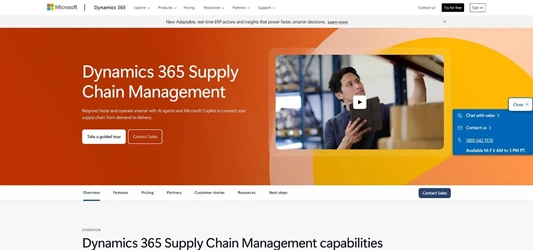
Microsoft Dynamics 365 Supply Chain Management warehouse automation screenshot
Dynamics 365 plugs into Azure and the Power Platform, so adding an AMR fleet often feels like any other low-code workflow. A pre-built connector pipes tasks from the WMS to the robot manager, while Power BI dashboards surface real-time pick rates without an extra data lake.
Because the application runs as SaaS only, updates land roughly every 30 days. New AI Copilot prompts, inventory insights, and connector refinements appear automatically, with no weekend outages and no version gaps that leave robots speaking an outdated dialect.
Functionally, D365 covers wave or waveless picking, advanced replenishment, and tight links to manufacturing orders. It treats each bot as a “worker,” so labor reporting stays consistent whether the task went to Pat on aisle seven or a Locus rolling past.
Integrator MCA Connect distills those hooks into its Warehouse Advisor Agent, a Microsoft-certified extension for Dynamics 365 Supply Chain Management.
As their analysis on Robotics adoption in distribution and manufacturing explains, the hurdle is no longer whether robots work but whether mixed fleets can be orchestrated as one system.
Warehouse Advisor Agent answers that need by translating robot events directly into Dynamics 365 work queues, giving supervisors a single flow instead of a patchwork of dashboards.
Andis, a grooming-products manufacturer, used the agent to roll out D365-directed robotics and cut order-processing time while raising shipment accuracy—no extra WES required.
The tool auto-maps robot events to standard warehouse tasks and streams exception alerts into the same D365 dashboards, so supervisors gain fleet visibility on day one instead of waiting for custom code.
Licenses scale by named user, making the math friendly for mid-market firms that plan to automate one site now and bring the next online later.
Oracle Fusion Cloud Warehouse Management
Oracle took the LogFire code base and moved it to its cloud, creating a WMS that handles real-time device traffic at scale.
Automation messages travel through standard REST endpoints into Oracle’s event engine. Conveyor photo-eyes, AS/RS cranes, and AGVs all publish status to one dashboard, so planners track flow in a single view instead of juggling vendor screens.
Connections to Oracle IoT Cloud add safeguards. Temperature spikes, battery warnings, or jam alerts trigger rules that reroute work before throughput dips.
Because the suite shares data with Oracle ERP and Transportation modules, inventory, freight, and finance stay synchronized. That view lets you model true cost-to-serve and prove robot ROI on the next budget call.
Most teams go live faster than with past Oracle projects, though skilled partners still fine-tune business rules. Subscription pricing scales with transaction volume, so peaks such as holiday surges remain predictable.
Blue Yonder warehouse management with Robotics Hub
Blue Yonder saw the integration snarl early and built a fix into the product. Its Robotics Hub sits between the WMS and every automated tool on your floor, normalizing commands so a Geek+ shuttle and a Locus AMR share the same playbook.
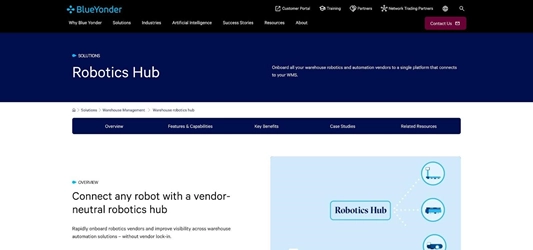
Blue Yonder Robotics Hub multi-robot warehouse orchestration screenshot
Setup feels like adding a new printer. You onboard a robot brand once, map its capabilities, and the hub handles the traffic. Future models drop in through the same interface, so expansion weekends shrink from months to days.
The core WMS already wins awards for waveless picking, labor gamification, and AI slotting. Add the hub and the software decides in real time whether a person or a bot should grab the next line. Bottlenecks clear before supervisors notice.
License costs sit at the premium end, and implementation needs seasoned partners, yet payback arrives quickly when every device pulls from one task queue.
Manhattan Active Warehouse Management
Manhattan rebuilt its flagship WMS as a cloud-native microservices platform, and the payoff shows in uptime and agility.
Because each feature runs as an independent service, the vendor ships weekly updates without overnight cutovers. New adapters for a goods-to-person shuttle or a palletizing cobot arrive; you flip a toggle, and the code goes live while orders keep moving.
The platform’s Mobile Automation Engine feeds tasks to bots and people from one queue, then reprioritizes on the fly if any asset slows. Supervisors watch color-coded heat maps on a tablet and step in with a tap instead of calling the control room.
Manhattan’s range covers wave planning, labor forecasting, yard, and returns. That power explains the premium price, yet many customers drop stand-alone WES licenses because Active WM already directs conveyors and AMRs in real time.
If you run multi-site, high-volume fulfillment and want tomorrow’s features delivered quietly on Sunday night, Manhattan deserves a spot on your shortlist.
Infor CloudSuite WMS
Infor rarely leads the hype cycle, yet 3PLs and vertical specialists praise its steady reliability.
Out of the box, it speaks voice, pick-to-light, carousels, and AS/RS through a mature equipment-interface layer. Add a handful of AMRs and the same API toolkit routes tasks their way without rewiring legacy devices.
Infor’s strength is configurability. You toggle industry templates such as food compliance, hazardous goods, or automotive kitting, and the WMS injects the correct rules. That focus trims project hours and keeps auditors satisfied.
Deployment matches your governance model. Run on-prem for tight IT control or use Infor’s AWS cloud for feature drops roughly every 90 days. Either path lets you connect IoT sensors through Infor ION so temperature spikes or lift-module jams trigger instant exception tasks.
Pricing sits in the middle tier. You pay less than a Manhattan implementation, more than an open-source experiment, and gain a platform that will not flinch when you add the next robot brand.
Epicor Kinetic with advanced MES
Epicor fits manufacturers that view the warehouse as the next station on the production line, not a separate planet.
Because inventory, work orders, and quality data share one database, an AGV feeding a press can close the move and update WIP in the same transaction. No swivel-chair entries, no lag.
Advanced MES listens to machine sensors and RFID portals, so when a pallet clears inspection the WMS triggers shipping tasks or replenishes line-side kanbans. Automation Studio, a low-code layer, exposes those events as drag-and-drop connectors. Your controls engineer can link a robot alert to an ERP receipt without writing Python at midnight.
Feature depth stays pragmatic: directed put-away, lot control, and handheld scanning cover most mid-market needs. If you require complex wave logic, look elsewhere, but for a plant-centric operation that wants a few cobots and lift modules talking natively to ERP, Epicor delivers results without stretching the budget.
Odoo with IoT and open APIs
Need automation on a tight budget? Odoo shows you can add robots without draining capital.
The core is open source. Spin up inventory, barcode, and manufacturing apps, then add the IoT module, a Raspberry Pi gateway that speaks MQTT, HTTP, or serial to nearly any gadget. One client connected it to a home-grown shuttle and watched Odoo dispatch totes the same day.
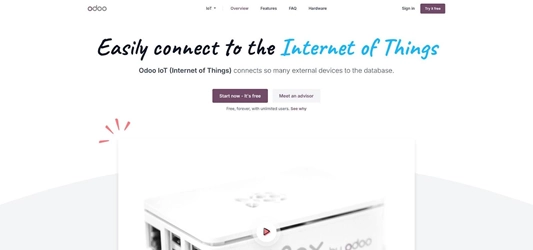
Odoo IoT module and Raspberry Pi warehouse automation screenshot
Because you own the code, you can embed robot calls directly into picking flows. A junior developer adds a JSON hook that tells an AMR to fetch pallet “A-123.” The bot replies “done,” and Odoo posts the stock move and prints the label without human taps.
Feature depth stays lean; you will not find advanced labor forecasting or AI slotting out of the box, but community add-ons fill many gaps. You trade license fees for do-it-yourself effort, yet the math often works: pay developers once, avoid six-figure annual subscriptions for good.
If you have in-house tech talent and want full control, Odoo can turn a little code and a small cloud bill into a capable automation stack.
Softeon WMS with built-in WES
Softeon attacks the integration puzzle by baking a Warehouse Execution System into the WMS itself.
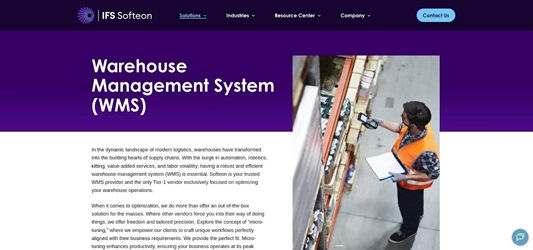
Softeon WMS with integrated WES warehouse orchestration screenshot
When an order drops, the WES balances robots, conveyors, and human zones from a single optimization engine. If an AMR lane clogs, Softeon slows releases and diverts picks to the next best resource before operators notice.
Adding a new device rarely needs custom code. Map endpoints in the integration workbench and the platform starts issuing tasks through the same event schema. That vendor-neutral stance prevents lock-in and keeps retrofit costs low when the next robot model arrives.
Clients praise speed to value. Many go live in under six months and shed separate WES license fees, turning Softeon into a budget-friendly alternative to marquee brands without losing enterprise muscle.
If your roadmap reads “multiple automation projects, zero finger-pointing,” Softeon deserves a spot on the demo list.
Conclusion
Selecting an ERP that treats robots as first-class workers is the difference between parking expensive hardware and capturing triple-digit ROI. Use the six criteria outlined above to match the right platform to your warehouse’s needs and scale automation with confidence.