>>
Education>>
Education>>
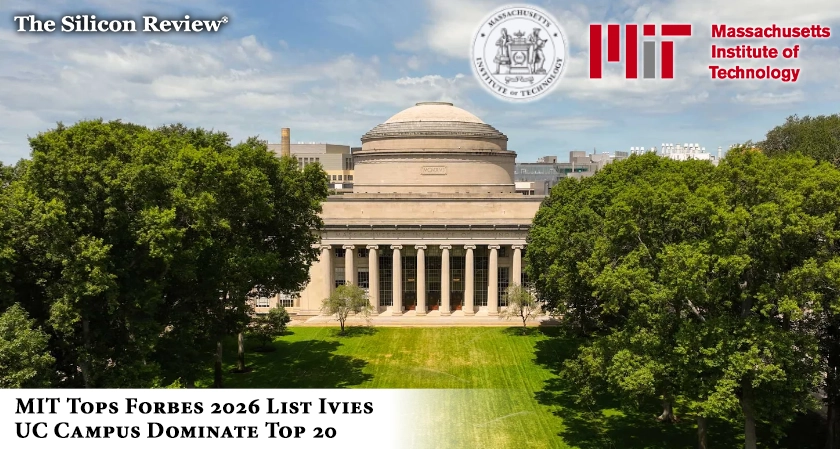
The Massachusetts Institute of...The Massachusetts Institute of Technology (MIT) Tops Forbes 2026 List, Ivies and UC Campuses Dominate Top 20
- Sashindra Suresh
The Massachusetts Institute of Technology (MIT) Retrieved the #1 spot on Forbes’ 2026 list of America’s Top Colleges, which ranks 500 schools based on graduate success and low student debt. All eight Ivies placed in the top 20, as did three University of California campuses.
The Massachusetts Institute of Technology (MIT) has retrieved the top spot on Forbes' 2026 ranking of America's Top Colleges, list that evaluates 500 schools based on graduate success, earning potential, and student debt levels. MIT's graduates earn a median salary of $110,200 just three years after graduation, & exceptional 99.8% of students return after their freshman year.
Columbia University spiked to No. 2 position, followed by Princeton University at No. 3, Stanford University 4, and the University of California, Berkeley at 5 rounding the top five as the highest-ranked public university in America.
To say it has been a rough year for American colleges would be an understatement, Forbes notes. Over the past eight months, President Donald Trump, his administration and Congressional Republicans have waged financial and cultural war on higher education freezing research funds, punishing diversity efforts, restricting the flow of foreign students, raising taxes on some endowments, and curbing student loan programs. Despite this, American colleges continue to deliver gold-standard undergraduate education.
All eight Ivy League institutions placed within the top 20, demonstrating their continued dominance in producing influential and high-earning graduates. Three University of California campuses also cracked the top 20, affirming the strength of public higher education.
Among the top 10, "Little Ivy" Williams College secured the No. 7 spot, marking a significant achievement for liberal arts colleges. Research powerhouse Johns Hopkins University came in at 8.
Forbes methodology focuses on return on investment, alumni salaries, student debt levels, graduation rates, and the presence of alumni on Forbes' leadership lists. This year's ranking also factored in outcomes for low-income students, particularly Pell Grant recipients, and rewarded colleges that enroll a greater percentage of students from disadvantaged economic backgrounds.
For families navigating the college selection process amid federal funding cuts and political pressures, Forbes advises doubling down on metrics that still matter: return on investment and institutional stability. College counselors recommend prospective students ask target universities whether the programs they care most about will even exist in four years, as budget cuts are forcing some institutions to close or consolidate degree programs.
As MIT reclaims the crown and public universities hold their own against elite private institutions, The Silicon Review examines what the 2026 Forbes rankings reveal about the changing landscape of American higher education and how families should choose colleges when the ground keeps shifting beneath their feet.
About the Author
Sashindra Suresh is an experienced writer specializing in artificial intelligence, software development, and emerging technologies. With a strong ability to translate complex technical concepts into clear, engaging insights, she has contributed to a wide range of publications and platforms. Her work focuses on making cutting-edge innovations accessible to both industry professionals and curious readers alike.