>>
Other>>
Blogs>>
Starlink Satellite Internet: E...Starlink Satellite Internet: Elon Musk’s Vision, Plans, Pricing & The Future of Space-Based WiFi
You live in a city. Fast internet is just there. Fiber, cable, 5G it is everywhere. You click. It loads. You never think about it. Now imagine you are thirty miles outside that city or sitting on a cruise ship in the middle of the ocean or living in a small town with one cell tower that barely works. Suddenly, your choices change. Dial-up speeds, Expensive hotspots with data caps or nothing at all.
More than 2.2 billion people roughly one-third of the global population still have no internet access at all in 2026, according to the International Telecommunication Union. That is not just remote villages. That is rural America, Australia, Canada, and across Europe. In Sub-Saharan Africa, only 37% of people use the internet. Rural populations are two and a half times less likely to be connected than urban populations.
For years, the only real solution was simple: move closer to a city or accept slow internet. Then a rocket company decided to fix the problem from space. Not a telecom company. Not a government. A rocket company founded by Elon Musk. That company is SpaceX. The product is Starlink satellite internet.
What Is Starlink Satellite Internet?
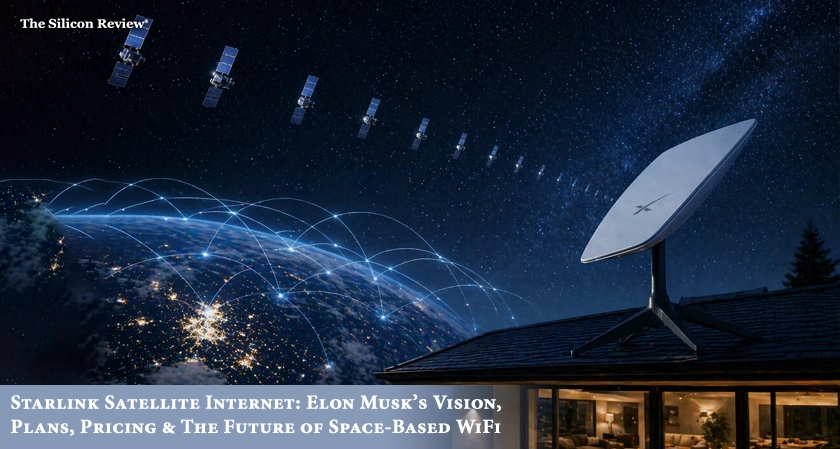
Starlink satellite internet is a constellation of thousands of small satellites orbiting Earth at low altitude approximately 550 kilometers (roughly 342 miles) up. Curious about how Elon Musk actually built this global network from scratch? We have a deep dive on that too. Traditional satellite internet uses one or two giant satellites sitting 22,000 miles away. That distance creates lag. A lot of it.
Starlink flips the model. More satellites. Closer to Earth. Lower latency. Faster speeds.
Here is the simple version: instead of your internet signal bouncing 22,000 miles up and back, it travels 340 miles. That cuts the round trip from over half a second to about twenty milliseconds. For comparison, that is as fast as cable or fiber in many cases.
Elon Musk's Starlink vision is not just about connecting rural homes. It is about blanketing the entire planet with high-speed, low-latency internet. Every ocean. Every desert. Every mountain range. Every village with no road leading to it.
How It Works (No Rocket Science Degree Required)
You do not need to understand orbital mechanics to use Starlink. Here is what actually happens.
Step 1: You order a Starlink kit. It arrives in a box.
Step 2: Inside the box: a dish (they call it "Dishy"), a wifi router, a power supply, and a tripod mount.
Step 3: You place the dish outside with a clear view of the sky. The dish automatically tilts and points itself toward the satellites.
Step 4: The dish talks to passing satellites. Those satellites talk to ground stations connected to the global internet backbone.
Step 5: You connect your devices to the Starlink wifi router. Internet works.
No technician visit. No digging up your yard. No contract locking you in for two years.
The dish has motors that adjust its angle as satellites move overhead. You do not need to track anything manually. The system is designed for people who just want internet to work.
Starlink Internet Plans and Pricing (2026)
Let us talk about money. Starlink internet plans have changed since the early beta days. Here is where things stand in 2026.
Standard Residential Plan
- Price: $120 per month (US)
- Speed: 50–200 Mbps download
- Latency: 20–40 milliseconds
- Hardware cost: $599 one-time (dish, router, cables)
- Best for: Rural homes, remote workers, families streaming video
Starlink Roaming (formerly "RV" and "Mobile")
- Price: $150 per month
- Speed: 40–150 Mbps
- Latency: 30–60 milliseconds
- Hardware cost: $599
- Best for: RV travelers, van lifers, boats, temporary locations
Starlink Business
- Price: $250 per month
- Speed: 150–350 Mbps
- Latency: 20–40 milliseconds
- Hardware cost: $2,500 (larger, high-performance dish)
- Best for: Small businesses, remote offices, construction sites
Starlink Maritime
- Price: $5,000 per month
- Speed: 100–350 Mbps
- Latency: 30–60 milliseconds
- Hardware cost: $10,000 (two high-performance dishes)
- Best for: Cargo ships, yachts, oil rigs
Starlink Aviation (In-Flight)
- Price: Custom enterprise pricing
- Speed: Up to 500 Mbps per plane
- Latency: Under 50 milliseconds
- Hardware cost: $150,000+ per aircraft
- Best for: Airlines, private jets, charter operators
Important note: No data caps on most plans. No throttling after a certain limit. What you pay is what you get.
Elon Musk Starlink: The Vision behind the Satellites
Elon Musk Starlink is not a side project. It is central to SpaceX's long-term survival.
Here is why. SpaceX launches rockets. Rockets are expensive to build. Most of SpaceX's revenue comes from launching other people's satellites. But that market is finite. Starlink changes the math. Instead of waiting for customers to pay SpaceX, Starlink pays SpaceX. Every Starlink launch costs SpaceX about $15 million in internal transfer pricing. That same launch would cost a customer $60 million. The difference is profit that stays within the company. Musk has said publicly that Starlink could generate $30 billion annually by the late 2020s. That money would fund Starship the rocket designed to take humans to Mars. So Elon Musk internet is not just about rural connectivity. It is about funding interplanetary travel. You pay for Starlink. Starlink pays for Starship. Starship goes to Mars. That is the vision.
Real-World Performance: What Users Actually Experience
Numbers on a page are nice. But what does starlink internet feel like? Speed tests: Most residential users report 80–150 Mbps download. That is enough for four people to stream 4K video simultaneously while someone else joins a Zoom call.
Weather effects: Heavy rain or snow can degrade the signal. The dish has a heater to melt snow, but a thick thunderstorm will slow things down. Not disconnect entirely. Just slow.
Obstructions: Trees, buildings, or mountains blocking the sky cause intermittent dropouts. The Starlink app has an augmented reality feature that shows you exactly where to place the dish for the clearest view.
Peak hours: Unlike traditional satellite internet, Starlink speeds do not collapse at 8 PM when everyone starts streaming. The constellation has enough capacity to handle evening demand in most regions.
The competition: HughesNet and Viasat (traditional satellite providers) offer plans with speeds around 25 Mbps and data caps as low as 15 GB per month. Starlink is not competing with them. It is replacing them.
Where Starlink Is Available Right Now
Starlink internet is live on every continent except Antarctica (though they have tested it there). Here is the current coverage map in simple terms:
- North America: Full coverage in US, Canada, Mexico
- Europe: Most of Western and Central Europe
- Australia & New Zealand: Full coverage
- South America: Parts of Brazil, Chile, Colombia
- Africa: Kenya, Nigeria, Rwanda, and expanding
- Asia: Japan, Philippines, parts of India (pending regulatory approval)
The "Waitlist" regions are slowly disappearing as more satellites launch. By late 2026, most populated areas will have immediate availability.
Starlink WiFi: What Is in the Box?
When people search for starlink wifi, they usually want to know what hardware they get.
The standard kit includes:
Dish (Gen 3): Flat, rectangular, about the size of a large pizza box. It has a motorized mount that adjusts angle automatically. The dish draws about 50–75 watts of power similar to a bright lightbulb.
Router: A wifi 5 (802.11ac) routers with dual-band support. Range is decent for a house but not enough for a large property. You can connect your own router if you want better coverage.
Cables: A 75-foot cable connects the dish to the router. Long enough to place the dish away from trees or roof obstructions.
Power supply: Standard AC adapter. No battery backup you will need a separate UPS if you want internet during power outages.
Mount: A simple tripod for temporary placement. Permanent mounts (roof, wall, and pole) are sold separately.
The entire setup takes about fifteen minutes. Most of that time is waiting for the dish to find satellites after you plug it in.
The Competition: Who Else Is Launching Space Internet?
Starlink is the leader. But they are not alone.
OneWeb: Owned by Eutelsat. Focuses on business and government customers, not residential. Lower latency than traditional satellite but not as fast as Starlink.
Amazon Project Kuiper: Still launching. Plans for over 3,000 satellites. Not yet operational for customers. When it launches, it will compete directly with Starlink residential.
T-Mobile / SpaceX Direct to Cell: Not full internet. SMS and basic data for phones in dead zones. Uses Starlink satellites but works with existing phones.
China GuoWang: China's answer to Starlink. Over 13,000 satellites planned. Not available outside China.
For now, starlink internet has a massive head start. Over 5,000 satellites in orbit. Millions of customers. A working product that ships today.
The Downsides (Honest Section)
No technology is perfect. Here is what critics and customers complain about.
Cost. $120 per month plus $599 upfront is expensive compared to city fiber. But for someone with no other option, it is a bargain compared to not having internet.
Satellite congestion. In dense areas, speeds drop. Starlink limits how many customers per cell (roughly 15 miles across) to prevent overload. If you live near a city, you might join a waitlist.
Astronomy interference. Astronomers hate Starlink. The satellites reflect sunlight and leave streaks in telescope images. SpaceX has added sunshades and changed satellite orientation to reduce reflection, but the problem is not solved.
Space debris risk. Thousands of satellites in low orbit increase collision risk. Starlink satellites have automated collision avoidance. But the more satellites up there, the higher the chance of a chain reaction event (Kessler syndrome).
Company risk. Starlink is still losing money on hardware. They sell the dish for less than it costs to manufacture. That works as long as subscriber growth continues. If growth slows, prices may rise.
The Future of Space-Based WiFi
Here is what the next five years look like.
2026–2027: Starlink launches v3 satellites with laser links. These satellites can pass data between each other in orbit, reducing the need for ground stations. Ships, planes, and remote research stations get seamless coverage.
2027–2028: Direct-to-cell service expands. Your phone connects to Starlink satellites without any special hardware. Text messaging first. Voice and data later.
2028–2029: Starlink reaches 10 million subscribers. The service becomes profitable. Prices may drop as hardware costs decrease.
2030 and beyond: Starlink funds Starship missions to Mars. The same satellite technology that connects rural homes on Earth connects habitats on another planet.
That is the long game. Not just starlink wifi for your cabin. Internet for humanity wherever humanity goes.
Frequently Asked Questions (FAQs)
What is Starlink satellite internet?
Starlink is a constellation of thousands of low-Earth orbit satellites providing high-speed, low-latency internet to anywhere on the planet.
How much Starlink internet do plans cost?
Residential plans start at $120 per month with a $599 one-time hardware fee. Roaming, business, and maritime plans are more expensive.
Is Elon Musk Starlink available in my area?
Starlink is available on every continent except Antarctica. Check the official Starlink map for specific availability in your region.
How fast is Starlink internet?
Residential users typically see 50–200 Mbps download speeds with 20–40 milliseconds latency.
Can I use Starlink WiFi in an RV or boat?
Yes. The Starlink Roaming plan works on RVs, vans, and boats. The Maritime plan is for larger vessels.
Does weather affect Starlink internet?
Heavy rain or snow can slow speeds but rarely causes complete disconnects. The dish has a heater to melt snow.
How is Elon Musk internet different from traditional satellite internet?
Traditional satellite uses one or two giant satellites 22,000 miles away, creating high latency. Starlink uses thousands of satellites 340 miles away, creating low latency similar to cable.
Is there a data cap on Starlink internet plans?
No. Most plans have no data caps. Starlink does not throttle speeds after a certain usage threshold.
Who owns Starlink internet?
Starlink is owned and operated by SpaceX. Elon Musk is the founder and CEO of SpaceX.
What is the future of space-based WiFi?
Starlink is expanding to direct-to-cell service, laser-linked satellites, and eventually funding Mars missions through SpaceX's Starship program.
About the Author
Sashindra Suresh is an experienced writer specializing in artificial intelligence, software development, and emerging technologies. With a strong ability to translate complex technical concepts into clear, engaging insights, she has contributed to a wide range of publications and platforms. Her work focuses on making cutting-edge innovations accessible to both industry professionals and curious readers alike.