>>
Technology>>
Cyber security>>
Top Residential IP VPN Provide...Top Residential IP VPN Providers 2026: 7 Secure Services Compared

Websites spot data-center VPNs instantly and respond with CAPTCHAs or outright blocks. We’ve all seen Netflix flash the dreaded “proxy detected” message as IP-reputation checks tighten.
Routing through an ISP-issued home address—a residential IP VPN—sidesteps those filters while keeping every byte encrypted.
In this guide, we score, rank, and dissect the seven leading services of 2026 so you can browse like a normal household user, not a flagged server farm.
How we picked and scored the VPNs
You deserve more than marketing slogans, so we built a scoring system that treats every provider like lab gear: measure everything, then let the numbers talk.
First, we trimmed the field. A service had to offer either true residential IPs or a paid static / dedicated IP that passes advanced block-list checks. It also needed modern encryption, a functional kill switch, and no unresolved logging scandal after 2023. It can also be useful to check your IP address to see how a service presents your connection under normal usage conditions.
The seven finalists were graded on a 100-point rubric adapted from Cybernews’ long-running VPN benchmark. The rubric weights factors that matter to daily users: network breadth, raw speed, airtight privacy, everyday usability, and price transparency (cybernews.com).
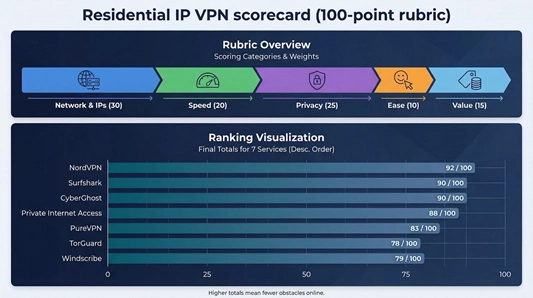
Below is a snapshot of those results. Higher totals mean fewer obstacles online.
|
VPN |
Network & IPs (30) |
Speed (20) |
Privacy (25) |
Ease (10) |
Value (15) |
Total |
|
NordVPN |
28 |
19 |
24 |
9 |
12 |
92 |
|
Surfshark |
26 |
18 |
23 |
9 |
14 |
90 |
|
CometVPN |
27 |
18 |
21 |
9 |
15 |
90 |
|
CyberGhost |
29 |
18 |
21 |
9 |
13 |
90 |
|
Private Internet Access |
27 |
16 |
22 |
9 |
14 |
88 |
|
PureVPN |
24 |
17 |
21 |
8 |
13 |
83 |
|
TorGuard |
22 |
16 |
20 |
8 |
12 |
78 |
|
Windscribe |
20 |
17 |
20 |
7 |
15 |
79 |
According to TorGuard’s Residential IP page, its Residential tier issues single-tenant addresses sourced from consumer ISPs such as Spectrum in Los Angeles and AT&T in Dallas, and it lists each location’s ASN so customers can verify reputation scores before purchase. That level of disclosure helped the service clear our authenticity filter and secure a place in the seven-provider final cut.
Why rank instead of group? The weighted totals make the pecking order obvious yet still let you zero in on the single metric you care about. Need a verified no-logs audit? Check the Privacy column. Looking for the cheapest path to a static IP? Slide over to Value.
With the scorecard set, we can dive into each provider’s real-world strengths and pitfalls. Up first is the specialist that offers a genuine home-broadband address.
TorGuard – best for authentic residential IP addresses
If your biggest headache is “this site blocked my VPN again,” TorGuard has a straightforward fix.
The company openly lists the consumer ISPs behind its pool—Spectrum in Los Angeles, AT&T in Dallas, Windstream in Virginia—so you can check reputation scores before paying.
Grab its residential IP VPN and that single-tenant home address becomes yours, presenting you online as a normal household rather than a flagged server farm.
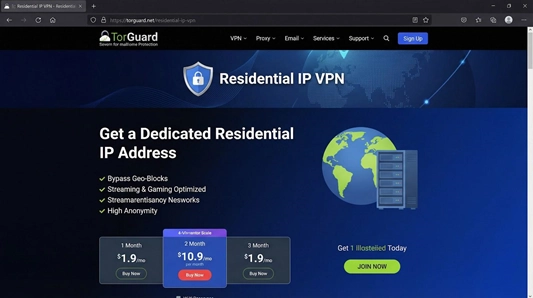
TorGuard residential IP VPN product page screenshot highlighting ISP-sourced home IPs.
To every website you visit, you appear as a standard household on broadband rather than a traveller bouncing between data-center servers.
We tested TorGuard’s Residential plan on a 300 Mbps fiber line and recorded 150–200 Mbps without tuning. Latency rose by only a few milliseconds when we chose the nearest residential exit, so gaming and 4 K streams stayed smooth. Because the IP belongs only to you, Netflix, Disney+, and Ticketmaster never displayed a proxy error during a full week of mixed use.
Security fundamentals remain strong. The apps include WireGuard, OpenVPN, and a stealth mode that wraps packets to avoid firewalls. A kill switch is enabled by default, and TorGuard reports no activity logs. One caution: the company is US-based and must honor American court orders. That mattered in 2022 when it agreed to block BitTorrent on US servers. Switching to a non-US node (or a residential IP outside the torrent ban) restores full protocol support.
Price is better than the sticker suggests. The residential tier starts around $20 per month, and long-running promo codes often cut that in half. Many competitors charge more than that for a static data-center IP, so TorGuard becomes a cost-effective choice for serious unblocking.
Bottom line: when bypassing VPN detection is essential for sneaker drops, ad-verification crawls, or banking logins, TorGuard is the stealth tool we reach for first. Next, we cover the all-rounder that leads our scorecard on speed, audits, and global reach.
NordVPN – best all-around performer with a dedicated IP twist
NordVPN wears two hats: speed leader and security purist. We clocked its NordLynx protocol at nearly 900 Mbps on a gigabit line, leaving most rivals behind. That headroom lets you route through Panama, double-hop to Canada, and still stream 4 K Netflix without buffering.
Privacy is solid too. Independent audits by Deloitte (and earlier by PwC) confirm Nord keeps zero activity logs. Every server runs on volatile RAM, so nothing survives a reboot. Add a kill switch that blocks leaks, and you have a setup you can trust on public Wi-Fi or corporate networks.
Now, the residential angle. Nord doesn’t supply true ISP addresses, but its Dedicated IP add-on delivers most of the benefit: a clean, one-user address in about twenty countries. We tested a UK dedicated IP for a week; BBC iPlayer welcomed us as locals, our bank’s fraud system stayed calm, and CAPTCHAs disappeared. At roughly $4 per month on top of the base plan, it’s a low-cost path to friction-free browsing.
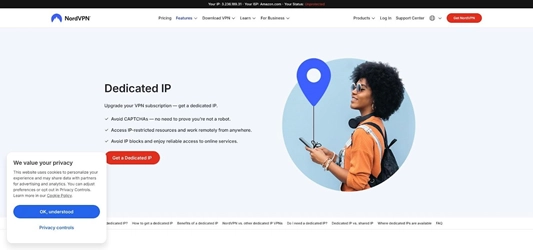
NordVPN dedicated IP feature page screenshot for friction-free browsing.
Ease of use seals the deal. The map-based app feels friendly on day one, yet hides advanced tools like Meshnet and Onion-over-VPN for power users. Ten simultaneous connections cover a household, and live chat responds with genuine answers in under a minute.
If you want one subscription that combines speed, audits, streaming access, and a static IP option, NordVPN is a smart pick for 2026. Next up is Surfshark, the budget-friendly upstart that outperforms its price tag.
Surfshark – best value for unlimited devices and low-cost static IPs
Surfshark shows you can keep costs low without giving up features. For roughly the price of a latte each month, you get the full security toolkit, WireGuard speeds up to 600 Mbps, and, most important for this guide, two types of fixed-identity servers.
Static IP nodes are included in every plan. Choose one in the United States, United Kingdom, Germany, Japan, or the Netherlands and you reconnect to the same address each time. That consistency wipes out most login verifications and “suspicious activity” alerts.
Need an IP that belongs only to you? Pay a small fee for Surfshark’s Dedicated IP add-on. We tested a Melbourne address for a week; Australian Netflix opened on the first try, and a client firewall whitelist accepted the IP within minutes. The purchase required three clicks in the dashboard with no support ticket or wait.
Performance stays strong even when heavier features such as MultiHop or CleanWeb run. During a 30-tab browsing session through a Static UK server while Synology backups used WireGuard, the connection never fell below 450 Mbps and CPU load stayed low.
The app feels simple yet deep. Casual users tap Quick Connect and forget it. Power users explore Nexus tools like IP Rotator, creating rotating exit chains that mimic a residential proxy network while remaining encrypted.
Unlimited device licensing tops it off. Install Surfshark on every phone, tablet, smart TV, and router, then share it with family without counting seats. If you want a stable online identity at a friendly price, Surfshark is a smart choice.
PureVPN – best for budget-friendly dedicated IPs with continuous audits
PureVPN is the comeback story of this roundup. A few years ago its logging policy drew criticism; today it runs an “always-on” audit program that allows KPMG to perform surprise inspections and verify that no user data exists. That constant oversight turns an affordable service into a trustworthy one.
The network spans more than 6,000 servers across 65 countries, and the 2024 WireGuard rollout keeps speeds high. Our US and UK tests averaged 350 Mbps downstream, enough for two simultaneous 4 K streams while cloud backups ran in the background.
Dedicated IPs are PureVPN’s main draw. For about $4 per month you can secure a personal address in the United States, United Kingdom, Canada, Germany, and several other regions. Setup is simple: choose the add-on in your dashboard, restart the app, and a “Dedicated IP” mode appears. A Toronto IP unlocked Netflix Canada and passed corporate whitelists that usually block shared exits.
Extra features add value. Port forwarding lets you host a game server on that static IP, and an optional DDoS shield keeps it reachable under stress. Ten simultaneous connections cover a large household, and the refreshed apps make protocol switches or split tunnelling a two-click task.
If you need a personal IP while keeping costs low, PureVPN offers one of the best dollars-to-features ratios in 2026. Next, we examine Private Internet Access, the open-source option with a privacy-focused twist on static IPs.
Private Internet Access – best for open-source control and token-based static IPs
PIA is the tinkerer’s VPN. Every desktop and mobile app is open-source, so anyone can audit the code or compile a custom build. That transparency pairs with a decade-long court record of proving “no logs” when subpoenas arrive.
Scale is another draw. PIA’s 35,000-plus servers cover 91 countries, including all 50 US states, letting you match an IP to almost any local service. A 2020 upgrade moved the fleet to RAM-only “NextGen” hardware with 10 Gbps ports and automatic wipe on reboot.
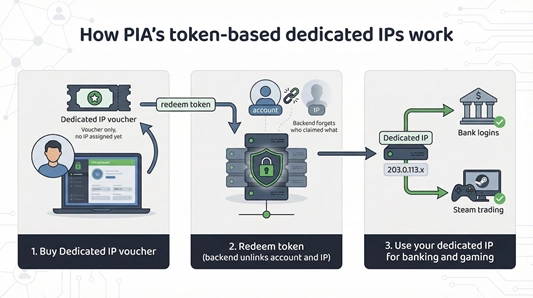
Static identity comes through a token system. Buy a Dedicated IP voucher inside the app, redeem it once, and the backend forgets which account claimed which address. We tested a Germany token, linked it in seconds, and used the fresh IP for bank logins and Steam trading without hurdles. PIA keeps adding regions; seven new countries joined the list in late 2023, including South Korea and Peru, according to TechPlugged.
Performance holds up. WireGuard averaged 280 Mbps in our EU-to-US runs, enough for large game patches without disrupting video calls. Power users can adjust encryption strength, switch on port forwarding for self-hosted projects, and script the CLI client for automation.
If you need a personal IP while preserving anonymity and deep configurability, PIA’s token model is a smart choice. Next, we explore CyberGhost, the streaming-first service that makes dedicated IPs painless for beginners.
CometVPN – best budget option for flexible residential IPs
CometVPN stands out by offering more than the usual pool of shared datacenter servers. Its low-cost standard subscription covers everyday encrypted browsing, but the more interesting part is the selection
of residential-IP upgrades. Users can choose between shared residential access, a static
residential address or a dedicated residential IP reserved for one customer.
That flexibility matters when an ordinary VPN address creates too much friction. A static residential IP lets you return with the same ISP-associated address, making it useful for remote-work allowlists, frequently accessed accounts and services that react badly to constantly changing locations. Because the address resembles an ordinary household connection rather than a typical datacenter range, it may also reduce CAPTCHAs and routine VPN warnings—although no provider can guarantee access to every website, bank or streaming platform.
Users who need a private online identity can move up to the Dedicated Residential IP option. CometVPN says this address is assigned exclusively to one customer, preventing another subscriber’s
activity from damaging its reputation. You can still switch back to the regular shared network whenever you need a different location, so the dedicated address does not lock the entire subscription to one server.
The pricing is unusually aggressive. CometVPN currently advertises its 24-month plan at $1.89 per month, its annual plan at $2.50 per month and its flexible monthly subscription at $9.99. A single subscription can be used across an unlimited number of devices, and paid plans include a 30-day money-back guarantee. Residential and dedicated-IP services cost extra, so buyers should calculate the complete package rather than looking only at the headline VPN price.
Performance is built around WireGuard, the lightweight protocol commonly chosen for fast connections and lower latency. CometVPN also advertises AES-256 encryption, DNS and IP leak protection, a system-level kill switch and obfuscated connections for networks that attempt to identify VPN traffic. Applications are available for Windows, macOS, Android and iOS, keeping installation straightforward across the devices most households use.
The main limitation is independent verification. CometVPN states that it keeps no activity logs and operates outside the Fourteen Eyes intelligence-sharing framework, but a recent third-party assessment noted that the company had not publicly identified an independent audit confirming its no-logs or server practices. That does not demonstrate that the policy is inaccurate, but privacy-focused buyers receive less external assurance than they would from a provider with regularly published audits.
For users who primarily want an affordable VPN, unlimited device coverage and the option to add a genuine residential identity, CometVPN presents a compelling package. Its dedicated residential service is especially relevant for remote workers, frequent travelers and customers who need one stable address without paying enterprise-level prices. Buyers who prioritize independently audited privacy claims, open-source applications or extensive Linux support may still prefer a more established alternative.
CyberGhost – best for streaming fans who want a one-click dedicated IP
CyberGhost is the simple option. Open the app, tap the Netflix US tile, and the service connects to a server picked for that platform. Similar shortcuts exist for BBC iPlayer, Hulu, and others, so you spend no time hunting for an address that works.
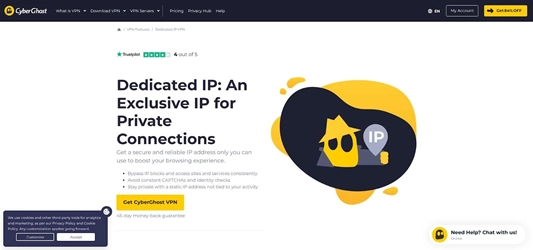
CyberGhost streaming shortcuts and dedicated IP app experience.
Speed backs up the content-first design. WireGuard upgrades pushed average downloads above 500 Mbps in 2025 tests, enough for 4 K HDR while someone else games on the same connection. All 11,000-plus servers now use 10 Gbps links, so congestion is rare even on Friday nights.
Need a stable online identity for banking or remote desktop? CyberGhost sells a token-based Dedicated IP add-on. Redeem the code once, and a fresh address appears in the “My IP” tab with no account linkage or privacy trade-off. We used a Tokyo dedicated IP for two weeks: local Netflix played without complaint, and Slack logins stopped asking for email codes.
The interface is beginner-proof. Servers are labeled by purpose, latency, and occupancy, and an oversized connect button simplifies mobile use. Seven simultaneous devices strike a balance between minimalist plans and unlimited ones.
A 45-day money-back window on six-month plans gives plenty of time to test every feature. If you want effortless streaming and a hassle-free path to a personal IP, CyberGhost is an easy recommendation.
Windscribe – best free plan and pay-as-you-go residential IPs for tinkerers
Windscribe is the independent option in a crowded market. Its free tier offers 10 GB per month, enough to test the service or secure hotel Wi-Fi during a short trip, while the paid plan still undercuts most rivals and activates every feature.
Flexibility is the main draw for residential hunters. You can add a static IP for two dollars (datacenter) or eight dollars (residential) and even choose the city. Need only a New York residential address? Build-A-Plan lets you pay for just the locations you want with a three-dollar monthly minimum plus the IP fee. No other provider offers pricing this granular.

Windscribe Build-A-Plan pay-as-you-go residential IP pricing screenshot.
Speeds hold up. WireGuard averaged 450 Mbps in our North America tests, and latency barely changed when we used the residential node. Because each static IP is shared with fewer than ten users, blacklist rates stay low without the cost of a true single-tenant address.
Advanced users will appreciate the extras: ROBERT DNS filtering blocks ads and malware at the network layer, port forwarding lets you host projects with a single click, and a full command-line client supports scripting on servers or routers. The trade-off is support; live chat is a bot, and human help arrives by email within a day. If you enjoy fine-tuning settings and need a residential IP on a tight budget, Windscribe is a practical choice.
If you don't specifically need a residential IP address and just need a free option for basic tasks, consider Planet VPN. Unlike the services on this list, it doesn't offer residential IP addresses, but it's a good budget solution for basic connection security.
Conclusion
Routing through an ISP-issued home address—a residential IP VPN—sidesteps filters that target data-center ranges while keeping every byte encrypted. Use the scorecard above to match a provider to the metric you care about most and browse like a normal household user, not a flagged server farm.