>>
Other>>
Women Leader of the Month>>
Cheng Li-wun: The Kuomintang (...Cheng Li-wun: The Kuomintang (KMT) Chairwoman Navigating Taiwan's Opposition in a Trump Era
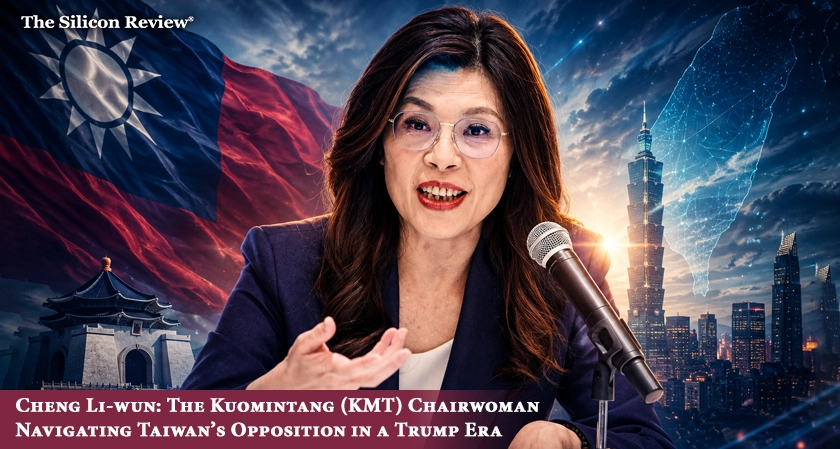
When Cheng Li-wun was elected chairwoman of Taiwan's Kuomintang in October 2025, few expected her to make headlines beyond Taipei's political bubble. A former Democratic Progressive Party member who had once supported Taiwanese independence, she seemed an unlikely standard-bearer for the century-old party that fled to Taiwan with Chiang Kai-shek in 1949. The Kuomintang (KMT) was hemorrhaging relevance. Its approval ratings were stagnant. Younger voters saw it as a relic of an era they neither remembered nor mourned. And its cross-strait policy rooted in the ambiguous "1992 Consensus" seemed increasingly out of step with a Taiwan that had grown more confident in its separate identity. Then Donald Trump returned to the White House. And suddenly, the woman who had once stood on the opposite side of Taiwan's political divide became the most important opposition leader in Asia tasked with navigating a path between Beijing's demands for unification & Washington's pressure for confrontation, while keeping her fractured party from tearing itself apart.
From DPP Activist to KMT Chairwoman
Cheng's political education is as elite as it gets. A law graduate of National Taiwan University, she earned a Master of Laws from Temple University & a Master's degree in International Relations from the University of Cambridge.
In the 1990s, she was a firebrand in the Democratic Progressive Party (DPP), the party that has built its identity on Taiwanese sovereignty. She believed Taiwan independence was the only path forward. Then something shifted.
"I know she is on the right side because she has experienced being on the wrong one," one political observer noted. Cheng herself has described her earlier beliefs as a "youthful mistake." At Cambridge, she says, she broadened a worldview that had once been narrowly focused on Taiwan's separation from China. She returned convinced that cross-strait confrontation was a dead end.
This is not a conversion story that pleases everyone. Democratic Progressive Party (DPP) loyalists view her as a traitor. The Kuomintang (KMT) hardliners suspect her of lingering sympathies. And yet, she leads. Because in a party that has lost three consecutive presidential elections, the members have decided that someone who understands the enemy might also understand how to defeat them not with force, but with persuasion.
What She Stands For: The 1992 Consensus and the Path of Peace
For Cheng Li-wun, the Kuomintang party’s (KMT’s) survival is inseparable from Taiwan’s survival. Her argument is not rooted in ideology alone, but in pragmatism. She believes Taiwan cannot afford permanent confrontation with China, especially at a time when the global balance of power is becoming more volatile under a renewed Trump presidency.
The “1992 Consensus” the long-disputed framework suggesting that both Beijing and Taipei acknowledge “One China” while interpreting it differently remains central to Cheng Li-wun’s political philosophy. To critics, the formula is outdated and dangerously ambiguous. To Cheng, it is a diplomatic pressure valve: imperfect, controversial, but necessary to keep communication alive across the Taiwan Strait.
That position places the Kuomintang party’s (KMT’s) chairwoman in one of the most politically unforgiving spaces in Asia.
On one side stands Beijing, increasingly impatient with Taiwan’s resistance to unification. On the other stands a younger Taiwanese generation that identifies less with China than ever before. Between them is Cheng Li-wun, attempting to persuade voters that dialogue is not surrender and that stability is not weakness.
Her message is especially significant for women in power across Asia. Unlike populist leaders who rise through spectacle, Cheng’s authority is built through negotiation, restraint, and intellectual endurance. She represents a different model of female leadership one that does not rely on political theatrics, but on the difficult art of managing contradictions.
Leading the Kuomintang Party through Crisis
The Kuomintang party (KMT) Cheng Li-wun inherited was divided, aging, & struggling to remain culturally relevant. Once dominant in Taiwanese politics, the KMT has spent years trying to reconnect with younger voters who increasingly see the party as too close to Beijing & too disconnected from modern Taiwanese identity.
Cheng understood that simply defending the past would not secure the future.
Since becoming The Kuomintang party (KMT) chairwoman, she has attempted to modernize the party’s image while preserving its core belief that peace with China is preferable to escalation. She has pushed for stronger engagement with youth voters, advocated economic stability over ideological warfare, & reframed cross-strait relations as a question of protecting ordinary lives rather than winning nationalist arguments.
It is a risky strategy. Every statement is scrutinized. Every diplomatic nuance becomes political ammunition.
Yet Cheng Li-wun has continued to position herself as a stabilizing figure in a region increasingly shaped by uncertainty. As tensions rise between Washington and Beijing, Taiwan’s opposition leader is trying to convince voters that survival may depend less on choosing sides and more on preventing catastrophe.
Women in Power and the Burden of Balance
What makes Cheng Li-wun particularly compelling in the broader conversation about women in power is the complexity of her leadership journey. She is not leading from the comfort of consensus. She is leading from the center of conflict ideological, generational, & geopolitical. In many ways, her story reflects the modern reality facing women leaders globally: they are often expected to solve crises they did not create while navigating standards their male counterparts rarely face.
As The Kuomintang party (KMT) chairwoman, Cheng is frequently judged not only on policy but on tone, demeanor, & symbolism. Too soft, critics say, & she appears weak. Too assertive, & she risks alienating moderates. It is a balancing act familiar to women leaders everywhere, but magnified in Taiwan’s uniquely fragile political landscape.
Still, Cheng Li-wun’s rise carries a deeper significance beyond electoral politics.
It signals that female leadership in Asia is no longer confined to dynastic succession or symbolic representation. Women are increasingly stepping into roles that demand strategic thinking, crisis management, and geopolitical influence at the highest level.
The Trump Era & Taiwan’s Uncertain Future, A Reluctant Warrior in the World's Most Dangerous Strait
Donald Trump’s return to the White House has transformed the stakes for Taiwan’s opposition politics. American pressure on China is expected to intensify, military rhetoric across the Indo-Pacific is growing sharper, and Taiwan once again sits at the center of global strategic anxiety.
For Cheng Li-wun, this environment presents both danger and opportunity.
Her critics accuse her of being too accommodating toward Beijing. Her supporters argue she may be one of the few Taiwanese politicians capable of reducing tensions before they spiral into something irreversible. Either way, her leadership will help shape how the Kuomintang party positions itself in a rapidly changing world.
And perhaps that is why Cheng Li-wun matters far beyond Taiwan.
At a moment when politics everywhere rewards outrage, ideological purity, and permanent confrontation, The Kuomintang party (KMT) chairwoman is attempting something far more difficult: defending the idea that compromise itself still has value.
The way forward
Cheng Li-wun’s political story is not one of easy popularity or uncomplicated heroism. It is the story of a woman navigating one of the world’s most dangerous political fault lines while carrying the weight of a party searching for relevance and a society struggling to define its future. Whether she succeeds or fails, The Kuomintang party (KMT)chairwoman has already become one of the most consequential women in power in Asia not because she commands armies or dominates headlines, but because she is trying to hold together the fragile space between conflict & coexistence.