>>
Industry>>
Healthcare>>
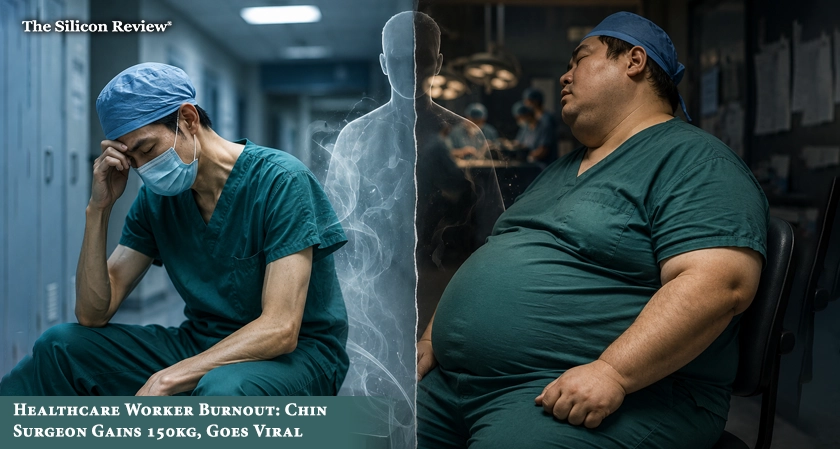
Healthcare Worker Burnout: Chi...Healthcare Worker Burnout: China Surgeon Gains 150kg, Goes Viral
The Silicon Review
19 May, 2026
Author:
Vinay Kumar
A Chinese surgeon weighing 150kg has gone viral, sparking a national conversation about healthcare worker burnout. The Silicon Review reports on the 16-hour shifts, stress eating, and the silent epidemic affecting doctors across China.
A 35-year-old surgeon in China has gone viral after revealing he weighs 150 kilograms, a weight he attributes to years of 16-hour shifts, stress eating, and an inability to exercise due to the relentless demands of his profession.
The surgeon, identified only by his surname Dr. Zhang, works at a major public hospital in central China. He told local media that he routinely skips meals during operations lasting six to eight hours, only to binge on high-calorie convenience foods late at night when his shifts finally end.
The healthcare worker burnout crisis in China has reached alarming levels. A 2025 survey by the Chinese Medical Doctor Association found that 67 percent of physicians report symptoms of severe burnout, including emotional exhaustion, depersonalization, and reduced personal accomplishment. The same survey found that 41 percent of doctors have gained significant weight since beginning their careers.
Dr. Zhang‘s story resonated with millionshttps://pmc.ncbi.nlm.nih.gov/articles/PMC8410695/ because it reflects a systemic problem, not an individual failing. Chinese hospitals, particularly in urban centers, face severe doctor shortages. The ratio of physicians to patients in tertiary hospitals is among the lowest in the developed world, with a single surgeon sometimes responsible for 30 to 40 inpatients simultaneously.
The viral post has prompted rare public discussion of doctor welfare in China, where healthcare workers have traditionally been expected to endure hardship without complaint. Commenters shared their own stories of colleagues collapsing from exhaustion, suffering heart attacks in their 30s, and leaving the profession entirely due to unsustainable workloads.
By the fourth quarter of 2026, the National Health Commission is expected to release new guidelines limiting consecutive working hours for surgeons and mandating mental health support services. However, critics note that without significantly increasing medical school enrollment and hospital staffing, such guidelines will be impossible to enforce.
The Silicon Review‘s analysis indicates that Dr. Zhang’s 150-kilogram frame is not a personal tragedy but a physical manifestation of a healthcare system in crisis. Until China addresses its fundamental doctor-to-patient ratio, healthcare worker burnout will continue to manifest in broken bodies viral posts or not.
Q: Who is the Chinese surgeon who went viral for weighing 150 kilograms?
A: Dr. Zhang, a 35-year-old surgeon at a major public hospital in central China, went viral after revealing he weighs 150 kilograms due to years of 16-hour shifts, stress eating, and inability to exercise.
Q: What did the 2025 Chinese Medical Doctor Association survey find about healthcare worker burnout?
A: The survey found that 67 percent of physicians report symptoms of severe burnout, including emotional exhaustion, depersonalization, and reduced personal accomplishment. Additionally, 41 percent of doctors have gained significant weight since beginning their careers.
Q: Why are Chinese doctors working such long hours?
A: Chinese hospitals face severe doctor shortages, particularly in urban tertiary hospitals. A single surgeon may be responsible for 30 to 40 inpatients simultaneously, leading to routine 16-hour shifts and skipped meals during long operations.
Q: What is the Chinese government planning to address healthcare worker burnout?
A: The National Health Commission is expected to release new guidelines by the fourth quarter of 2026 limiting consecutive working hours for surgeons and mandating mental health support services.
Q: Why might the new guidelines be difficult to enforce?
A: Critics note that without significantly increasing medical school enrollment and hospital staffing, guidelines limiting working hours will be impossible to enforce. The fundamental doctor-to-patient ratio remains severely imbalanced.
Q: Is healthcare worker burnout a problem unique to China?
A: No. Burnout among physicians is a global issue. However, China's combination of high patient volumes, low doctor-to-population ratios, and cultural expectations of endurance makes the problem particularly acute.
MOST VIEWED ARTICLES
RECOMMENDED NEWS








LATEST NEWS


Artificial Intelligence News
Startups News