>>
Industry>>
Transportation>>
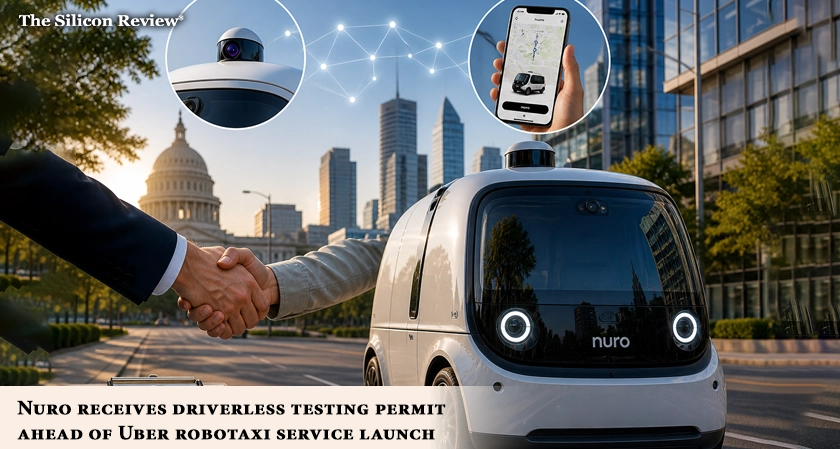
Nuro receives driverless testi...Nuro receives driverless testing permit ahead of Uber robotaxi service launch
The Silicon Review
06 May, 2026
Author:
Sashindra Suresh
Nuro has secured a driverless testing permit from California regulators ahead of its Uber robotaxi service launch. The Silicon Review reports on the autonomous vehicle milestone that brings commercial driverless rides closer to American roads.
Nuro, the Mountain View-based autonomous vehicle company, has received a driverless testing permit from the California Department of Motor Vehicles, clearing a critical regulatory hurdle just weeks before its planned Uber robotaxi service launch. The permit allows Nuro to operate its third-generation R3 electric autonomous vehicles on public roads in Santa Clara and San Mateo counties without a human safety driver behind the wheel.
Nuro driverless testing permit Uber robotaxi. Nuro's partnership with Uber, first announced in 2024, aims to integrate Nuro's vehicles into Uber's ride-hailing and Uber Eats platforms. With the permit secured, the companies are targeting a phased commercial launch beginning in Palo Alto and Mountain View before expanding to San Jose and San Francisco by early 2027.
What does Nuro's driverless permit mean for Uber robotaxi? can expect Nuro to test empty vehicles without safety drivers. Unlike competitors Waymo and Cruise, Nuro's R3 vehicle has no steering wheel or pedals and is built exclusively for delivery and short-hop passenger trips. The R3's maximum speed is 35 miles per hour, making it suited for suburban routes.
The permit applies to Santa Clara and San Mateo counties, home to Apple, Google, and Stanford University. Nuro has completed over one million autonomous miles with safety drivers, giving regulators confidence. The first commercial application will likely be Uber Eats deliveries, followed by low-speed robotaxi rides priced under $10 for trips under three miles.
The autonomous vehicle landscape has seen turbulence. Cruise suspended U.S. operations after a 2023 San Francisco incident, while Waymo continues operating in Phoenix, San Francisco, and Los Angeles with over 100,000 weekly rides. Nuro's strategy is more conservative: focus on suburbs, lower speeds, and dedicated delivery use cases.
The California DMV's permit comes with strict conditions. Nuro must maintain a remote operations center with human monitors, report all collisions within 10 days, and carry a $5 million insurance policy per vehicle. The permit does not allow fare-charging passenger rides initially that requires a separate deployment permit expected within 90 days.
As Nuro receives its driverless testing permit ahead of the Uber robotaxi service launch in California, The Silicon Review reports that the Mountain View AV startup is now poised to beat Tesla and Zoox to commercial deployment in suburban America, with Uber riders potentially hailing driverless R3 vehicles for under-$10 trips before the end of 2026.