>>
Women-in-Power>>
Women in Power>>
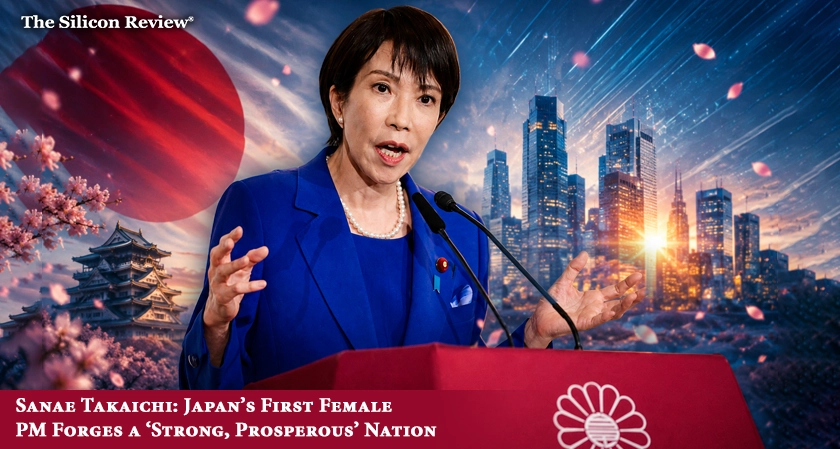
Sanae Takaichi: Japan's First ...Sanae Takaichi: Japan's First Female PM Forges a 'Strong, Prosperous' Nation
The Silicon Review
12 May, 2026
Author:
Sashindra Suresh
On October 1, 2025, Sanae Takaichi walked into the Prime Minister's Office in Tokyo and made history. Not as a symbol. Not as a placeholder. As the first woman to lead Japan in its 2,000-year history of emperors, samurai, and salarymen. When she took the oath, the 64-year-old lawmaker did something unexpected. She did not deliver a soaring speech about breaking glass ceilings. She did not mention her gender at all. Instead, she talked about "Japan's resolute leadership" and her vision of a "strong, prosperous, & culturally proud nation" that would no longer apologize for its power or it’s potential. Six months later, she has proven that her rise was not an accident of political math. It was a warning shot to every boardroom, every bureaucracy, & every old-boy network across Asia that the rules of power are being rewritten and women are holding the pen. Let’s get to know in detail about Japan’s first female prime minister.
From Nara to the National Stage
Born in Nara Prefecture in 1961, Takaichi grew up in Japan's ancient capital surrounded by temples older than most countries. Her father was a local politician, & politics ran through her blood. But the path for a woman in Japan's Liberal Democratic Party a party as male-dominated as any in the developed world was never meant to lead to the top floor.
She studied law at Kyoto University. She worked briefly as a tax accountant. And then, at 29, she ran for a seat in the House of Councillors and won, becoming one of the youngest female lawmakers in Japan's post-war history.
For the next three decades, she climbed. Slowly. Methodically. Against a system built to keep women in supporting roles, she became Internal Affairs and Communications Minister. Then Minister in charge of Administrative Reform. Then Minister for Gender Equality. Each title was a stepping stone. Each promotion was a quiet victory in a party where women still account for fewer than 10 percent of lawmakers.
When she finally declared her candidacy for LDP president in September 2025 the de facto pathway to prime minister few gave her a chance. The party elders had their preferred male candidates. The media speculated about which man would prevail.
She won anyway.
What She Inherited: A Japan at a Crossroads
Takaichi did not inherit a Japan at peace. The war in Iran had already sent oil prices soaring, threatening Japan's import-dependent economy. The US-China trade war had disrupted the semiconductor supply chains that Japan's manufacturers rely on. And at home, a shrinking population & stagnant wages had left millions of Japanese wondering if their children would have a better life than they did.
The critics said she was not qualified. They said she lacked experience in foreign policy. They said she would be a caretaker prime minister, a token woman kept in place until the party's favored son was ready.
Then she started governing.
The 'Sanae Shock': How She Changed Japan in Six Months
In her first hundred days, Takaichi did what no male predecessor had dared. She ordered a comprehensive review of Japan's energy policy, refusing to simply accept the premise that soaring oil prices were beyond her control. She pushed through a supplemental budget that put cash directly into the hands of low-income families, bypassing the usual bureaucratic layers that would have diluted its impact.
She upgraded the Cabinet Intelligence Office to a fully-fledged national intelligence agency, giving Japan a centralized capability to counter "unjustifiable foreign interference" for the first time. The move was a direct response to China's increasing cyber & military pressure in the region & a declaration that Japan under Takaichi would not be passive.
In February 2026, she delivered her first major policy address following a snap election landslide. Her theme: "overcoming deflation and building a growth economy." She declared an end to Japan's "excessive fiscal austerity," a philosophy that had governed Japanese economic policy for decades. "We must press, press, press, press, and press the switch for growth," she said, her voice rising with conviction.
The markets took notice. The yen stabilized. Foreign investors began returning to Tokyo.
A Woman in a Man's World: The Leadership Lessons
Ask women what they admire about Takaichi, & they do not talk about her policies. They talk about how she carries herself.
In a political culture where female lawmakers are often photographed pouring tea or standing in the back of group shots, Takaichi commands the center of every frame. She wears bold colors when the dress code expects muted tones. She speaks in full sentences when the expectation is deference. She interrupts male colleagues when they interrupt her and they have learned not to.
"She doesn't pretend to be one of the boys," says Yumiko Murakami, a political commentator in Tokyo. "She doesn't need to. She has redefined what strong leadership looks like in Japan, and that version looks like her."
Her leadership style is direct, decisive, & unapologetically feminine in ways that challenge stereotypes. She does not mimic male aggression. She does not soften her differences. She simply leads & expects others to follow.
The Global Stage: TIME's Recognition and Beyond
In April 2026, TIME magazine named Takaichi one of the "100 Most Influential People of 2026." The citation noted that she "represents a fundamental shift in Japanese politics a shift that was decades overdue and is now irreversible."
The honor came as she was navigating Japan through the spring escalation of the Iran war, which sent energy prices spiking again. Her response was measured but firm: a price-hike review, targeted subsidies for vulnerable households, & a renewed push for long-term energy independence including restarting more nuclear reactors and accelerating investments in renewable energy.
She also refused to bow to pressure from Washington to commit Japanese troops to the Middle East conflict. Japan's constitution, she noted, limits the Self-Defense Forces to defensive operations. The decision disappointed American officials but thrilled a Japanese public weary of foreign entanglements.
What Her Leadership Means for Japan's Women
The most profound impact of Takaichi's premiership may not be measured in GDP growth or diplomatic victories. It will be measured in the ambitions of Japanese girls who now know, for the first time, that the highest office in their country is not reserved for men.
When she became prime minister, a survey of Japanese schoolchildren asked what they wanted to be when they grew up. For the first time, "prime minister" appeared in the top ten responses among girls.
"The ceiling she broke is not just in politics," says Mari Kato, a university student in Tokyo. "It is in every boardroom, every law firm, every newsroom. She has shown us that a woman can lead and not just lead, but lead well."
Takaichi herself rarely discusses her gender. When asked about being Japan's first female prime minister, she typically pivots to policy. But in a rare moment of reflection, she told a Japanese magazine: "I did not run to be a symbol. I ran to govern. If my presence encourages more women to participate in public life, that is a welcome consequence. But it is not the goal. The goal is a Japan that is strong, prosperous, and secure."
It is a characteristically understated answer from a woman who has spent her life defying expectations. She did not set out to be a trailblazer. She set out to lead. That she is also a trailblazer is a gift she has given to every woman who comes after her whether they vote for her or not.
The Road Ahead
As 2026 unfolds, Takaichi faces challenges that would test any leader: managing the economic fallout of a distant war, balancing relations with China and the United States, and preparing Japan for a demographic crisis that threatens its social fabric. But she has already achieved something that cannot be reversed. She has normalized a woman in Japan's highest office. The next female prime minister will not be a "first." She will simply be a prime minister. That is Takaichi's true legacy not the policies she enacts, but the possibility she has made real for every woman who follows.