>>
Industry>>
Telecom>>
SES Revenue Soars 80% to €84...SES Revenue Soars 80% to €847M on Airplane WiFi, Japan Airlines Deals
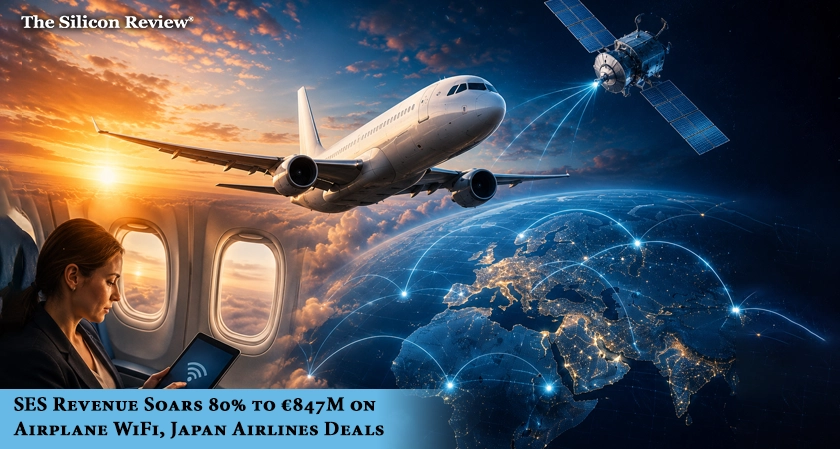
Satellite firm SES's revenue jumped 80% to €847M as airplane connectivity deals with Japan Airlines and Boeing took off. The Silicon Review reports on the 600-aircraft milestone and €6.2B backlog.
Satellite operator SES’s revenue soared 80.5% year-on-year in the first quarter of 2026, reaching €847 million ($996 million), fueled by explosive growth in its airplane connectivity business and strategic wins with major aviation partners .
The Luxembourg-based company’s Networks division, which includes inflight WiFi services, surged 106% to €556 million, driven by a 207.8% leap in its Mobility segment. CEO Adel Al-Saleh credited the performance to strong demand for high-speed internet in the skies, revealing that nearly 600 aircraft are now flying with SES’s multi-orbit inflight connectivity system, delivering fast, dependable internet to millions of passengers worldwide.
SES secured commitments to equip more than 40 long-haul aircraft for Japan Airlines, adding a major Asian carrier to its client roster. The company also reached a milestone with Boeing toward a factory line-fit solution for its multi-orbit system across all Boeing aircraft models.
SES’s revenue growth was further supported by nearly €306 million in new business and contract renewals signed during the quarter. The company’s government segment grew 50.7% to €189 million. On the European infrastructure front, SES extended its EGNOS GEO-1 satellite service agreement with the EU through 2030, maintaining high-precision navigation for aviation across Europe.
Despite the headline surge, SES noted that about half of the reported growth came from the consolidation of Intelsat, which it fully integrated from July 2025. On a like-for-like basis, revenue rose 3.1% year-on-year.
SES reiterated its full-year outlook, expecting stable revenue and adjusted EBITDA on a like-for-like basis. The company continues to progress on orders for the EU’s IRIS² programme, validating costs and technical requirements for a sovereign space-based connectivity infrastructure.
The company’s gross backlog stood at €6.2 billion, with €3.3 billion in the Networks division, underpinned by solid pipelines in aviation and government contracts. Additionally, O3b mPOWER satellites 9 and 10 began serving customers in February, with three more satellites scheduled to launch in the second half of 2026.
As satellite firm SES’s revenue jumps 80% on the back of airplane connectivity deals with Japan Airlines and Boeing, The Silicon Review examines how in-flight internet has become the unlikely engine powering one of Europe’s largest space players and why 600 aircraft is just the beginning.