>>
Industry>>
Agritech>>
When to Apply Pre-Emergent Fer...When to Apply Pre-Emergent Fertilizer for Weed Control
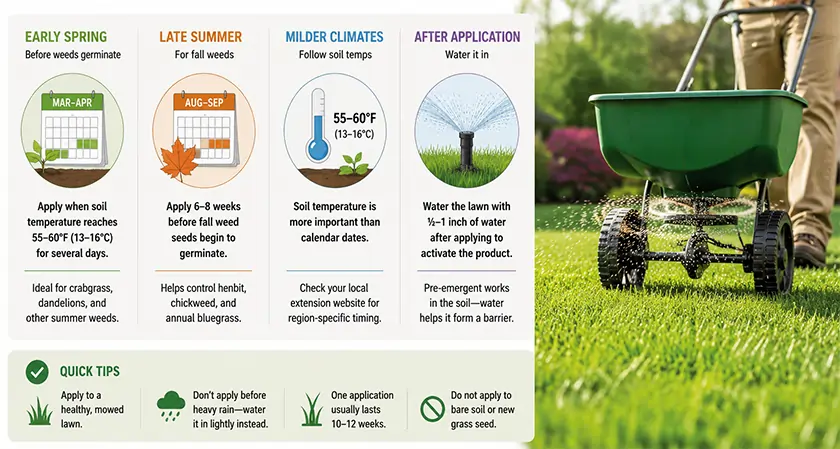
Pre-emergent weed and feed is one of those treatments that only works if you get ahead of the problem. Because it combines fertilizer with a pre-emergent herbicide, the timing matters just as much as the product itself. Once weeds start showing up, it’s already too late for that particular application, which is where a lot of frustration comes from. Most people don’t realize how early it needs to be applied for the herbicide portion to prevent weeds before they begin growing.
Pre-emergent fertilizer should be applied before weed seeds begin to germinate, not after weeds appear on the surface. For effective weed control, the best time to apply it is early in the season, before soil temperatures rise enough for weeds to start growing.
The Right Time to Apply in Spring
Spring is when most pre-emergent applications happen, and it’s also where timing tends to be missed.
You’re aiming for that short window when the lawn is just starting to come out of dormancy but before weeds begin to germinate. In practical terms, that usually lines up with the first stretch of consistently warmer days. If you’re already seeing weeds, especially crabgrass, you’re past the point where pre-emergent will help.
Some homeowners try to follow calendar dates, but those shift slightly every year depending on weather. Watching how your lawn responds is usually more reliable than picking a fixed week. A trick in the north is to apply when you see the forsythia in bloom.
Why Fall Applications Are Sometimes Needed
Spring gets most of the attention, but it’s not the only time weeds develop.
Some weeds start growing in the fall and carry through into the next season. If you’ve ever noticed weeds coming back early every year, this is usually part of the reason.
Applying pre-emergent in early fall helps interrupt that cycle. This is usually not necessary for cool season lawns, but it’s a great way to keep winter annual weeds out of dormant warm season lawns.
How to Apply Pre-emergent Fertilizer Without Running Into Issues
The application itself is straightforward, but a few details tend to make the difference. You want even coverage across the lawn, since missed areas will stand out later when weeds start to appear. Watering the pre-emergent lightly after application helps move the product into the soil where it can start working.
Most problems come down to either uneven application or timing that’s just slightly off.
If you’d rather not track that every season, programs built around weed control usually handle both timing and coverage as part of a schedule.
What Pre-Emergent Is Actually Doing
Pre-emergent doesn’t remove weeds; it prevents them from establishing in the first place.
It creates a barrier in the soil that affects weeds as they begin to grow. You won’t see anything happen right away, which is why it’s easy to think it didn’t work. The results show up later when fewer weeds come through.
That’s also why it’s important not to disturb the soil too much after applying it. Digging or heavy raking can break that barrier and reduce how effective it is.
Where This Fits in Overall Weed Control
Pre-emergent is only one part of keeping weeds under control. You’ll still need to deal with anything that gets through, either by pulling it or using a post-emergent treatment. Lawn health also plays a role. Grass that grows thicker leaves less space for weeds to take hold.
Certain types of weeds need a different approach altogether. Broadleaf weeds, for example, are often treated after they appear rather than prevented completely. If those are a regular issue, looking into how broadleaf weed control is handled can help you adjust your approach.
What to Pay Attention to Going Forward
You don’t need a complicated schedule to get this right, but you do need to stay aware of timing.
If weeds keep showing up earlier than expected, it usually means the application is happening too late. If large sections of the lawn are affected, it may be an issue with coverage.
Once you dial in the timing, the difference is noticeable. You spend less time reacting to weeds and more time maintaining the lawn as it grows.