>>
Industry>>
Startups>>
VLC Developer's New Startup Ky...VLC Developer's New Startup Kyber Raises $5 Million to Bring Ultra-Low Latency to Robots and Drones
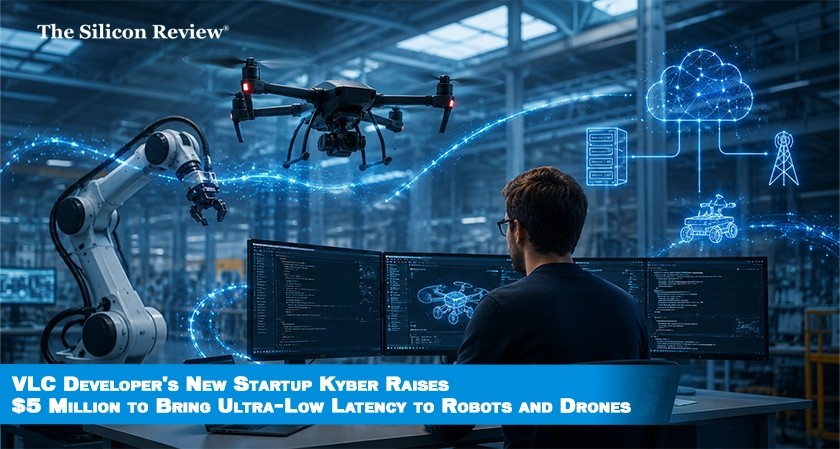
The lead developer behind VLC Media Player's 6 billion downloads has raised $5 million for Kyber, a startup building the ultra-low latency infrastructure that will connect hundreds of millions of robots, drones, and remote devices in the age of physical AI.
If you have ever watched a video on your computer, you have used Jean-Baptiste Kempf's work. He is the lead developer behind VLC Media Player, the open-source video player with the orange traffic cone icon that has been downloaded more than 6 billion times.
Now Kempf is solving a much harder problem. He is building the nervous system for the next generation of robots.
Kempf's new startup, Kyber, has raised $5 million in a seed round led by Lightspeed Venture Partners, the same firm that backed Mistral AI and Anthropic. The Paris-based company is building an infrastructure layer for controlling remote devices in real time, what Kempf calls "all the use cases where the person who's operating is not in the same place as the compute, which is not in the same place as the action."
Kyber's core product is an SDK that synchronises video, audio, sensor data, and control inputs with what the company claims is the lowest achievable latency . In a February 2025 demonstration, Kempf showed Kyber achieving 8 milliseconds of glass-to-glass latency the time it takes for a video frame to be captured, encoded, transmitted, decoded, and displayed.
"If you control things in the real world, every millisecond matters," Kempf told TechCrunch. The startup's name is a nod to the lightsaber crystals in Star Wars a fitting tribute to the speed and precision it aims to deliver.
The connection to VLC is more than biographical. VLC's video-streaming expertise is the technical foundation of Kyber. The platform is built on top of FFmpeg and VLC, the open-source projects Kempf has spent two decades contributing to. Kempf built the startup as a side project while serving as CTO at Shadow, the French cloud gaming company, before spinning it out.
Kyber's potential applications span robotics, drones, remote vehicles, cloud rendering, and remote IT access. The company says it is already in commercial deployment with customers in defence, telecommunications, robotics, and AI. Kempf notes that the largest remote driving fleets today manage perhaps 2,000 to 3,000 vehicles scaling to millions requires a completely different kind of platform.
Kyber is prioritising three segments: robotics, drones, and remote IT access, where demand has been particularly strong. In the remote IT segment, Kempf positions Kyber as a potential challenger to Citrix, pointing to a large addressable market even before the robotics opportunity materialises.
True to Kempf's open-source roots, the core project is freely available under a dual licence. The company sells a productised version to enterprise customers and, like Palantir, deploys forward-deployed engineers for custom integrations. Kyber's 25-person team includes a significant share of FDEs.
The Paris-based company has offices in San Francisco and Singapore. Global investment in robotics and physical AI reached $27.6 billion in 2025, more than double the previous year. Lightspeed called the investment a bet on the plumbing beneath physical AI, writing: "Physical AI is only as good as the underlying systems running it."
For Kempf, the thesis is simpler: if hundreds of millions of robots and drones are coming, someone needs to build the nervous system that connects them. He is betting the person who made video playback work for 6 billion users is the right one to do it.
As VLC's lead developer raises $5 million for Kyber, The Silicon Review examines how the man who made video playback a commodity is now building the software that will make physical AI a reality.
FAQ:
Q: Who is Jean-Baptiste Kempf and what is his new startup?
A: Jean-Baptiste Kempf is the lead developer of VLC Media Player, which has been downloaded more than 6 billion times. His new startup, Kyber, builds ultra-low latency infrastructure for controlling robots, drones, and remote devices.
Q: How much funding did Kyber raise and who led the round?
A: Kyber raised $5 million in a seed round led by Lightspeed Venture Partners, with participation from OVNI Capital and Kima Ventures.
Q: What is Kyber's core product?
A: Kyber's core product is an SDK that synchronises video, audio, sensor data, and control inputs with ultra-low latency, achieving as low as 8 milliseconds of glass-to-glass latency in demonstrations.
Q: What is Kyber's connection to VLC Media Player?
A: Kyber is built on top of FFmpeg and VLC, the open-source projects Kempf has contributed to for two decades.
Q: What industries is Kyber targeting?
A: Kyber is designed for robotics, drones, remote vehicles, cloud rendering, remote IT access, defence, telecommunications, and AI.
Q: Where is Kyber headquartered?
A: Kyber is headquartered in Paris with offices in San Francisco and Singapore.














Comments