>>
Industry>>
EdTech>>
English Grammar Rules for Begi...English Grammar Rules for Beginners: A Complete UK Academic Writing Guide
The Silicon Review
14 July, 2026
Author:
The Silicon Review Team
Sometimes students generate ideas, select an appropriate topic, meet learning outcomes, critically analyse findings, and discuss diverse aspects, yet they do not receive higher marks. Do you know the reason? It is poor English grammar writing, or in simple words, ignoring grammar rules in English when writing assignments or dissertations.
Introduction
For a student’s academic success, grammar plays a vital role because a single grammatical mistake can change the meaning of a sentence. In the context of UK academic writing, grammar is a technical skill through which students share ideas, describe theories, and highlight the problem. Grammar is also a tool used to facilitate the expression of ideas clearly, logically, and professionally.
Correct grammar makes writing more readable and enhances academic arguments, whether it is an essay, assignment, report, or dissertation. It has been recognised that many students make small grammatical mistakes that lead to significant mark deduction and change the intended meaning.. Therefore, in this English grammar guide, you can learn about English grammar rules and determine how to use the appropriate tenses in English grammar. Similarly, you can also recognise the common mistakes that you must avoid if you are a beginner.
Core Idea at a Glance
-
Grammar mistakes are common in writing, and students usually ignore punctuation, use incorrect subject -verb-agreement, miss commas,and make article errors.
-
In an experimental study, cover letters containing an error rate of 2/100 words, were judged noticeably less favourably by readers, and the effect grew stronger at 4/100 (Bleske-Rechek et al., 2019).
-
Considering these statistics, The Academic Papers UK provides a detailed guide containing grammar rules for English through which beginners can strengthen their writing skills.
Why Grammar Matters More in Academic Writing Than Everyday English
It is time to discover the problem of where and why grammar mistakes occur in academic writing.
Academic writing requires a level of accuracy and precision that goes far beyond normal speech. While minor grammatical slip-ups might slide in casual conversations or informal texts, they stand out sharply in an academic paper. In fact, failing to correct these errors directly compromises the overall quality and effectiveness of your research.
According to the University of Edinburgh, proper grammar is essential because it ensures your core ideas are communicated correctly and appropriately to your reader. Building on this, the University of Staffordshire highlights that mastering academic writing means adequately managing punctuation, parts of speech, sentence structure, and conjunctions. If you are a student writing an academic paper, you must master these elements because they heavily influence your grades and academic credibility.
However, balancing complex research with flawless grammar can be incredibly demanding when managing heavy course loads. This is why many students turn to professional support; utilizing trusted assignment writing services from The Academic Papers UK can help ensure your final drafts are polished, structurally sound, and tailored to meet strict university standards.
.webp)
How Grammar Influences Grades and Credibility
-
Proper grammar reduces the doubt about the authenticity of the work and shows attention to detail.
-
Clear sentences and precise language allow the examiner and lecturer to concentrate on the substance of your arguments and not be distracted by your mistakes.
-
Correct grammar can thus help the success of students' academic work and grade.
For Example
Incorrect: The findings of the study shows a significant increase in customer satisfaction.
Correct: The findings of the study show a significant increase in customer satisfaction.
The Link Between Grammar and Academic Clarity
-
Grammar gives structure to effectively communicate complex ideas.
-
You will be able to organise your ideas and follow the development of your discussion easily for the reader if you use good sentence structure, punctuation, and proper verb usage.
-
Good grammar minimises confusion and enhances the comprehensibility of academic writing.
For Example
Incorrect: After reviewing the literature, the researcher discussed the findings with limitations.
Correct: After reviewing the literature, the researcher discussed the findings and their limitations.
Common Consequences of Poor Grammar
-
The lack of proper grammar can cause misunderstandings, confusion, and a weaker argument.
-
Academic writing can seem unprofessional and may not have the impact it is supposed to have if it contains any errors, like incorrect punctuation, inconsistent verb tenses, or sentence fragments.
-
Good grammar is, therefore, a basic element in producing good, clear, persuasive, and academically sound pieces.
For Example
Incorrect: Let's eat students.
Correct: Let's eat, students.
Understanding the Foundations of English Grammar
The Building Blocks of Every Sentence
.webp)
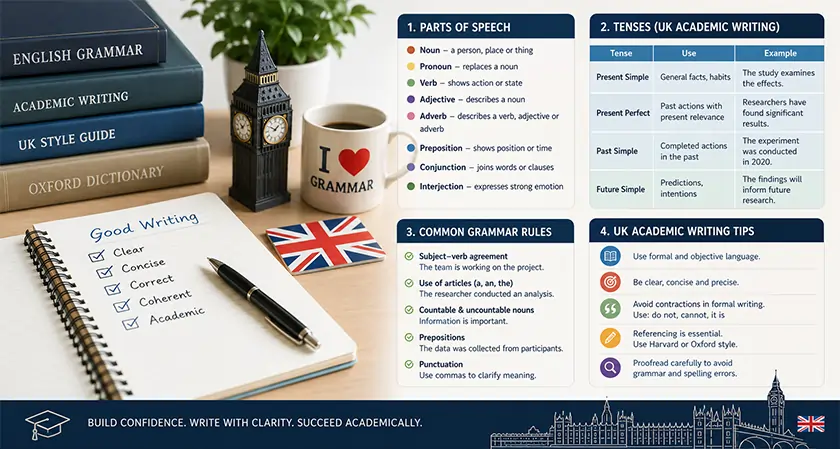
Every English sentence is built from eight parts of speech: nouns, pronouns, verbs, adjectives, adverbs, prepositions, conjunctions, and interjections. The comparison table listed below summarises each of these with academic examples.
Comparison Table: Parts of Speech at a Glance
Let us take a short review of parts of speech in English grammar with examples that you can use in your academic papers.
.webp)
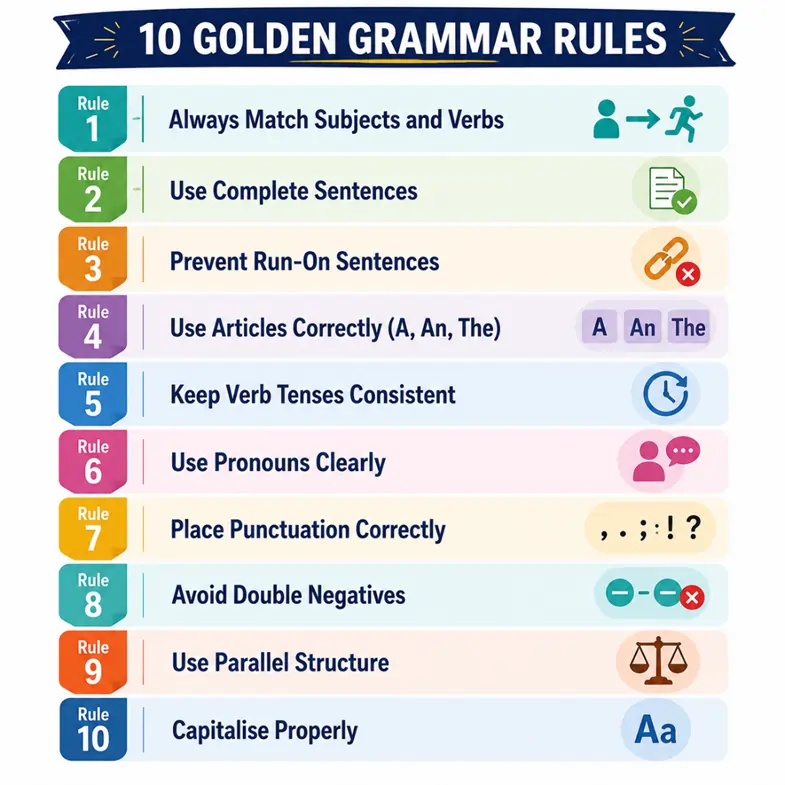
The 10 Essential Grammar Rules Every Beginner Must Master
It is time to understand the 10 rules of English grammar basics for beginners that you must follow:
Rule 1: Always Match Subjects and Verbs
The verb should match the subject in number. If you use a singular subject, the verb should be singular, while plural subjects take plural verbs.
Example Includes
Incorrect: The results show improvement.
Correct: The results show improvement.
Rule 2: Use Complete Sentences
In academic writing, every sentence should contain a subject, a verb, a complete thought.
Example:
Incorrect: Because the study was successful.
Correct: The study was successful.
Rule 3: Prevent Run-On Sentences
Considering English sentence structure rules, you must use separate and independent ideas using punctuation or conjunctions. It is necessary to keep in mind that run-on-sentences can reduce readability and make analysis complicated.
Example:
Incorrect: Because the study was successful.
Correct: The study was successful.
Rule 4: Use Articles Correctly (A, An, The)
Using articles correctly is a comprehensive approach because it clarifies whether a noun is general or specific. In academic writing, you must utilise “A”, “An”, “The” appropriately.
Example Includes
Incorrect: The researcher conducted a study.
Correct: The researcher conducted a study.
Rule 5: Keep Verb Tenses Consistent
You must maintain consistency in tenses in English grammar unless a change in time requires different verbs. According to English grammar rules for beginners, consistency in tenses improves clarity of writing.
For Example
Incorrect: The researcher conducted a study.
Correct: The researcher conducted a study.
Rule 6: Use Pronouns Clearly
Unclear pronouns can lead to confusion and a negative impact on academic writing. In your academic writing, pronouns should clearly refer to a specific noun so that readers can smoothly understand your idea.
Example:
Incorrect: When the manager met the employee, she was nervous.
Correct: The employee was nervous when she met the manager.
Rule 7: Place Punctuation Correctly
If you want to increase the readability and clarity of academic writing, you must use correct punctuation. Remember, misplaced punctuation can change the meaning of a sentence.
Example:
Incorrect: Let's eat students.
Correct: Let's eat, students.
Rule 8: Avoid Double Negatives
You must avoid using two or more negative words in one sentence because they reduce credibility and readability. Multiple negative words in a sentence can confuse your reader because they produce unintended positive meaning.
Example:
Incorrect:I don't know nothing about the topic.
Correct:I don't know anything about the topic.
Rule 9: Use Parallel Structure
According to basic English grammar rules, items should be listed in the same grammatical order so that consistency, accuracy, and readability can be maintained efficiently.
For Example:
Incorrect: The study aimed to collect data, analysing results, and interpretation.
Correct: The study aimed to collect data, analyse results, and interpret findings.
Rule 10: Capitalise Properly
In academic writing, capitalisation rules in English plays a vital role. You should capitalise the first letter of a sentence, proper nouns, and official titles in order to maintain professionalism.
Example:
Incorrect: the university of london published the report.
Correct:The University of London published the report.
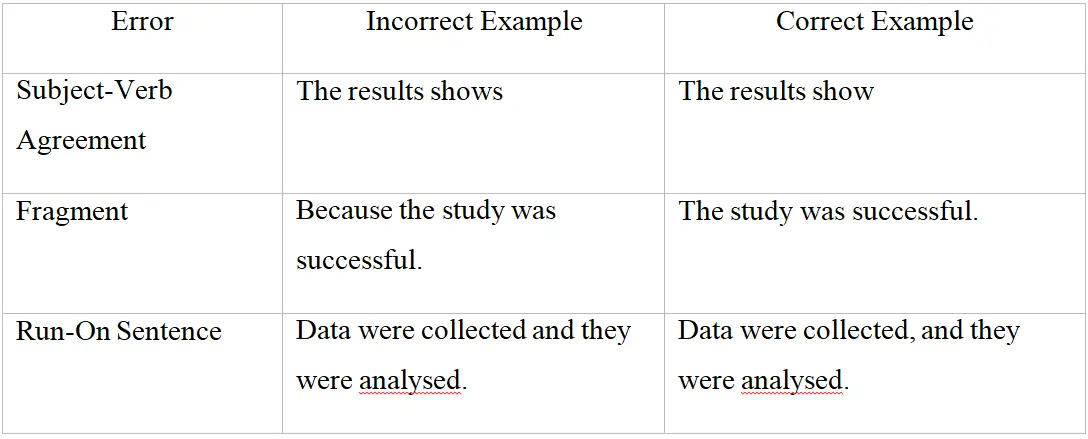
Quick Reference Table: Common Grammar Errors and Fixes
Academic Writing vs Everyday English: What Beginners Need to Know
Comparison Table: Informal vs Academic Writing
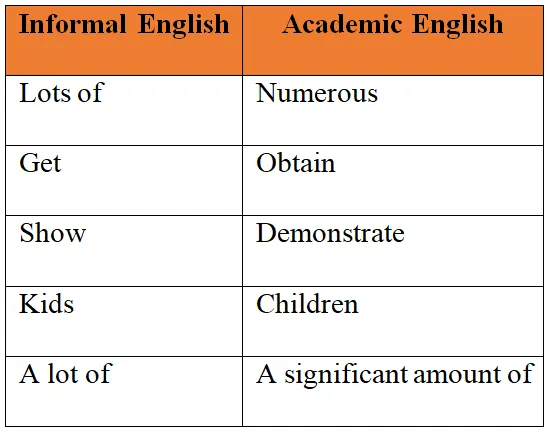
Why Formal Language Matters in UK Universities
Grammar Rules for Writing Strong Academic Sentences
Clear writing relies on sentence structure, punctuation, and consistency in concepts. English grammar lessons provide you with in-depth insight into the language requirements of UK universities. Knowing how to use various sentence types can enable writers to organise information and keep readers interested. There are three types of sentence structures used in academic writing: simple, compound, and complex.
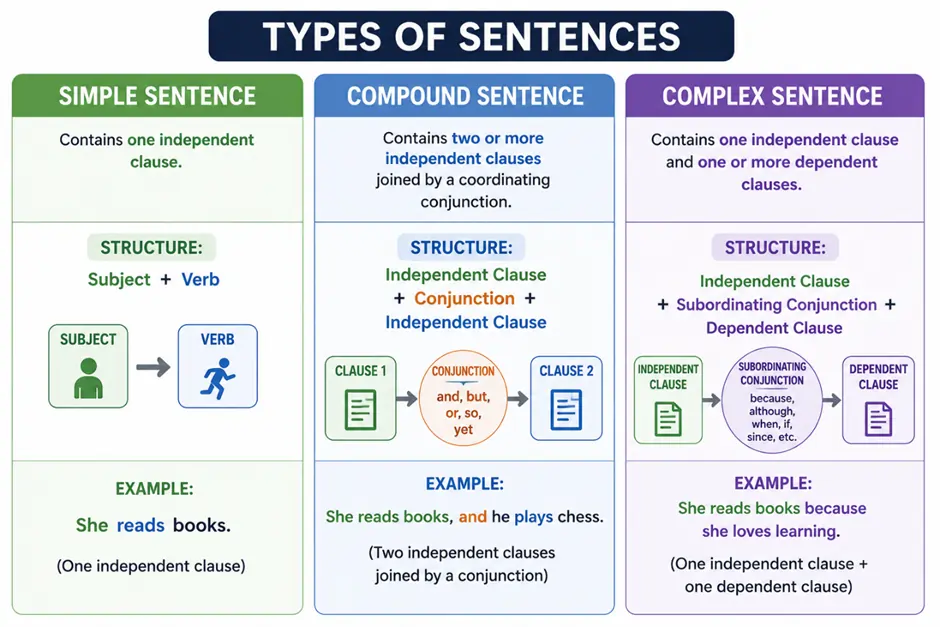
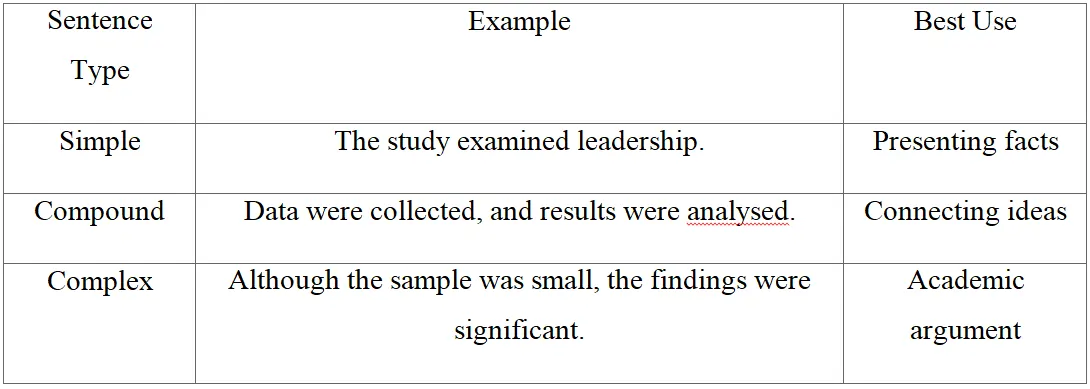
According to English grammar fundamentals, you must use a simple sentence with an independent clause that expresses a complete meaning. For instance, “employee satisfaction was studied”. This is a good format for clearly communicating facts and points.
On the other hand, you must recognise that a compound sentence refers to joining two or more independent clauses together with coordinating conjunctions “and”, “but” and “or”. Now consider how to use compound sentences in academic writing. “Data was collected and the results were analysed”. Considering this example, you can evaluate two ideas that link together.
An independent clause is a sentence of its own, and a dependent clause is one that relies upon the meaning of another. In English grammar practice, a complex sentence is made up of one independent clause and at least one dependent clause. For instance: “Although the sample was small, the findings were significant.”Complex sentences are especially useful in explaining contrasts, causes, and relationships.
Sentence Structure Comparison Table
Mastering Punctuation for Academic Success
According to English punctuation rules, seven marks matter most in academic work:
-
Full stops end complete sentences: “The results indicate improvements in learning.”
-
Commas separate items, clauses and introductory phrases: “The researcher collected data, analysed it carefully, and presented the results clearly.”
-
Apostrophes show possession: “The student’s analysis was insightful.”
-
Colons introduce lists or explanations: “The study had three objectives: to examine, to evaluate and to compare.”
-
Semicolons connect closely related independent clauses: “The data were reliable; the results were consistent with previous studies.”
-
Quotation marks show exact words from a source: as stated by Smith (2023), “effective communication enhances learning”.
-
Parentheses add extra, non-essential information: “The participants (n = 50) completed the questionnaire.”
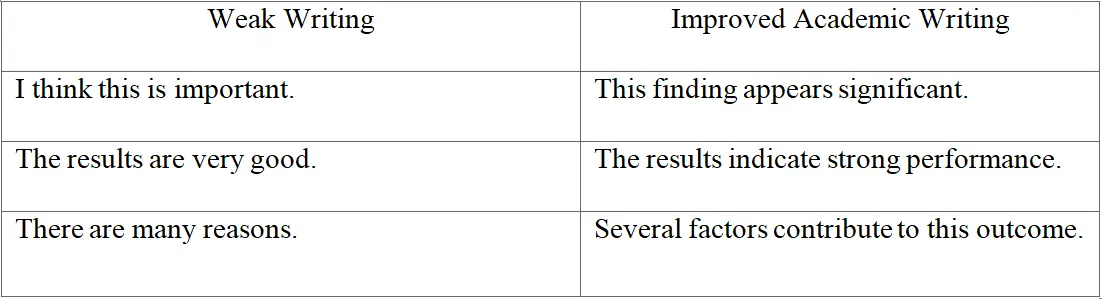
Comparison Table: Weak vs Strong Academic Writing
A Beginner’s Grammar Proofreading Checklist
Before submitting any assignment, run through this quick checklist:
-
Subject–verb agreement – ensure the verb agrees with the subject in number (“The results show”, not “The results shows”).
-
Tense consistency – keep the same tense throughout each section.
-
Capitalisation – use capitals for proper nouns, titles and the start of sentences (“The University of Manchester published the report”).
-
Punctuation – check commas, apostrophes and full stops carefully.
-
Complete sentences – remove fragments and run-on sentences.
-
Articles – confirm the correct use of “a”, “an” and “the”.
-
Pronoun clarity – every pronoun should refer to one clear noun.
-
UK spelling – use British forms such as “analyse”, “organisation” and “programme”.
UK English vs American English: Key Differences for Academic Writers
Comparison Table
Top Grammar Tools That Help Beginners Improve Faster
-
Grammarly
-
Hemingway Editor
-
Language Tool
Tools such as Grammarly, LanguageTool, and the Hemingway Editor can flag agreement errors, misplaced commas, and overly long sentences within seconds. However, these tools should be used as a safety net rather than a substitute for actual learning. Automated checkers still frequently miss content-dependent errors, which is why you should always proofread your work manually against a solid structural checklist.
Of course, when a deadline is looming and an automated tool isn't enough to fix deeper structural or research issues, relying on seasoned experts can make all the difference. For comprehensive support, students can get the best assignment help to ensure their final submissions are thoroughly polished, accurately cited, and ready for evaluation.
Conclusion
In this blog, detailed information related to English grammar rules basics is provided in the context of eliminating mistakes when writing academic papers. For the beginner, common English grammar concepts have been discussed so that students can accomplish their academic goals. In addition, ten rules have also been mentioned that you should keep in mind to maintain consistency and readability in every academic paper.
FAQs
What are the basic rules of English grammar?
Rules of English grammar are used to structure sentences, to use verbs, to punctuate, to capitalise and to relate words to ensure clear communication.
Why are English grammar rules important?
The rules of grammar make ideas more clear, accurate, and credible, guide readers to understand ideas correctly, and improve the quality of the writing.
What are the parts of speech in English grammar?
Nouns, pronouns, verbs, adjectives, adverbs, prepositions, conjunctions and interjections.
How does subject-verb agreement work?
Singular subjects take singular verbs and plural subjects take plural verbs; for example, “the result shows” but “the result show”.
How do punctuation rules work in English?
English punctuation rules organises sentences, separate ideas, make meaning clear and increase readability through the correct use of commas, full stops, and other marks.






















Comments