>>
Industry>>
Pharmaceutics and Life science>>
New National Program Targets H...PHARMACEUTICS AND LIFE SCIENCE
New National Program Targets Harmful Medicine Use: $5 Million Initiative to Help GPs and Pharmacists Safely Stop Unnecessary Prescriptions
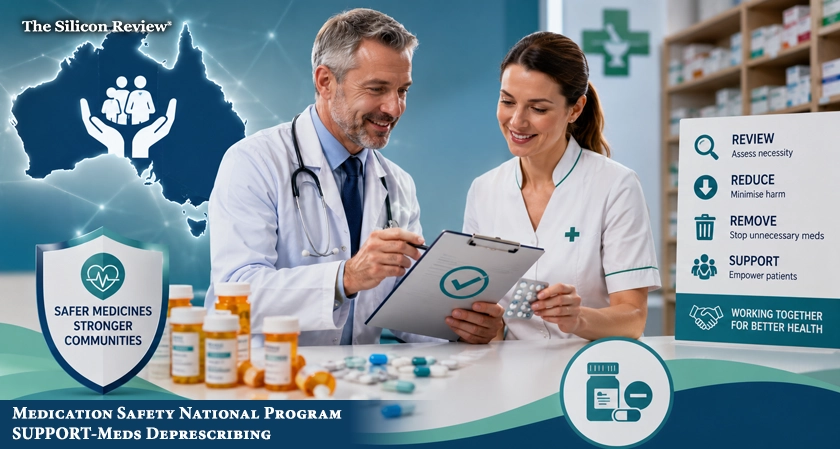
Monash University has launched a $5 million national program to help GPs, pharmacists, and nurses reduce unnecessary medicine use in Australia, targeting high-risk medications. The Silicon Review examines how the SUPPORT-Meds program could protect Australians from preventable medication-related harm.
Every year, thousands of Australians are admitted to hospital because of the very medicines meant to help them. Now a new national program is equipping health professionals with the skills to safely stop medications that are doing more harm than good.
Monash University's SUPPORT-Meds program, backed by a $5 million grant from the Department of Health, Disability and Ageing, will roll out free education and resources to help GPs, pharmacists, and nurses confidently deprescribe medicines that are no longer benefiting patients.
The program initially targets two high-risk categories: benzodiazepines and Z-drugs prescribed for sleep in older people, and opioids used for persistent non-cancer pain. It will later expand to cover proton pump inhibitors, antipsychotics for behavioural symptoms in dementia, NSAIDs, and gabapentinoids.
"We know unnecessary medicine use is prevalent across Australia, and the risks of long-term use outweigh the benefits to the individual," says Associate Professor Dr Emily Reeve, who leads the program at the Centre for Medicine Use and Safety at the Monash Institute of Pharmaceutical Sciences. "That's why we're equipping health professionals working in primary care with the practical skills, communication strategies and resources they need to safely deprescribe certain medicines."
The scale of the problem is sobering. Data suggests medicine-related harm is responsible for at least 250,000 hospital admissions each year in Australia, with an annual cost of around $1.4 billion. Two-thirds of these admissions are potentially preventable.
Polypharmacy is a significant driver of this harm. Over 40 per cent of people aged 50 years or older take five or more medicines, and more than 10 per cent take ten or more medicines. Polypharmacy is associated with increased risk of hospitalisation, functional impairment, falls, confusion, incontinence, frailty, and mortality.
The SUPPORT-Meds program will deliver free accredited education through self-paced online modules and face-to-face sessions, supported by a nationwide network of knowledge brokers specialists who will tailor the content to local practice settings. Clinicians will also have access to consumer-facing information, a deprescribing algorithm, and an online tapering calculator.
GP and Advisory Group member Professor Parker Magin says knowing when to stop a medication is a clinical skill that often gets less attention than initiating one. The program, he says, gives clinicians the tools to have these conversations.
Consumer representative and Advisory Group member Dr Janney Wale says the program has the potential to make a real difference to consumers.
"Most of us don't realise how much unnecessary medication can affect our quality of life. Side effects, costs and the risks of serious harm build up over time," says Dr Wale. "Deprescribing is about managing our medicines, not about taking things away. It's about making sure every medicine we're on is actually doing something for us."
Here is the question this program raises. Hundreds of thousands of Australians are taking medications every day that may be doing them more harm than good. Doctors and pharmacists have long known the problem exists but until now, they have lacked the training and resources to safely help patients stop. When a $5 million program is what it takes to fix a problem causing 250,000 hospital admissions a year, is Australia finally taking unnecessary medicine use seriously or just starting to scratch the surface?
The SUPPORT-Meds program aims to bridge the gap between existing evidence-based guidelines and everyday clinical practice by providing practical, evidence-based resources adapted from tools initially developed in Canada. It is collaboration between Monash University and several peak bodies, including the Pharmaceutical Society of Australia and Advanced Pharmacy Australia.
As the new national program targets harmful and unnecessary medicine use in Australia, The Silicon Review asks a final question. When a $5 million program could prevent thousands of hospital admissions and save lives, what took so long and what happens to the patients who need help now?
FAQ:
Q: What is the new national program targeting unnecessary medicine use in Australia?
A: The SUPPORT-Meds program is a $5 million national initiative led by Monash University that provides free education and resources to help GPs, pharmacists, and nurses safely deprescribe medicines that are no longer benefiting patients.
Q: Which medications are targeted by the SUPPORT-Meds program?
A: The program initially targets benzodiazepines, Z-drugs for sleep in older people, and opioids for persistent non-cancer pain. It will later cover PPIs, antipsychotics for dementia, NSAIDs, and gabapentinoids.
Q: What is deprescribing?
A: Deprescribing is the process of safely reducing or stopping medications that may be causing harm or are no longer providing benefit, under the supervision of a healthcare professional.
Q: What is polypharmacy and why is it a problem?
A: Polypharmacy is the use of five or more regular medicines. Over 40% of Australians aged 50 or older take five or more medicines, increasing the risk of falls, confusion, frailty, hospitalisation, and death.
Q: How much does medicine-related harm cost Australia?
A: Medicine-related harm is responsible for at least 250,000 hospital admissions each year in Australia, costing approximately $1.4 billion annually.
Q: Who is leading the SUPPORT-Meds program?
A: The program is led by Associate Professor Dr Emily Reeve at the Centre for Medicine Use and Safety at the Monash Institute of Pharmaceutical Sciences.



















Comments